I have really enjoyed Part 5 of the course and feel as though it has sparked an interest in contemporary art. I was particularly drawn to the site-specific sculptures of Richard Serra and Nancy Holt. It has also encouraged me to explore video installations and I particularly felt as though I connected with the work of Bill Viola. Overall the whole of the Understanding Visual Culture course has been very rewarding as my knowledge and understanding of art has deepened significantly. I was especially interested in the modern art movement and how this developed. I have not visited an art gallery for over a year due to an injury and the Covid-19 pandemic so am very much looking forward to visiting the Tate Modern with a ‘new perspective’ and a better understanding of the works displayed there.
Assessment Criteria
Demonstration of subjectbased knowledge and understanding
I believe that my knowledge and understanding regarding contemporary art has improved dramatically and that this is reflected in my writing. I have spent a lot of time exploring subjects such as the genre of ‘institutional critique’. I had previously not heard of this term and quickly became aware that this type of art is something that I feel passionately about. Assignment 5 demonstrated my ability to compare and contrast two different uses of the same medium and how the use and placing of this medium creates different effects for the viewer.
Demonstration of Research skills
I am confident that my research skills have improved throughout this course as I am able to locate resources that help me to understand a subject. I have significantly improved my referencing as I take notes during research, I ensure that everything is referenced to author, location of work, date and page number. This helps me to reference accurately and easily when I am writing an exercise or assignment.
Demonstration of critical and evaluation skills
I have been successful thinking critically around a subject. I often research an area and then spend a lot of time thinking and reflecting upon it before I start to write. I feel as though I can apply concepts and wider current issues to the exercises and assignments which, I feel, helps my understanding on a deeper level.
Communication
Following feedback from my tutor, I now feel that my communication and presentation skills are well developed. I am able to organise ideas and thoughts by using subheadings. I effectively use illustrations to visually support the writing element of my work and this helps to engage the reader. I have become better at fully exploring ideas and insights and writing around quotes so that they are fully understood.
Watch Richard Serra’s films ‘Hand catching Lead’ and ‘Boomerang’. Familiarize yourself with his work and say why you think he made these films.
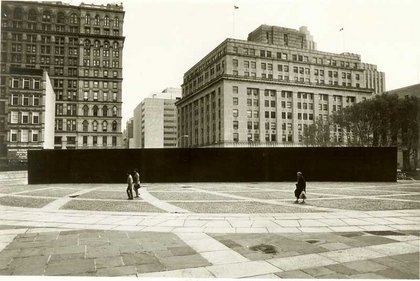
Richard Serra is mostly known for his minimalist sculptures that include works such as Tilted arc(1988) and Fulcrum(1987). Serra’s work was often site specific that gave the viewers an experience that was not just visual but physical as well. The placement of Tilted arc, a 12ft tall,120 foot long 15 ton slab of steel, across Federal Plaza in New York altered people’s experience of the space they inhabited. Instead of a sculpture that was looked at from a distance, Serra’s sculptures interacted and immersed themselves with the everyday lives of the inhabitants whilst altering their experience and perspective of that space (Dosh, M. s.d).
During the 1960’s Serra explored the new medium of film to create art. Two of such films were Hand catching lead (1968) and Boomerang (1974) with artist Nancy Holt. By exploring these films it is possible to understand why Serra made them.
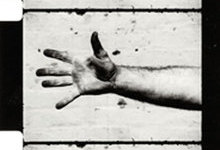
Hand Catching Lead (1968) is a short silent 3 minute black and white 16mm film in which an outstretched hand attempts to catch pieces of lead that appear to drop from above. The entire film is focused just on the hand as it opens and closes sometimes catching the lead (then dropping it) and sometimes not. The film records a repetitive and continuous action without any climax (Bukhari, 2017).
Serra was interested in the working processes of creating sculpture, whether by hand or through industrial means, and seems to explore this through film (Clark, M.E s.d. Accessed 31/07/2020). The artist’s 1967 “Verb List Compilation: Actions to Relate to Oneself” included verbs such as “to roll,” “to crease” and “to fold,”. Chayka (2011) explains that ‘the action, signified by the verb, becomes the art, rather than the resultant object.’ In the case of Hand catching lead the artist is focused on the action catching. Other works of this period capture the actions of the verbs splashing and scraping.
In Boomerang (1974) the artist Nancy Holt was recorded by Serra whilst hearing her words repeated back to her after a one second delay through headphones. The effects are quite extraordinary and Holt is able to articulate her experience during the 10 minute video.
Holt states ‘I am once removed from myself’, ‘I have a feeling that I am not where I am,’ ‘words become like things’, and ‘I feel that this place is removed from reality.’ Her thought process becomes interrupted and she starts to experience an altered sense of reality. Her experience of displacement and altered reality mirrors the effects that Serra creates through his sculptures that aim to disrupt and alter the perspectives of the people interacting with it.
It is likely that Serra produced these films to explore the creation of art through a newly available medium. His interests in the processes of creating sculpture are evident in Hand catching lead and the repeated effects of displacement caused by site specific sculpture are reproduced in Boomerang.
Bukhari, K. (2017) Movements of Media in Yvonne Rainer’s Hand Movie (1966) and Richard Serra’s Hand Catching Lead (1968) In: The Internationl Journal of Screendance Vol 8 (2017) At: https://screendancejournal.org/article/view/5366/4641 (Accessed 31/07/2020)
Does institutional critique presuppose an ‘insider’ audience requiring familiarity with artworld topics and issues or can it be understood by almost anyone spending an hour or two in a gallery?
Institutional critique is a genre of art that draws attention to the institutional framework of the art world. This can include the sale, display and value of art, the structures and commercial agendas that underlie art galleries, and the social, political, cultural and economic factors that determine what fine art is (Price: 2018). By examining some art work from this genre it is possible to determine whether a viewer would require ‘insider’ knowledge of the art world to understand it or if this type of art is accessible to all.
A movement that started in the 1960’s, artists such as Michael Asher and Hans Haacke started to question how neutral the museum, as an institution, was. In Untitled intervention (Fig 1.) Asher removed the partitioning wall in a gallery exhibition room to reveal an administrative area of the gallery normally unseen (Price 2018).
No prior inside knowledge of art would be required to understand that this was drawing attention to and revealing the behind the scenes inner workings of the running of the gallery. As a viewer though one would need some indication that this was actually an art installation or they might think that they had wandered into an empty room!
In the same year, Haans Haacke drew attention to the relationships that galleries/museums have with certain private individuals. In Solomon R. Guggenheim Museum Board of trustees (1974) , 7 panels of framed text revealing connections between a number of the trustees of the Guggenheim museum and the Kennecott Copper Corporation in Chile were revealed. (Bois et. al. 2004:547). The neutrality and morality of these unseen influential individuals were open for debate. The accessibility for the viewer understanding this artwork would be questionable. Firstly, framed text is not usually expected in an art gallery and secondly, one would have to have some prior knowledge of the political situation in Chile and the role and influence played by the trustees.
During the 1980’s artists such as Fred Wilson critiqued the institution through exhibitions such as mining the museum (1992). The installation critiqued the neutrality of the museum when exhibiting artefacts that underrepresented Black and Native American local history. If the viewer was a regular museum visitor they would notice that the artefacts and the placing of them were unusual. They enlightened the viewer in a new way that raised awareness of a more honest version of history. Wilson also exhibited Guarded View at the Whitney museum in 1991.
Fig 2. Wilson, F. (1991) Guarded View [wood, paint, steel and fabric] exhibited at the Whitney museum 1991 At https://whitney.org/collection/works/11433 (accessed 27/02/2020)
These black mannequins (with no heads) in museum guard clothing demonstrated the social inequalities experienced by the Black community within the art world. A Black person was more likely to work as an anonymous security guard or a cafe assistant than be an artist or a visitor to the gallery/museum (Price, 2018). Would the meaning behind Guarded View be accessible to the average gallery visitor? Perhaps this would require more thought and an awareness of Black and Minority Ethnic inequalities from the viewer.
Perhaps the most easily accessible art that critiques the institution is that of the Guerilla girls. This New York based activist group of anonymous female artists was formed in 1985. Their aim was to critique individuals and institutions within the art world that excluded or underrepresented women and minority groups (Dempsey, 2002:292).
With bright posters and statistics that highlight their critique of the institution (Fig 3.) any viewer can easily access the point being made by the Guerrila Girls. No insider knowledge of the art world is required as the facts are clearly stated and easily interpreted.
Conclusion
The genre of institutional critique does not require an audience to be familiar with art world topics and issues. However, some works (The Guerilla girls) are more accessible than others (Haacke). The aim of the works is to draw attention to the viewer the institutional structure and workings of the art world. The audience therefore needs to spend some time with the art work to enable a new way of looking and understanding. However, if the audience member is not open to new ways of looking and perhaps doesn’t consider the social, political and class issues in the wider society, they may struggle to see the significance of some of these pieces.
Fig 2. Wilson, F. (1991) Guarded View [wood, paint, steel and fabric] exhibited at the Whitney museum 1991 At: https://whitney.org/collection/works/11433 (accessed 27/02/2020)
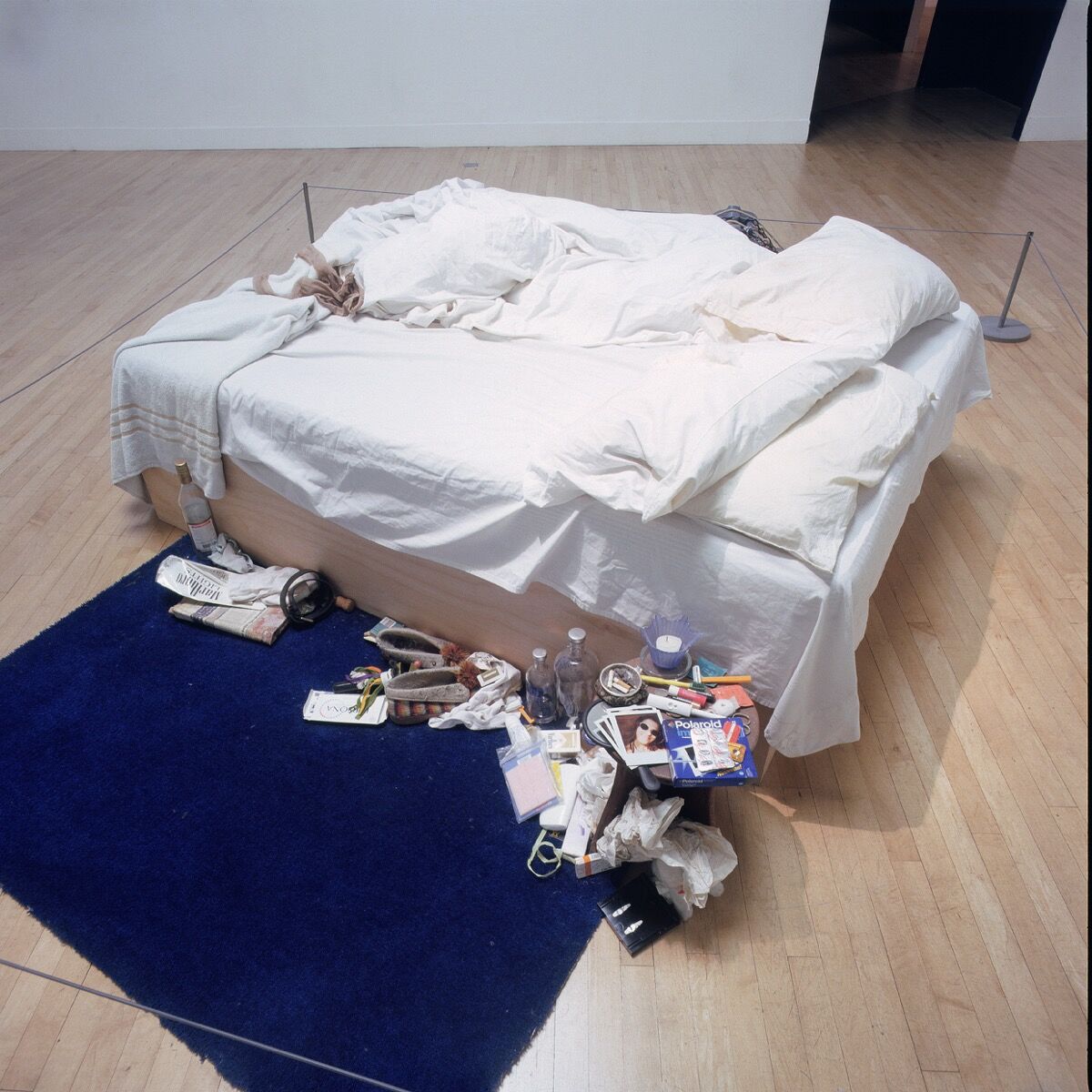
If Tracy Emin’s My Bed (1998) had not become a work of art, it would just be part of someones (in this case the artist’s) personal living space. The clutter around the bed is unique to the individual concerned and their personal experience of life. Every human being has a sleeping space so a bed surrounded by clutter/objects would just be seen as a part of everyday living.
Bringing the ‘taken for granted’ out of its functioning position and placing it within a gallery setting isolates it in a way that allows us to observe this private living space openly and in a new way. By being a work of art, we have been given permission to scrutinise the objects scattered around the bed and deduce the character and state of mind of the individual who inhabited it.
If this installation was not in a gallery it would not be seen as art. In a gallery where it can be viewed and analysed it now becomes art.
Reflections
I think that Emin’s work becomes a piece of art in the gallery due to the symbolism associated with the objects surrounding the bed and how they represent the emotional state and experiences of an individual over a period of time. Would this art installation work if Emin was not in emotional turmoil at the time? Probably not.
What would be the significance of reversing the arrows in Barr’s chart? Make two columns – one ‘forwards’ the other ‘back.’ List as many relevant concepts as you are able to develop the contrast between the two columns. Feel free to ‘cheat’ with a thesaurus.
By comparing the two columns, it is possible to see that going forwards through the chart suggests a move towards primitive art and that going backwards sees a reversal of this – from primitive to socialised or civilised. Neo-impressionist art was representative of the object with traditional perspective and often urban subject matter. There was a scientific and logical approach to optical colour mixing theories (Dempsey, 2002:27). In Fauvism and Expressionism, emotional content became more important, firstly in the viewer and then in the artist. Dadaism rejected reason an logic and the systems enforcing them, replacing them with anarchy and the irrational (Dempsey, 2002: 115). Art was an an idea, made from anything. Surrealism attempted to liberate the unconscious(Dempsey, 2002:153) and to revolutionise human experience (Tate online Accessed 22/07/2020). As a revolt against society, Surrealism was described as ‘thought expressed in the absence of all control exerted by reason, and outside all moral and aesthetic consideration’ (Breton 1924 cited in Dempsey 2002:151). Logic and reason were seen to block the natural human state accessed via the unconscious mind.
By reversing Barr’s chart, art moves from a primitive state (Surrealism) to a more logical and rational one (Neo-Impressionism). Going forwards, logic gives way to the primitive which is a reversal of how the human race has developed!
We could also view the reversal of the chart as moving from the internal world of the mind, passing through emotional states (Fauvism and Expressionism) to the external world (Neo-impressionism) -Visually passing from the unconscious world to the conscious one. It is almost as though (going forwards from conscious to unconscious) artists were trying to purify their art and find some deeper human truth.
Reflections
I wasn’t entirely sure that I understood the exercise above. I had no idea what concepts I was supposed to find and just had to go with what I observed when I reversed the chart. By reversing the charts some quite big concepts became apparent. By looking backwards and then forwards again I could see the transition of this period in art that moved towards rejecting social constructs and realities. By shedding conventions, the artists were moving back towards a more natural and primitive state. They were attempting to capture the pure human condition, residing in the emotions and the unconscious mind.
Bibliography
Dempsey, A. (2002) Styles, Schools and Movements Thames and Hudson:London
Access a summary of Kant’s Critique of Judgement and select three key points that you should then further summarise in approximately 50 words each.
Judgements of Beauty/Taste (Aesthetic judgements)
A judgement of beauty/taste is based on an individual’s feelings. The object is perceived by the subject so the judgement is therefore subjective. Kant explains that this judgement is ‘disinterested’ as it has no purpose and is an end in itself. A flower is just ‘beautiful’. Aesthetic judgements are universally felt (sparknotes, accessed 12/02/2020).
Judgements of the sublime
The experience of the sublime goes beyond the limits of human comprehension and holds an air of mystery. Experiences of the sublime are never negative and are usually attached to nature. For example, the movement of clouds or mist on a river. Experiences of the sublime are also subjective, universal judgements. Kant argues that the sublime rests in the realms of reason and not in the object itself (sparknotes, accessed 12/02/2020).
The critique of Teleological judgment
The concept of Teleology is concerned with the ‘explanation of phenomena in term of the purpose things serve rather than of the cause by which they arise.’ (Lexico, Oxford online, accessed 12/07/2020). Kant argues that this is useful in scientific study but that the principles are not at work in nature. Organisms must be viewed in teleological terms as ‘natural purposes’ (Stanford Encyclopedia of Philosophy, accessed 12/07/2020).
Read the first three pages (at least) of Arthur Danto’s essay ‘Works of Art and Mere Real Things’ in his book ‘The Transfiguration of the Commonplace.‘ Then conduct your own ‘thought experiment’ by choosing a picture or object that is, or you can imagine it to be, a work of art. Give the ‘work’ three or more different titles, then reflect on the effect of the title on the work and the work on the title.
This Exercise took me back to part one of this course when in Exercise 1.3 we were asked to suggest how a Dyson vacuum cleaner can be seen as a work of art. This had led me to reflect upon the ‘ready-made’ art object such as Duchamp’s ‘Fountain’. It is a big question to ask why a ready-made object when outside the gallery is just an object but when it is inside the gallery walls it becomes art. I considered that the title attached to an object when in a gallery can prompt a new perspective in the viewer or act as a gateway to a new conceptual thought. Later in the course, I stumbled across the work ‘New hoover convertibles, Green, Red, Brown, New Shelton wet/dry 10 Gallon Displaced Doubledecker.‘(1981-1987) by Jeff Koons. I hadn’t realised that an artist had already placed some ready-made vacuum cleaners in a display and called it art!
Koons’s title for this art work is very literal although there appear to be four columns not rows? Koons has organised the balls in a similar way to how they would be presented to us in a shop. By keeping them in a glass display case he is denying them of their purpose and almost treating them like precious objects (Tate online, accessed 28/06/2020).
Alternative titlesfor Encased – Four Rows
Welcome to Sports Direct– This title creates a new effect on the piece of work. We, the viewer, are now looking at the basketball in the context of the capitalist consumer system. Our attention is drawn to the way that we, the consumer, access and purchase objects to enable certain activities. The effect the work has on the title is one that illuminates the mass production and repetitive nature of objects in a consumer society.
Prison Life – This title brings a symbolic dimension to the encased basketballs. We now think of the glass case as the prison walls and the basketballs as the prisoners. The work of art has an effect on the title as we can see the basketballs describing prison life. Lives and identities frozen for periods of time, potentials unrealized and purposes unfulfilled. The packaging resembling restrictive small cells in compacted living spaces.
Untitled – If Koons’s basketballs were Untitled we would assume that the artist is intent on not revealing their own thoughts or intentions. This would allow us, the viewer, to take the opportunity to interpret the art in our own way.




 Lara's Understanding Visual culture (Visual Studies 1) blog