Reflections on Part 4 and self-assessment

I must admit to struggling with the theories of difference in Part 4. I particularly found it really hard to understand Deleuze and had to do a lot of reading. Unfortunately, the more I read the deeper into the realms of philosophy I got and found myself lost a lot of the time. Watching simple introductions on you tube by lecturers and students helped me to grasp the basics – hopefully!

I knew instantly when I reached Assignment 4 that I wanted to investigate Fred Wilson’s installation. I had briefly come across this work watching a you tube lecture and knew then that I should explore this further. I commented in my notes how relevant this work is today in light of the death of George Floyd and the removal of certain statues. Although fascinated by this work of art, I struggled immensely interpreting it in terms of difference and had to do a lot of background research to achieve this.

Assessment Criteria

Demonstration of subject based knowledge and understanding

I completed a lot of reading around theories of difference because I felt lacking in confidence and unsure that I had understood them properly. I was especially drawn to the work of Deleuze because his philosophy seemed to resonate with my own beliefs. The subject of difference is something that I have never consciously considered on a deeper level before and was amazed at how it can affect the way that we perceive the world. Assignment 4 provided me with an opportunity to actively apply these theories to a piece of art work and allow for a deeper interpretation of it.

Demonstration of Research skills

I have been successful at researching the relevant areas for part 4. Where I have become stuck and unable to comprehend certain works, I have looked to secondary sources that were easier to understand. This included you tube tutorials and secondary journals and books about relevant philosophers.

Demonstration of critical and evaluation skills

I have effectively engaged with concepts and theories and applied them to my written work. I have analysed and investigated theories of ‘difference’. Through critical thinking I have been able to evaluate and interpret these theories and apply them relevantly to a piece of art. I have also been able to reflect on the relevance of the art and the theories in today’s current issues.

Communication

I feel more confident when communicating my ideas in written form. This is due to responding to my tutor’s feedback and breaking up my assignment into relevant sections. I have ensured that any points or insights have been fully explored and have explained them fully without the assumption that the viewer has any prior knowledge to the subject.

Exercise 4.5

Apply the dialectic diagram to Barr’s. What would count as a thesis, an antithesis and a synthesis. You will need to refer to images of art works for a persuasive answer.

Fig 1. Diagram to illustrate Hegel’s dialectic of subjectivity and objectivity. At https://calmapossawi.tk/113-hegel-thesis-antithesis-synthesis-dialectic.php (accessed 20/05/2020)
Cubism and Abstract Art | MoMA
Fig 2. Barr, A.H. (1936) Cubism and Abstract Art. At https://www.moma.org/calendar/exhibitions/2748 (Accessed 20/05/2020)

By studying Barr’s chart, it can be shown that at the beginning of the 20th Century Cubism acts as a thesis whilst Fauvism acts as an opposing antithesis. The emergence of Orphism can be seen as a synthesis of both of these two movements, being influenced by and using elements of both. To demonstrate this synthesis, the fundamentals of each movement will be discussed and art works indicated.

Cubism (Thesis)

Cubism was invented around the year 1907 by artists Pablo Picasso and Georges Braque. Analytical cubism gave way to synthetic cubism as the artists developed their ideas. Picasso and Braque developed a new form of realism that abandoned the traditional single point perspective form of representation. Instead they created a new form of realism to convey form and structure more accurately and convincingly. Inspired by Cezanne, who constructed forms out of different planes, Analytical Cubism used multiple viewpoints that created an experience of three dimensional objects in space and time. Movement is continuous as the viewer constructs, not just through sight but through thought as well, the suggestion of an object (Dempsey, 2002:85). Objects were reduced and fragmented to depict volume and mass in space.

Fig 3. Braque, G. (1909-10) Mandora [oil on canvas] At https://www.tate.org.uk/art/artworks/braque-mandora-t00833 (Accessed 20/05/2020)

Mandora (Fig 3.) illustrates the new perspective explored in analytical cubism. Overlapping planes, fragmented form and structure give the illusion of a more realistic depiction of subjects in space and time (Tate online s.d. Accessed 20/05/2020). It reflects our experience of life that flows through movement in time rather than exists in a static state.

In both Braque’s Mandora (Fig 3) and Picasso’s The Accordionist (Fig 4) the subject matter is similar. The two artists focused on neutral subject matter (still life) and completed their images in a subdued and monochromatic palette. This ensured that the whole of the viewers’ attention was focused upon the structure of the form and the density of the image.(Tate online s.d. accessed 20/05/2020)

Pablo Picasso, Accordionist, Céret, summer 1911. Oil on canvas, 51 1/4 x 35 1/4 inches (130.2 x 89.5 cm)
Fig 4. Picasso, P. (1911) The Accordionist [oil on canvas] At https://www.guggenheim.org/artwork/3426 (Accessed 20/05/2020)

In Synthetic Cubism (Fig 5), the artists started to flatten the image rather than breaking it down into multiple viewpoints. Experiments with collage, textures and patterns in their art helped to achieve this, alongside large blocks of colour (Dempsey, 2002:85).

Juan Gris, ‘The Sunblind’ 1914
Fig 5. Gris, J. (1914) The Sunblind [oil on canvas] At https://www.tate.org.uk/art/art-terms/s/synthetic-cubism (Accessed 21/05/2020)

Fuavism (Antithesis)

Fauvism was a movement that existed between 1905 and 1910 and included artists such as Henri Matisse and Andre Derain. After an exhibition at the salon d’automne in Paris, in 1905, the critic Louis Vauxcelles labelled this group of artists Les Fauves (wild beasts) due to their use of bold colours and wild brushstrokes . Unlike the cubists, who focused on realism of form, depth and structure through movement and time, the belief amongst this group of artists was that art should evoke emotional sensations through form and colour. The artists primarily expressed themselves through the use of bold, unnatural, strong colours which served to create atmosphere (Dempsey, 2002, 66).

Joy of Life (Bonheur de Vivre), 1905 by Henri Matisse
Fig 6. Matisse, H (1905) Joy of Life (Bonheur de Vivre) [oil on canvas] At https://www.henrimatisse.org/joy-of-life.jsp (Accessed 20/05/2020)

Matisse’s Joy of Life (Fig 6) illustrates the Fauvist’s strong use of colour which creates a warm, inviting atmosphere. The curving simple lines create the forms of bodies reclining and relaxing amongst nature. The expression through colour and the simplified forms evokes sensations of pleasure and physical delight (Dempsey,2002:66). Similar to the cubists, the fauvists rejected traditional three-dimensional space and used flat areas of colour and spontaneous brushwork to flatten the surface of the canvas.

Scientific colour theory was important to the Fauvists and they paid particular interest in the 19th Century colour theories relating to the effects of complementary colours (Essaulova, s.d.). In Bridge to Charing Cross (Fig 7), Derain uses complementary colours to heighten the scene and allow the contrasting colours to heighten the impact of the painting.

Pont de Charing Cross - André Derain Diagram | Quizlet
Fig 7. Derain, A. (1906) Bridge to Charing Cross [oil on canvas] At https://arthive.com/andrederain/works/323773~Bridge_To_Charing_Cross (20/05/2020)

Orphism (Synthesis)

The thesis (Analytical cubism) and the antithesis (Fauvism) act in opposition to one another. Cubism focuses on the structure of form and mass through time and space whereas Fauvism focuses on the expression of emotion through the use of colour and simple forms. Both movements reject the traditional forms of representation and flatten or give depth to the image. The synthesis for these two art movements is that of Orphism.

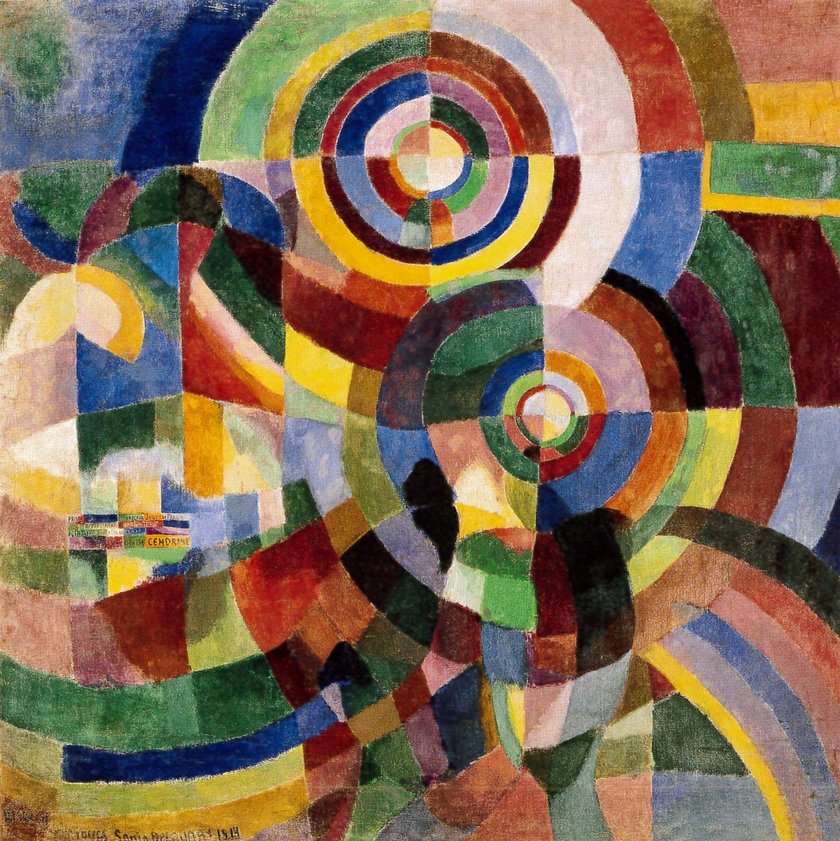
Orphism, that evolved from about 1912, included artists such as Frantisek Kupka, Robert Delauney and Sonia Delauney. These artists were highly influenced by the cubist and Fauvist movements taking elements from each. Fig 8. illustrates Delauney’s Red Tower which shows the representation of the subject matter from multiple viewpoints but also shows some Fauvist qualities by introducing a more striking subject matter and the use of bright bold colours.

Robert Delaunay, Red Eiffel Tower, 1911–12. Oil on canvas, 49 1/4 x 35 3/8 inches (125 x 90.3 cm)
Fig 8. Delauney, R.(1912) The Red Tower [oil on canvas] At https://www.guggenheim.org/artwork/1020 (Accessed 20/05/2020)

As Orphism progressed, they started to move beyond reality into pure abstraction. There was a mystical and spiritual element to their paintings through the use of colour and shape. Like the Fauvists, colour theory became very important as they learnt the interrelationships of colour, light and movement and applied it to their work. Contrasting colours, colour harmonies and rhythms create expression that gives depth, form, movement and an emotional content (The art story, accessed 20/05/2020).

Sonia Delaunay, Prismes electriques 1914
Fig 9. Delauney, S. (1914)Prismes electriques [oil on canvas] At https://www.tate.org.uk/press/press-releases/ey-exhibition-sonia-delaunay (Accessed 20/05/2020)

In the later stages of Orphism we can see a fusion of pure abstracted forms and an expressive interplay of colour (Fig 9. Prismes electriques) (Tate online, accessed 20/05/2020). The result is an expressive form of abstract art that draws attention to the flat surface of the canvas.

Orphism is a synthesis of Analytical cubism and Fauvism. Both movements rejected the traditional representation of three dimensional reality pushing them both towards near abstraction of form and a flattening of the image. The Orphists expressed themselves through bold bright colours based on colour theories of the time (Fauvism) and embraced the multiple fragmented viewpoints of cubism that ultimately led to pure abstraction.

Reflections

This was a very interesting exercise and it was fascinating to see how two movements could influence artists of the time. There seemed to be more opposing forces between Fauvism and Cubism than similarities, yet the two movements seemed to inspire the Orphists to create one of the earliest approaches to complete abstraction.

List of Illustrations

Fig 1. Diagram to illustrate Hegel’s dialectic of subjectivity and objectivity. At https://calmapossawi.tk/113-hegel-thesis-antithesis-synthesis-dialectic.php (Accessed 20/05/2020)

Fig 2. Barr, A.H. (1936) Cubism and Abstract Art. At https://www.moma.org/calendar/exhibitions/2748 (Accessed 20/05/2020)

Fig 3. Braque, G. (1909-10) Mandora [oil on canvas] At https://www.tate.org.uk/art/artworks/braque-mandora-t00833 (Accessed 20/05/2020)

Fig 4. Picasso, P. (1911) The Accordionist [oil on canvas] At https://www.guggenheim.org/artwork/3426 (Accessed 20/05/2020)

Fig 5. Gris, J. (1914) The Sunblind [oil on canvas] At https://www.tate.org.uk/art/art-terms/s/synthetic-cubism (Accessed 21/05/2020)

Fig 6. Matisse, H (1905) Joy of Life (Bonheur de Vivre) [oil on canvas] At https://www.henrimatisse.org/joy-of-life.jsp (Accessed 20/05/2020)

Fig 7. Derain, A. (1906) Bridge to Charing Cross [oil on canvas] At https://arthive.com/andrederain/works/323773~Bridge_To_Charing_Cross (Accessed 20/05/2020)

Fig 8. Delauney, R.(1912) The Red Tower [oil on canvas] At https://www.guggenheim.org/artwork/1020 (Accessed 20/05/2020)

Fig 9. Delauney, S. (1914)Prismes electriques [oil on canvas] At https://www.tate.org.uk/press/press-releases/ey-exhibition-sonia-delaunay (Accessed 20/05/2020)

Bibliography

Bois, Y-A (2004) with B.Buchloh, H. Foster, R. Krauss. Art since 1900 London and New York, Thames and Hudson.

Dempsey, A. (2002) Styles, Schools and Movements Thames and Hudson Ltd. London.

Esaulova, A. Bridge to Charing Cross At https://arthive.com/andrederain/works/323773~Bridge_To_Charing_Cross (Accessed 20/05/2020)

https://en.wikipedia.org/wiki/Orphism_(art) (Accessed 20/05/2020)

https://www.tate.org.uk/art/art-terms Accessed 20/05/2020

https://www.theartstory.org/movement/orphism/artworks/ (Accessed 20/05/2020)

https://www.metmuseum.org/toah/hd/fauv/hd_fauv.htm (Accessed 20/05/2020)

Exercise 4.4

Say to what extent Giotti’s painting can serve to illustrate the quote be Deleuze. (200 words)

Kiss of Judas - Wikipedia
Fig 1. Bodone di Giotto, (1305) The Kiss of Judas [Fresco] Scrovegni Chapel, Padua, Italy At https://en.wikipedia.org/wiki/Kiss_of_Judas (Accessed 15/05/2020)

“Let us imagine something which is distinguished – and yet that from which it is distinguished is not distinguished from it. The flash of lightening for example, is distinguished from the black sky, but must carry the sky along with it… One would say that the bottom rises to the surface, without ceasing to be the bottom. There is, on both sides, something cruel – and even monstrous – in this struggle against an elusive adversary, where the distinguished is opposed to something which cannot be distinguished from it, and which continues to embrace that which is divorced from it.” (Deleuze, 2014:361 cited in OCA UVC handbook 2016:105)

In Giotti’s painting ‘The Kiss of Judas’ (1305), we are able differentiate the figure and the background. As there is no use of single point perspective or illusion of three dimensions, there is no ordering of the space (Olkowski 1999:17). This means that the bottom of the painting (or the distinguished background) rises up to the surface of the canvas, just as;

‘The flash of lightening… is distinguished from the black sky, but must carry the sky along with it… One would say that the bottom rises to the surface without ceasing to be the bottom.’ (Deleuze, 2014:361 cited in OCA UVC handbook 2016:105)

The figures in the painting are distinguished from the background yet carry the background with it. Deleuze describes this effect as ‘monstrous’ (Deleuze, 2014:361 cited in OCA UVC handbook 2016:105). Form and representation have been destroyed through the creation of a depth-less surface and a flattening of the image.

The figures in the ‘The King of Judas’ fresco, are static and flattened. They have all been painted form a side on perspective which further emphasises the flatness of the image. This resonates with the Ancient Egyptian art and writing which places the human form in a similar manner. Alongside the figures, the background has risen to the surface. The relationship between background and figure creates an ‘indifferent difference’ (Olkowski, 1999) between contradictory and inseparable entities. Olkowski describes this as a ‘highly differentiated kind of pictorial space[s] that draws attention to the surface of the picture’. Comparisons can be made to Greenberg’s theory on modernist art where the emphasis was places on drawing attention to the flat surface of the canvas.

List of Illustrations

Fig 1. Bodone di Giotto, (1305) The Kiss of Judas [Fresco] Scrovegni Chapel, Padua, Italy At https://en.wikipedia.org/wiki/Kiss_of_Judas (Accessed 15/05/2020)

Bibliography

Belshaw, M. (2016) OCA Handbook for Understanding Visual Culture Open College of the Arts

Olkowski, D. (1999) Difference and Organic Representation in Gilles Deleuze and the Ruin of Representation (p.15-32) University of California Press: London At https://books.google.co.uk/books?id=xdzqBgAAQBAJ&pg=PA24&lpg=PA24&dq=difference+and+organic+representation+olkowski&source=bl&ots=OFdeHocgZY&sig=ACfU3U3GI7cLKySlrXjPMjoc3RWJTJO-XQ&hl=en&sa=X&ved=2ahUKEwjo3KDd9rXpAhW0uXEKHSBJDt8Q6AEwAHoECAgQAQ#v=onepage&q=difference%20and%20organic%20representation%20olkowski&f=false (Accessed 15/05/2020)

Exercise 4.3

In your own words (one brief paragraph) say why you think creation and affirmation are linked here.

According to Deleuze, all things (sensations, animals, ideas) are creations in their own right and ‘not merely an account of their interactions with other things.’ (Hallward, 2006,1) They are all connected and yet no two things are the same. Therefore difference is creation. Difference, in an everyday sense focuses on the positive and the negatives between two things or oppositions (Williams, 2003:60-61). For example, one black cat has blue eyes and the other has brown (negative) and everything else is the same (positive). However, we do not have to see things as contrasting or in contradiction positively or negatively instead we can view difference as creation as affirmative (Belshaw, 2016:104).

Creation is the energy of transformation.It allows for continuous differentiation, mutation and change. To affirm creation and being allows for an ‘inexhaustible source of pure potential or transformation’ (Hallward,2006,37).

Bibliography

Belshaw, M. (2016) OCA UVC coursebook Barnsley

https://www.merriam-webster.com/dictionary/affirmative (Accessed 11/05/2020)

Leucrezia (2014) Deleuze, Active Nihilism & Revolt At https://theanarchistlibrary.org/library/lucrezia-deleuze-active-nihilism-revolt (Accessed 11/05/2020)

Smith, D. (2008) Gilles Deleuze Stanford Enclyclopedia of philosophy 23/5/08 Accessed at https://plato.stanford.edu/entries/deleuze/ (Accessed 11/05/2020)

Williams, J.(2003) Gilles Deleuze’s Difference and Repitition A critical introduction and guide Edinburgh University Press

Exercise 4.2

Read the text of Newman’s essay in Art in Theory and write a short summary (200 words).

In the essay ‘The first man was an artist’ (1947) by Barnett Newman, Newman argues that the original man was born an artist and poet as opposed to a social animal. Man’s first experience was aesthetic and his speech was ‘a poetic outcry’ rather than a need for communication. His first cry was a song and his address to a neighbour was a cry not a request. Men built idols out of mud before they built axes or pottery – the manual products of civilisation.

Newman prioritises the aesthetic over the social. The first humans were ‘artists before they were hunters, storytellers before scientists.’ The creative mind came before utilitarian instincts in a desire to find meaning/truth in the world (Kirkpatrick, 2010). Newman references Christianity and suggests that in the Genesis, Adam sought a creative life by eating from the tree. He wanted to be a creator like God but as a punishment he was reduced to a life of toil.

The fall of man is due to our inability to live the ‘life of a creator’. Artists today strive for a closer approach to the truth concerning the original man. They are driven to be a painter and poet in our natural human state, in defiance of scientific reasoning which restricts creativity and holds us back (Kirkpatrick, 2010).

Reflections

At the heart of Newman’s essay is the fact that the creative human is a natural state of being that we all have. All children will draw freely and without inhibition but, as we grow older, a society based on science and reasoning blocks and stunts this creative outlet. Artists, poets, writers and musicians all strive to release that pure creativity that we seem to have lost.

Bibliography

Kirkpatrick, M. (2010) Review of the First Man was An Artist http://mattkirkpatrick.blogspot.com/2010/03/review-of-newman.html (accessed 02/05/2020)

Newman, B. (1947) The first man was an artist from Tiger’s Eye (New York) No.1 (October 1947)pp.59-60 At http://theoria.art-zoo.com/the-first-man-was-an-artist-barnett-newman/ (Accessed 02/05/2020)

https://www.theartstory.org/artist/newman-barnett/life-and-legacy/ (Accessed 02/05/2020)

Exercise 4.1

Look again at Alfred Barr’s chart for Cubism and Abstract Art and say briefly how it might be understood as information in a system. Briefly compare it to Minard’s map.

La bitácora de AAT: 2019
Fig 1. Alfred Barr’s chart for cubism and abstract art (1936) At
https://www.pinterest.co.uk/pin/85357355408219226/ (Accessed 26/04/2020)

Information has been described by Gregory Bateson (1972) as ‘a difference that makes a difference’. Information needs to be seen within a system or as a product of the system. A system can be described as ‘a set of things working together as parts of a mechanism or an interconnecting network; a complex whole.‘ (Oxford online dictionary) If we view these ‘things’ as parts carrying information, they can be seen as systems in themselves composed of further parts or as part of an ever widening set of systems.

Barrs’ cubism and abstract art chart can be viewed holistically as visually representing information in a system. The parts carrying information can be seen as the different art movements with some indication of artists and locations within the movements. The system is supported by a vertical directional flow of the dates between 1890 and 1935. Arrows indicate when initial change is triggered (difference) and new parts carrying different information (new movement) are created. The flow of the information system through time allows us to gain insights into how early 20th Century art movements interconnected, evolved and triggered new movements.

Minard’s Map

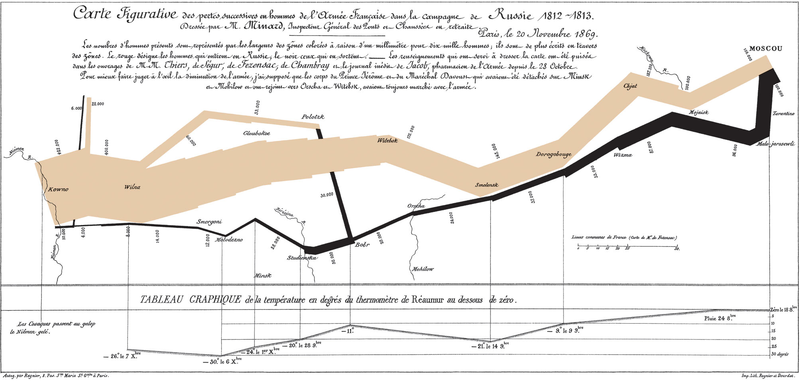
Fig 2. Charles Minard’s map of Napolean’s Russian campaign of 1812.At https://en.wikipedia.org/wiki/Charles_Joseph_Minard (Accessed 26/04/2020)
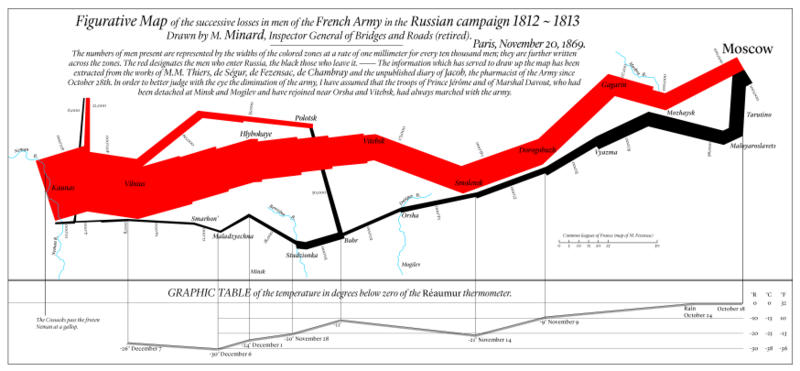
Fig 3. Modern redrawing of Charles Joseph Minard’s figurative map of the 1812 French invasion of Russia, including a table of temperatures converting degrees Reaumur to degrees Fahrenheit and Celsius. At https://en.wikipedia.org/wiki/Charles_Joseph_Minard (Accessed 26/04/2020) 

Fig 2. shows a map by Charles Minard representing information based upon Napoleon’s invasion of Russia in 1812. It can also be seen as a system of information, however it carries a lot more information than Barr’s chart in a very simple visual format. Barr’s system provides information regarding art movements, dates and locations all flowing in one vertical direction and interconnected via arrows. Minard’s map indicates the number of troops, location, dates, distance and direction travelled, as well as the temperature. The number of troops moving towards Russia are indicated through the width of the beige band (1mm for 10,000 men) and the number of troops retreating from Russia through the width of the black band. In a second’s glance, we are instantly able to detect the disastrous losses of Napolean’s troops on this campaign.

Similar to Barr, Minard’s information flows but instead of a vertical flow we have a horizontal flow and are viewing the information as if from above. Minard’s information system is highly complex due to the amount of interacting parts but Minard manages to display this system of information in a very simple and easily digestible manner.

List of illustrations

Fig 1. Alfred Barr’s chart for cubism and abstract art (1936) At
https://www.pinterest.co.uk/pin/85357355408219226/ (Accessed 26/04/2020)

Fig 2. Charles Minard’s map of Napolean’s Russian campaign of 1812.At https://en.wikipedia.org/wiki/Charles_Joseph_Minard (Accessed 26/04/2020)

Fig 3. Modern redrawing of Charles Joseph Minard’s figurative map of the 1812 French invasion of Russia, including a table of temperatures converting degrees Reaumur to degrees Fahrenheit and Celsius. At https://en.wikipedia.org/wiki/Charles_Joseph_Minard (Accessed 26/04/2020) 

Bibliography

Gregory Bateson 1904- 1980 The Information Philosopher At https://www.informationphilosopher.com/solutions/scientists/bateson/ (Accessed 16/04/2020)

https://en.wikipedia.org/wiki/Charles_Joseph_Minard (Accessed 16/04/2020)

Schroeder, M. (2017) The Difference that Makes a Difference for the
Conceptualization of Information
MDPI, Basel, Switzerland. At https://www.researchgate.net/publication/318740201_The_Difference_That_Makes_a_Difference_for_the_Conceptualization_of_Information (Accessed 12/07/2020)

Exercise 4.0

Look at the two paintings [below] and account for their similarities and differences in three columns – one for each artist – Millet and Van Gogh – either side of a column for similarities. Indicate the differences by underlining the appropriate description in the outer columns.

The Sower, 1850 - Jean-Francois Millet - WikiArt.org
Fig 1. Millet, J-F. (1850) The Sower [oil on canvas]
At https://www.wikiart.org/en/jean-francois-millet/the-sower-1850 (Accessed 23/04/2020)
The Sower (after Millet), 1889 - Vincent van Gogh - WikiArt.org
Fig 2. Van Gogh, V. (1889) The Sower (After Millet) [oil on canvas] At
https://www.wikiart.org/en/vincent-van-gogh/sower-after-millet-1889 (Accessed 23/04/2020)
Millet, The Sower (1850) Similarities Van Gogh , The Sower (1889)
Realistic and symbolic
painting.

Dark, heavy and strong presence of the sower.

Strong use of primary
colours against
natural earth tones.

Strong shadows,
especially
over the sower’s face.

The sower has
elongated limbs
and exaggerated
muscles suggesting strength

The human body is
portrayed as strong and
‘machine like’.

Crows in the
background, perhaps undoing the
sower’s efforts.

Millet caused controversy and criticism
when this painting
appeared in the
Paris salon 1850
due to the
heroic representation
of peasant life.

The sower (peasant)
dominates the canvas.

Both artists capture
the movement and spirit
of the sower as he works.


The sower can be seen
as a symbol for the
cycle of life, growth and harvest.

Viewer is given a low viewpoint.

Radiant and dominant complimentary
colours. (yellow and blue/purple.)

Visible diagonal brushstrokes.

Thickly applied paint.

Post- impressionist – spontaneous.

No visible crows in the background, but the
seeds are more visible.

Light, physical presence of the sower.

Visible face of sower.
.

Reflections

Comparing and contrasting the two different versions of ‘the sower’ was a really interesting exercise. Millet’s sower creates a heavier atmosphere with his immense physical strength – almost like a strong farm animal going about his work. Van Gogh’s on the other hand, doesn’t appear as strong and the style of painting creates a lighter atmosphere. Both paintings are celebrating peasant life – portraying the sower as part of the natural seasonal cycle of life. This was a controversial subject matter at the time and not something art collectors wanted.

List of Illustrations

Fig 1. Millet, J-F. (1850) The Sower [oil on canvas]
At https://www.wikiart.org/en/jean-francois-millet/the-sower-1850 (Accessed 23/04/2020)

Fig 2. Van Gogh, V. (1889) The Sower (After Millet) [oil on canvas] At
https://www.wikiart.org/en/vincent-van-gogh/sower-after-millet-1889 (Accessed 23/04/2020)

Bibliography

https://www.vangoghmuseum.nl/en/collection/d0443V1962

https://www.wikiart.org/en/jean-francois-millet/the-sower-1850

Jean-François Millet Artworks The Art Story At https://www.theartstory.org/artist/millet-jean-francois/artworks/ (Accessed 23/04/2020)

Design a site like this with WordPress.com
Get started