Find two paintings and one sculpture, each of which appears concerned with modernity, modernism and modernization. Indicate the relevant features on annotated reproductions.
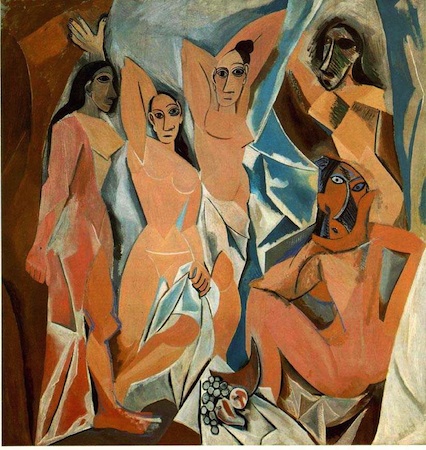
- 5 women in a modernized Parisian society brothel in the early 20th Century. Painting as a reflection of modern capitalist consumer culture – women to be consumed.
- Cubism – form of modernism developed by Picasso.
- Acknowledgement of the modernist painter of the flat 2 dimensional surface of the canvas. Traditional perspective is missing (no vanishing point) and there is no depth. The women’s bodies fill the entire canvas.
- Nontraditional representation of anatomy. Curves are minimal as the bodies are angular and geometric in form. Simplified faces influenced by primitive Iberian sculptures and African masks. Challenges the idealised representations of female beauty.
- Visible textured brush strokes. Pink and blue palette.
- As with Manet’s ‘Olympia’ the viewer’s gaze is now reflected back at him/her though the onlooking prostitutes. He/she is now no longer the anonymous spectator. ‘The self-consciousness of the actual spectator… is never entirely lost before the decorated surface of the canvas.’ (Harrison 1996: 151 )

[oil on canvas]. At https://www.nationalgallery.org.uk/paintings/camille-pissarro-the-boulevard-montmartre-at-night (Accessed 11/10/2019)
- Everyday experience of modernization. Material conditions shaped and created by industrialisation and urbanisation of landscape.
- Modern architecture of Parisian street – a social public space. Anonymity of the individual.
- visible brushstrokes – thick, textural marks. Paint applied in blocks of pure unmixed colour which creates atmosphere.
- A focus on capturing different types of light to create more of an impression of reality than a realistic depiction. Strong contrast between light and dark and colour used for shadows.
- Details, such as people, are suggested.
- En-plein air painting and not in the studio. (In this case, through a window!)

- Futurist movement influenced by the speed and technology of industrialisation. Captures the human experience of modernized society.
- Non- representational – kinesthetic perception of objects in space. The body is captured in motion depicting stages of movement in time and space. ‘..inserts the fluidity of perception into a static representation.’ (Foster, et al 2004:93)
- Influenced by new technology of motion photography.
- Mechanical appearance of sculpture. Robotic and mechanised body deformed by wind and speed.
- Use of traditional sculptural methods but incorporates industrially produced materials.
List of Illustrations
Fig 1. Picasso, P. (2007)Les Demoiselles d’Avignon Paris [oil on canvas]. At https://spanishartinternalconflict.weebly.com/les-desmoiselles -davignon.html Accessed (11/10/2019)
Fig 2. Pissarro, C. (1897) The Boulevard Montmartre at Night
[oil on canvas]. At https://www.nationalgallery.org.uk/paintings/camille-pissarro-the-boulevard-montmartre-at-night (Accessed 11/10/2019)
Fig 3. Boccioni, U. (1913) Unique Forms of Continuity in Space, [Bronze] At https://www.guggenheim.org/arts-curriculum/topic/sculpture (Accessed 11/10/2019)
Bibliography
Foster, H. Krauss, R. Bois Y. Buchloh, B, (2004) Art since 1900. London: Thames and Hudson Ltd.
Harrison, C. ‘Modernism’ . In Nelson, R.S and Shiff. R. (1996) Critical terms for Art History, London : University of Chicago Press. pp142-155.
https://modernism-literature-movement.weebly.com/impressionism.html
https://www.moma.org/collection/works/81179
https://www.tate.org.uk/art/artworks/boccioni-unique-forms-of-continuity-in-space-t01589
Jones, J. (2007) ‘Pablo’s Punks’. The Guardian Culture 09/01/2007. In https://www.theguardian.com/culture/2007/jan/09/2 (Accessed 10/10/2019)
Les Demoiselles d’Avignon – Conserving a Modern Masterpiece. MOMA At:https://www.moma.org/collection/about/conservation/demoiselles/history_2_c.html (Accessed 10/10/2019)







 Lara's Understanding Visual culture (Visual Studies 1) blog