Exercise 3.4

Write 10 sentences containing any of the following words: origin, original or originality. Is the meaning much the same in each example or are there significant differences? Briefly comment on your findings.

  1. Stephen Hawking often discussed theories about the origin of the universe.
  2. Many film companies are turning to origin stories to create new films in their franchise.
  3. She moved back to her country of origin.
  4. They questioned whether the Picasso painting was an original.
  5. I need to see the original copy of the manuscript.
  6. The fashion designer had some original ideas.
  7. The new version of the film was not very good. I much preferred the original.
  8. I was impressed by the originality of her performance.
  9. Originality is the best form of rebellion” (Mike Sasso)
  10. We thought that her painting expressed a lot originality.

The three words (origin, original, originality) used in the sentence examples all have some reference to the new, first, or beginning of something. However, there are differences in the meaning of each word.

Origin refers to the point where something (e.g person, object, tradition) begins, arises or is derived. (Lexico online dictionary accessed 22/02/2020). Original (noun)refers to an object or creation. This is the earliest form or first version of something from which copies can be made Cambridge dictionary online accessed 22/02/2020). Originality refers to the quality or state of something created/invented as being original (Merriam Webster online accessed 22/02/2020).

Bibliography

https://dictionary.cambridge.org/dictionary/english/origin (Accessed 22/02/2020)

https://dictionary.cambridge.org/dictionary/english/original (Accessed 22/02/2020)

https://en.wikipedia.org/wiki/Originality (Accessed 22/02/2020)

https://www.goodreads.com/author/quotes/5317724.Mike_Sasso (Accessed 22/02/2020)

https://www.lexico.com/en/definition/origin (Accessed 22/02/2020)

https://www.merriam-webster.com/dictionary/originality (Accessed 22/02/2020)

Exercise 3.3

Find and collate 10 diverse examples of meta-painting from the 17th Century to the present.

Meta-painting

A meta-painting can be described as a painting that shows or suggests awareness of itself – it is a painting about ‘painting’. Lorenzo Pericolo(2013:12) states that ‘..meta-painting is the whole gamut of pictorial devices through which painting stages its fictiveness’. A meta-painting can partially uncover its materiality through suggesting or depicting its maker or the making of the painting. It can involve ‘the beholder as an active or even indispensable component of the image’ (Pericolo 2013:12); or incorporate a painting or paintings as an object of representation within the image. This inner picture or pictures can be described to be ‘nesting’ inside the outer picture (Mitchell 2006).

W.J.T Mitchell also explains ,when describing a ‘metapicture’, that the image can reflect or double itself – the same picture reappears inside the picture. This is known as the ‘mise en abine’. He also states that another form of metapicture or metapainting is:

‘The picture that is framed, not inside another picture, but within a discourse that reflects on it as an exemplar of ‘picturality’ as such.’ (Mitchell 2006)

This feels like quite a big statement from Mitchell and perhaps goes a little far because the implications of this would suggest that any picture can become a meta-picture. We could reference this idea of meta-painting in the realms of Clement Greenberg’s theory of abstract modernist painting. Modernist paintings were self-referential and drew attention to the nature of its medium -canvas, paint, texture and shape. Writer Ronald B Richard argues that all abstract paintings are meta-paintings as they emphasise the process of creation. This is supported by the earlier description of meta-paintings that partially uncover their materiality through suggesting or depicting its maker or the making of the painting.

Examples of meta-painting form the 17th Century to the present

  1. Las Meninas‘ (1656) Diego Velázquez
Las Meninas
Fig 1. Velázquez, D. (1656) Las Meninas [oil on canvas] At https://www.artsy.net/article/artsy-editorial-centuries-people-las-meninas (Accessed 17/02/2020)

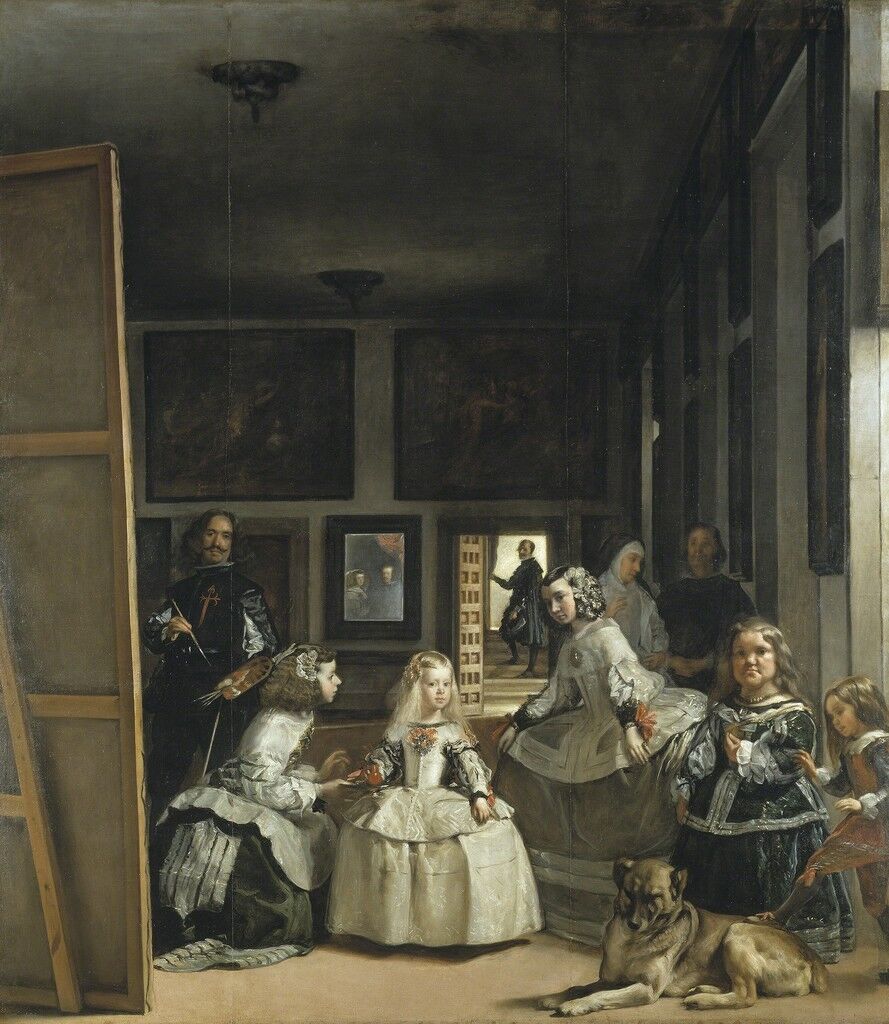
‘Las Meninas’ by Diego Velázquez is considered a masterpiece of Western painting. Painted for King Phillip IV of Spain in the 17th Century, Velázquez depicts a scene in his palace studio whereby the artist himself is seen in the process of painting alongside the King’s daughter Margaret and her court aides. The viewer is placed in an interesting position and is the source of the gaze for Velazquez, Margaret and several others in the room. Reflected in the mirror at the back of the room is the King and Queen which suggests that the viewpoint is from the King or Queen as they pose for their portrait perhaps awaiting Margaret to join them.

The presence of Velázquez himself indicates that the ‘Les Meninas’ is an early example of a meta-painting. The artist is shown in the creative process of creating his masterpiece . We are placed within the artists studio that has walls covered in paintings (the two at the back are copies of two Reubens paintings). This painting is definitely about the world of painting and gives us an insight into not what the artist sees when creating a portrait but what the sitter sees whilst the process occurs.

2. ‘The Art of Painting’ (ca. 1667) Johannes Vermeer

figure13
Fig 2. Vermeer, J. (ca 1667) The Art of Painting [oil on canvas] At https://www.nature.com/articles/palcomms201768 (Accessed 17/02/2020)

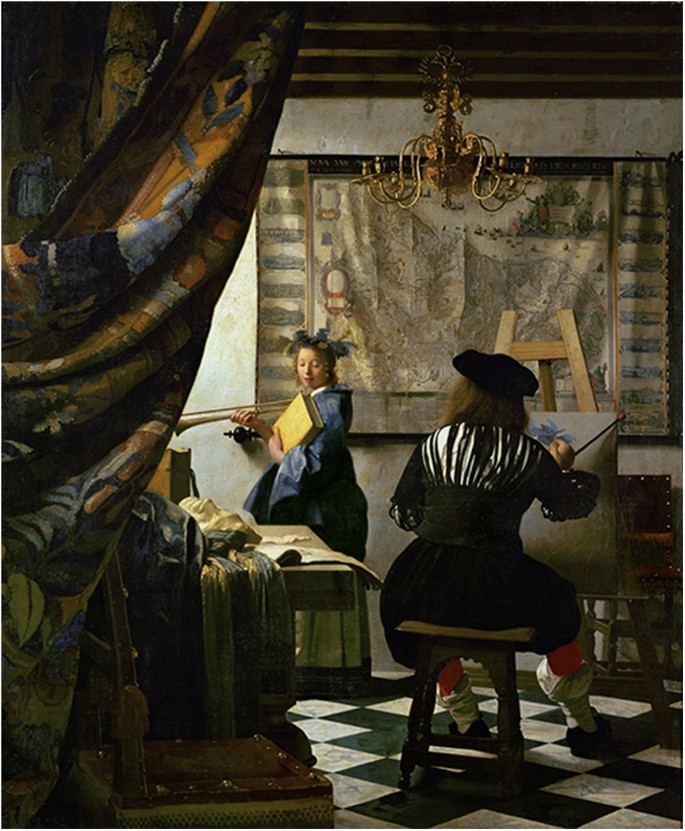
In this meta-painting by Vermeer, we are again viewing a painting about the creation and creator of a portrait painting. However, unlike ‘Las Meninas’‘ the viewer is positioned behind the painter (Vermeer) and allowed to see the staging of the scene and the object of representation – in this case a young girl holding a book and an instrument. We can peer over Vermeer’s shoulder and see the careful brushstrokes on his canvas as he takes in his subject matter.

3. ‘Reverse side of a painting’ (1670) Cornelius Gijsbrechts

Image result for reverse side of painting cornelius
Fig 3. Gijsbrechts, C. (1670) Trompe l’oeil. Reverse Side of a Painting [oil on canvas] At https://commons.wikimedia.org/wiki/File:Cornelius_Norbertus_Gijsbrechts_-_Trompe_l%27oeil._The_Reverse_of_a_Framed_Painting_-_Google_Art_Project.jpg (Accessed 17/02/2020)

On first viewing of Gijsbrechts Reverse Side of a Painting, I was convinced this was a 20th Century modern painting and not from the 17th Century! What we are viewing in this meta-painting is a realistic depiction of the back of a framed canvas, complete with a sales room ticket attached. The detail is extraordinary and includes the wooden inner and outer frames with splits in the wood and small nails surrounding the inner canvas. We, as the viewer are fooled into believing that this is a real painting but hung the wrong way round.

The artist has depicted the materiality of his craft. Viewers believe that they are looking at the physical materials that construct the framed canvas. Gijsbrechts was part of a group of 17th-century Dutch still-life painters known as ‘betriegertje (little trickster). Their aim was to decieve the viewer with their paintings of paintings.

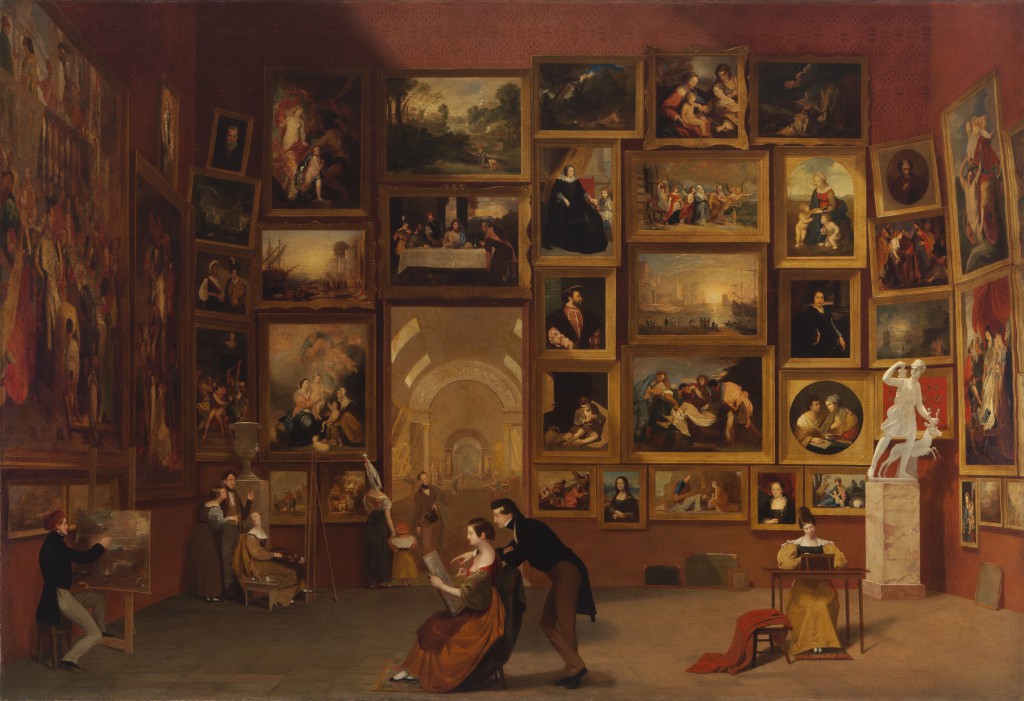
4. ‘Gallery at the Louvre‘ (1831-33) Samuel F.B Morse

In Morse’s meta-painting of the Louvre, we are thrust into the institution of the art gallery and exposed to numerous classic paintings displayed on the walls including works by Titian and Da Vinci’s Mona Lisa. We are able to view paintings within the painting itself as well as experience the social institution of the gallery. Within the gallery are artists in the process of painting or drawing, presumably inspired by the surrounding masterpieces.

5.’The Treachery of Images‘, (1929) Rene Magritte

The Treachery of Images, 1929 by Rene Magritte
Fig 5. Magritte, R. (1929) The Treachery of Images [oil on canvas] At https://www.renemagritte.org/the-treachery-of-images.jsp (Accessed 18/02/2020)

Magritte’s surrealist painting ‘The treachery of Images’ is quite an interesting meta-painting because it invites the viewer to contemplate what they are looking at – a pipe or a painting? The words beneath the painting of a pipe state in French – ‘This is not a pipe.’ Yet it is not clear whether this refers to the writing or the image of a pipe. The writing is not a pipe but also the image is not a pipe because it is purely the representation of a pipe using oil paints on canvas. However, it is a pipe because we perceive it as one even though we know that it is a painting!

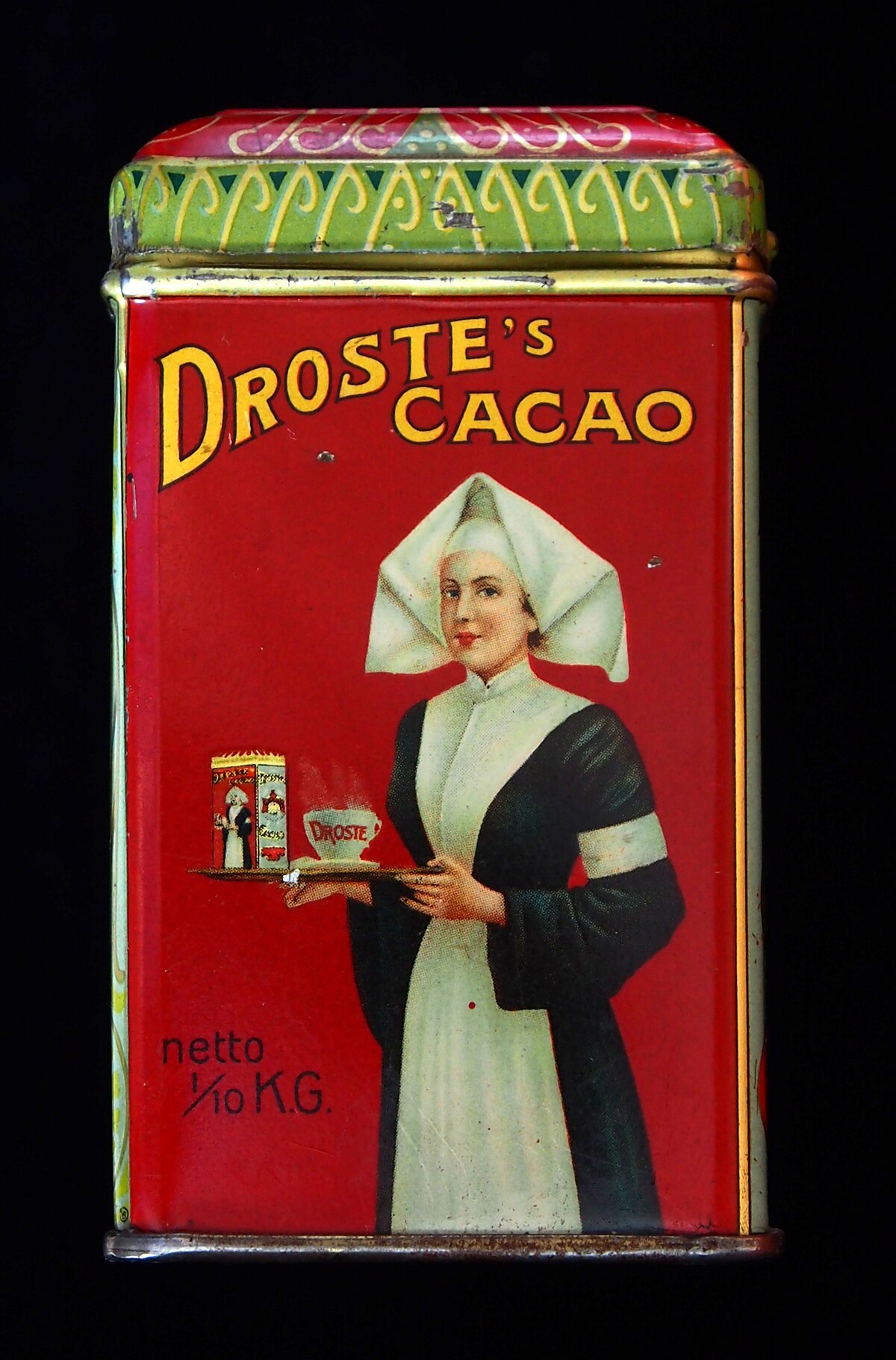
6. ‘Droste’s Cacao‘ (1904) Jan Misset

Image result for droste cacao
Fig 6. Misset, J. (1904) Droste’s Cacao At https://en.wikipedia.org/wiki/Droste_effect (Accessed 18/02/2020)

The effect of ‘mise en abine’ refers to an image that recursivley places a copy of itself within itself (often infinitely) and is most commonly found in photography. This type of picture often known as the ‘Droste’ effect originate from the tins of Dutch Droste cocoa from the early 20th Century. The nurse in the tins image is holding a tin that shows a repeated and recursive image.

7. ‘The face of war‘ (1940) Salvador Dali

Image result for the face of war dali
Fig 7. Dali, S. (1940) The face of war [oil on canvas] At https://www.dalipaintings.com/the-face-of-war.jsp (Accessed 18/02/2020)

I believe that ‘The Face of War’ by Surrealist artist Salvador Dali could be seen as a meta-painting displaying the effect of ‘mise en abine’. This unnerving face most likely refers to the horrors experienced in the Spanish Civil war. Our eyes are drawn to the face of death with its eye sockets and mouth wide open with its infinite recurring image. In the bottom right of the painting, we can also see the imprint of Dali’s hand revealing and suggesting the presence of creator.

8. ‘Las Meninas’ (1957) Pablo Picasso

The Maids of Honor (Las Meninas, after Velázquez)
Fig 8. Picasso, P. (1957)  The Maids of Honor (Las Meninas, after Velázquez) [oil on canvas] At http://web.guggenheim.org/exhibitions/picasso/artworks/maids_of_honor (Accessed 18/02/2020)

During the year 1957, Picasso created 44 paintings inspired by Diego Velázquez’s Las Meninas (1656). This version is perhaps the one that recreates the scene most faithfully to the original. Picasso sticks to a black, white and grey palette and keeps the original figures in a similar position. We have already discussed the original Las Meninas as being a meta-painting and now we have a 20th Century painting based upon a painting that is about painting! A meta-meta painting!

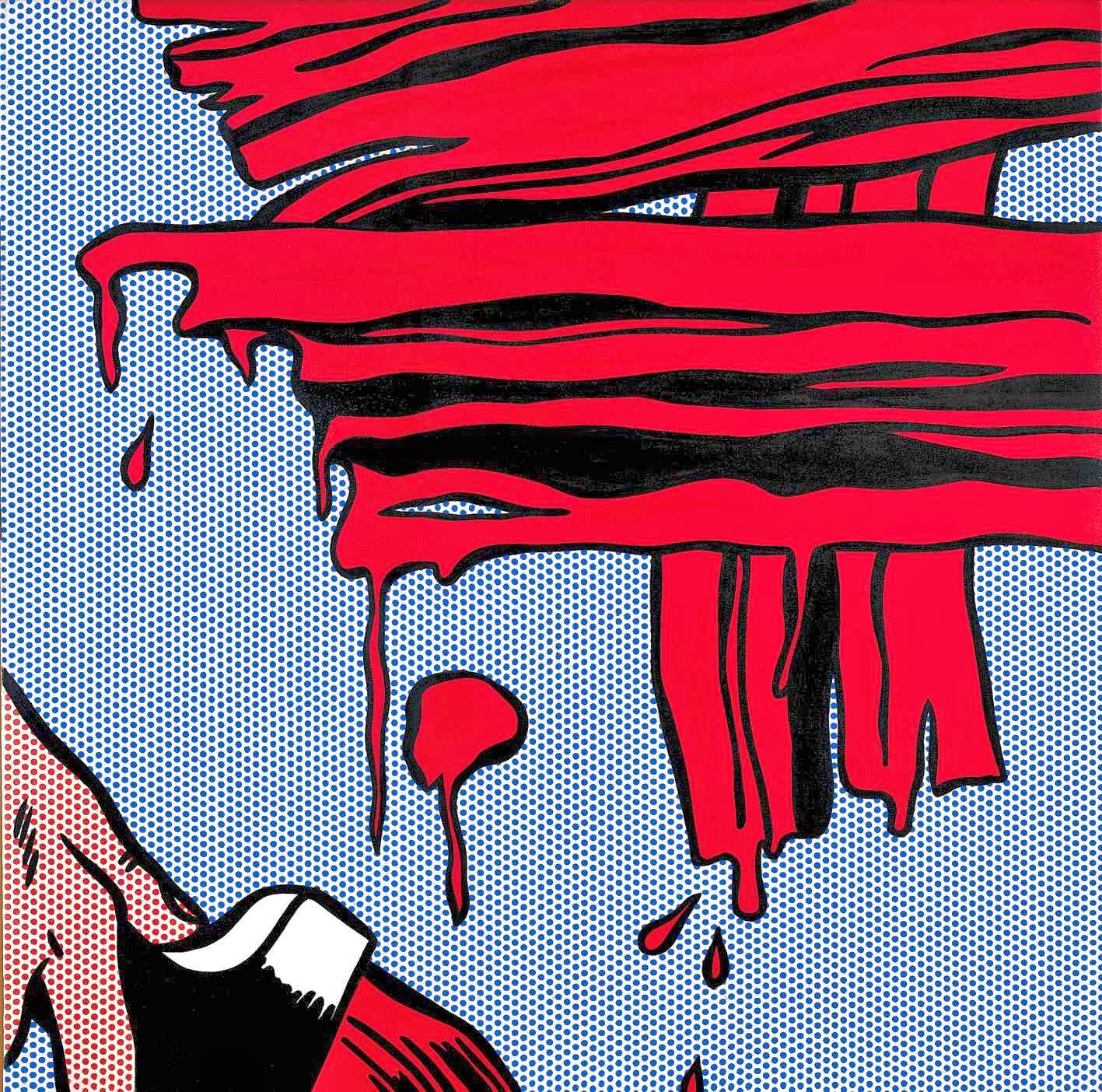
9.‘Brushstrokes’ (1965) Roy Lichtenstein

Brushstrokes, Roy Lichtenstein 1965 - Singulart
Fig. 9 Lichtenstein (1965) Brushstrokes [screen-print on paper] At https://www.singulart.com/en/collection/inspired-by-roy-lichtenstein-1189 (Accessed 19/02/2020)

In this pop-art example of a meta-painting, Lichtenstein depicts the making of a painting. We can see the artist’s hand clutching the paint brush just after they have roughly placed red paint on a surface. We are viewing a close up and intimate moment between the painter and their painting.

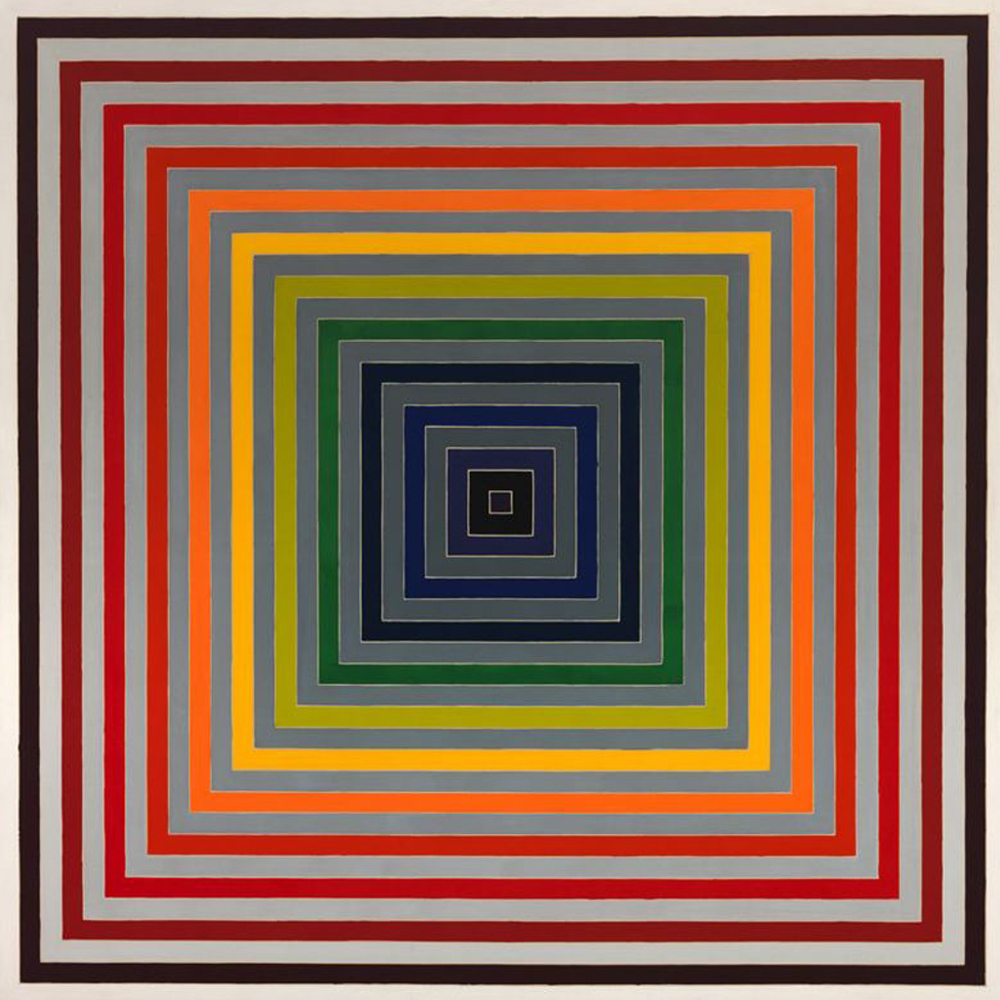
10. ‘Letter on the Blind 11’ (2014) Frank Stella

Image result for letter on the blind stella
Fig 10. Stella, F. (2014) Letter on the Blind 11′ [offset lithograph] At https://www.sartle.com/artwork/letter-on-the-blind-ii-frank-stella (Accessed 19/02/2020)

This last example of what might controversially be termed a ‘meta-painting’ was created by Frank Stella in 2014. As an abstract non-representational artwork, the viewer is conscious that they are looking at a painting. The use of materials becomes apparent as the artist has emphasised the canvas’s shape by using geometric lines to construct the pattern within. Recurring and diminishing squares create a ‘mise en abine’ effect as our eyes are drawn to the centre of the canvas.

Reflections

This was a really enjoyable exercise. It was interesting to learn about different paintings from different periods and explore how they can be defined as meta-paintings. I tried to include a diverse range of paintings and couldn’t resist adding an abstract one at the end as I thought the idea that abstract paintings could be meta-paintings was an intriguing concept.

List of illustrations

Fig 1. Velázquez, D. (1656) Las Meninas [oil on canvas] At https://www.artsy.net/article/artsy-editorial-centuries-people-las-meninas (Accessed 17/02/2020)

Fig 2. Vermeer, J. (ca 1667) The Art of Painting [oil on canvas] At https://www.nature.com/articles/palcomms201768 (Accessed 17/02/2020)

Fig 3. Gijsbrechts, C. (1670) Trompe l’oeil. Reverse Side of a Painting [oil on canvas] At https://commons.wikimedia.org/wiki/File:Cornelius_Norbertus_Gijsbrechts_-_Trompe_l%27oeil._The_Reverse_of_a_Framed_Painting_-_Google_Art_Project.jpg (Accessed 17/02/2020)

Fig 4. Morse, S.F.B. (1831-33) Gallery at the Louvre [oil on canvas] At https://www.terraamericanart.org/what-we-offer/our-art-collection/terra-collection-initiative-samuel-f-b-morses-gallery-of-the-louvre-and-the-art-of-invention/ (Accessed 18/02/2020)

Fig 5. Magritte, R. (1929) The Treachery of Images [oil on canvas] At https://www.renemagritte.org/the-treachery-of-images.jsp (Accessed 18/02/2020)

Fig 6. Misset, J. (1904) Droste’s Cacao At https://en.wikipedia.org/wiki/Droste_effect (Accessed 18/02/2020)

Fig 7. Dali, S. (1940) The face of war [oil on canvas] At https://www.dalipaintings.com/the-face-of-war.jsp (Accessed 18/02/2020)

Fig 8. Picasso, P. (1957)  The Maids of Honor (Las Meninas, after Velázquez) [oil on canvas] At http://web.guggenheim.org/exhibitions/picasso/artworks/maids_of_honor (Accessed 18/02/2020)

Fig. 9 Lichtenstein (1965) Brushstrokes [screen-print on paper] At https://www.singulart.com/en/collection/inspired-by-roy-lichtenstein-1189 (Accessed 19/02/2020)

Fig 10. Stella, F. (2014) Letter on the Blind 11′ [offset lithograph] At https://www.sartle.com/artwork/letter-on-the-blind-ii-frank-stella (Accessed 19/02/2020)

Bibliography

Finch, C. (s.d) Gallery at the Louvre, Morse code Art net At http://www.artnet.com/magazineus/features/finch/mccoullough-morse-gallery-at-the-louvre-4-13-11.asp (Accessed 19/02/2020)

Gronstad, A. & Vagnes, O. (2006) What do pictures want? Interview with W.J.T. Mitchell Image & Narrative, (November 2006)At https://www.visual-studies.com/interviews/mitchell.html (Accessed 19/02/2020)

Guggenheim, Comparative works The Solomon R. Guggenheim Foundation 2012 At http://web.guggenheim.org/exhibitions/picasso/artworks/maids_of_honor (Accessed 19/02/2020)

https://en.wikipedia.org/wiki/Droste_effect

https://www.dalipaintings.com/the-face-of-war.jsp

https://www.renemagritte.org/the-treachery-of-images.jsp

https://www.tate.org.uk/art/artworks/lichtenstein-brushstroke-p07354

Lesser, C. (2018) Centuries Later, People Still Don’t Know What to Make of “Las Meninas” Artsy Mar 23, 2018 At https://www.artsy.net/article/artsy-editorial-centuries-people-las-meninas (Accessed 19/02/2020)

Pericolo, L. (2013) What is Metapainting? The self-aware image Twenty Years Later At https://www.academia.edu/16776812/What_is_Metapainting_The_Self-Aware_Image_Twenty_Years_Later

Richardson, R.B. (2011) Abstract paintings are metapaintings At http://ronaldbrichardson.com/metafiction/abstract-paintings-are-meta-paintings/ (Accessed 19/02/2020)

Web Gallery of art GIJSBRECHTS, Cornelis Norbertus Reverse side of a painting At https://www.wga.hu/html_m/g/gijsbrec/cornelis/reverse.html (Accessed 18/02/2020)
Exercise 3.2

Do you think art is and will remain a distinct category or is it best seen as a species of visual culture? List reasons for and against a distinct category. How many ways could ‘best seen as’ be understood? Aesthetically, morally, socially?

In order to answer this question I needed to define and clarify various terms that have been used. The first definition is that of ‘art’ (or visual art). The Encyclopedia Britannica gives a definition of ‘(visual) art’ as:

‘..a visual object or experience consciously created through an expression of skill or imagination. The term art encompasses diverse media such as painting, sculpture, printmaking, drawing, decorative arts, photography and installation.’ (Encyclopedia Britannica)

and Lexico online defines art as:

‘The expression or application of human creative skill and imagination, typically in a visual form such as painting or sculpture, producing works to be appreciated primarily for their beauty or emotional power.’

Image result for art sculpture
Fig 1. example of visual art: Hepworth, B. (1946) Pelagos [Elm and strings on oak base] Musée Rodin (Paris, France) At https://www.tate.org.uk/art/artworks/hepworth-pelagos-t00699 (Accessed 09/02/2020)

Visual culture can be defined as ‘the study of the cultural construction of visual experience.’ (Mitchell 1995:540) Disciplines such as art history, media studies, philosophy and politics converge in the study of visual culture to find new ways of looking at the visual world. Hunter describes visual culture as;

‘a term that refers to the tangible, or visible, expressions by a people, a state or a civilization, and collectively describes the characteristics of that body as a whole.’ (Hunter S.D cited in Schleimer 2008)

Visual culture has emerged as a field of study in post-modern society largely due to the development and usage of visual technology. The visual world is now saturated – social media, film, television the arts… . All these can be seen as a ‘species’ of visual culture and can be studied as a reflection of social reality.

Image result for tablet showing images
Fig 2. Example of visual media.Apple ipad mini (2019) At https://uk.pcmag.com/tablets/10395/the-best-tablets-for-2020 (Accessed 09/02/2020
Image result for cinema
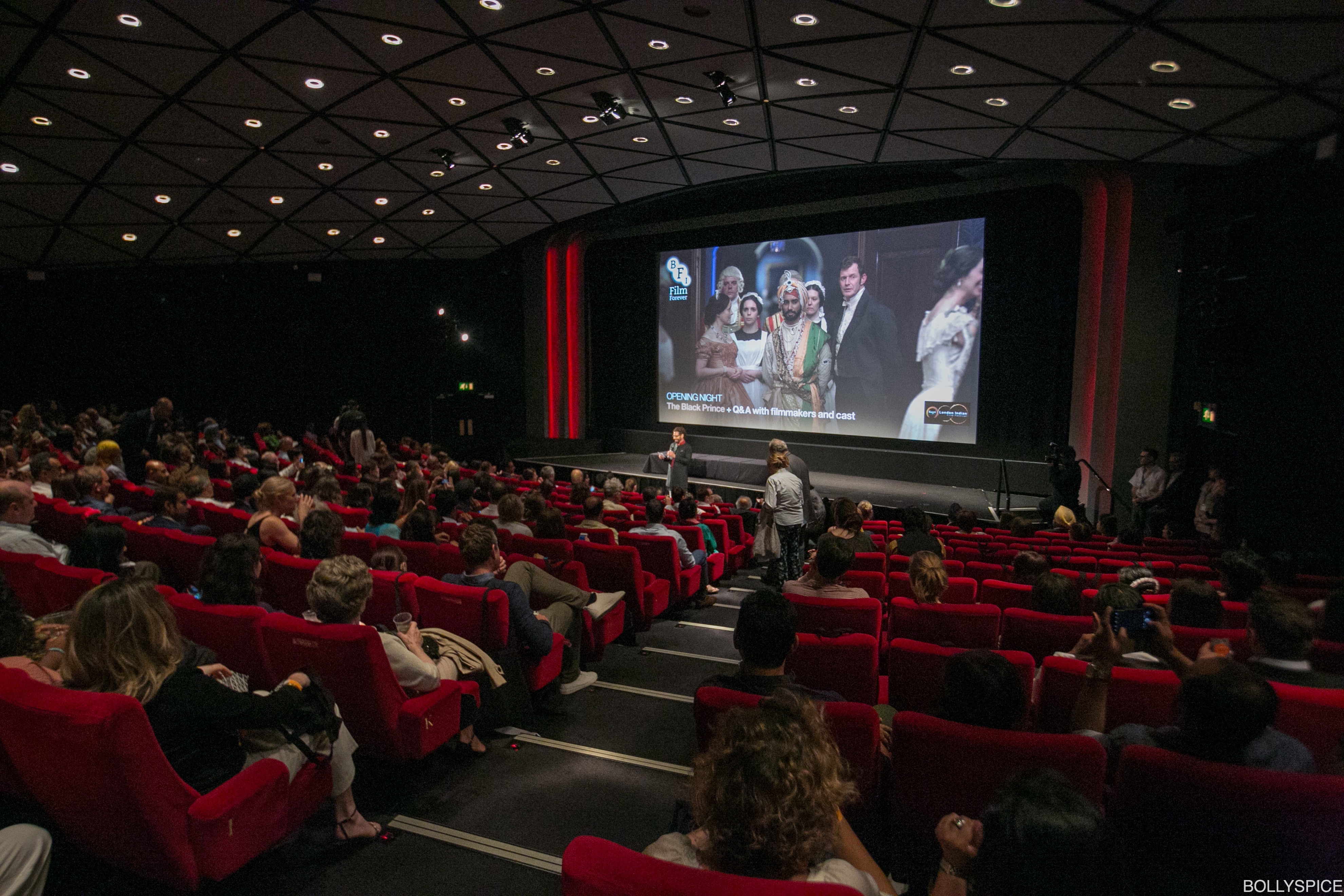
Fig 3. Example of visual culture. London Indian film Festival At https://bollyspice.com/london-indian-film-festival-opening-night-the-black-prince/(Accessed 09/02/2020)

Art in today’s world is not just viewed in a gallery or in a collectors house. All the other media of visual culture (magazines, internet pages, books, television) have the ability to bring that world into peoples homes (albeit second-hand) as part of mass culture. For example one can just as easily flick from one channel showing a science-fiction classic to a documentary on Monet.

Art has always traditionally been an independent discipline but in contemporary culture with multiple forms media is it now best seen as a species of visual culture?

Art Remaining a distinct category

  • Humanity has a long history of art and this needs to be seen as separate from other visual medium that may be short-lived/temporary. The oldest known art object ‘the Venus of Tan Tan’ was believed to have been made between 300,000 and 500,000 years ago (Morris 2013:64). Film, internet, and modern visual media have only been in existence for a mere fraction of that.
  • Art is ‘the expression or application of human creative skill and imagination’ (Lexico online, accessed 08/02/20) and often does not need to serve a purpose – art for art’s sake! If it was seen a species of visual culture it might lose its autonomy.
  • Academically, art remaining a distinct category maintains specialist learning and expertise.

Art as a ‘species’ of Visual Culture

  • Holistic understanding of subjects and issues within society and visual culture allow new ways of thinking/creating.
  • A deeper/wider and perhaps more realistic approach to the visual arts that is able to reflect life in a more ‘honest’ way.
  • The study of visual experience through art and other mediums can help to understand how reality is socially constructed and not necessarily a ‘given’.
  • Art as well as other visual media is created by individuals who are part of a socially constructed society and will therefore reflect that culture within their art.
  • The lines between types of visual media can become blurred. Artists are now combining new technology such as computers and film within their creative process or displaying art on visual media. Visual media such as television and magazines can show images of art meaning it doesn’t have to be seen in a gallery.

It would appear that there are merits to both sides of this argument. It is important for art to remain a distinct category to ensure that specialised, focused and in-depth creativity and research occurs. However, as art is a part of the visual culture that we experience today it also should be encompassed into that category to create new ways of understanding. I believe that in the future it will remain its own category alongside being a ‘species’ of visual culture.

How many ways could ‘best seen as’ be understood? Aesthetically, morally, socially?

‘Best seen’ can be understood in different ways. Art is ‘best seen’ as aesthetically, morally, culturally, socially, philosophically, anthropologically and historically as a species of Visual Culture.

Reflections

This was a really tough exercise for me. I had to read and re-read the question to try and understand how to answer the question. I initially took the question to mean whether the study of art should be a single discipline or whether it is best as part of the interdisciplinary studies of Visual Culture. After completing the exercise I became concerned that I had misinterpreted the question and tackled it again.

List of illustrations

Fig 1. example of visual art: Hepworth, B. (1946) Pelagos [Elm and strings on oak base] Musée Rodin (Paris, France) At https://www.tate.org.uk/art/artworks/hepworth-pelagos-t00699 (Accessed 09/02/2020)

Fig 2. Example of visual media.Apple ipad mini (2019) At https://uk.pcmag.com/tablets/10395/the-best-tablets-for-2020 (Accessed 09/02/2020

Fig 3. Example of visual culture. London Indian film Festival At https://bollyspice.com/london-indian-film-festival-opening-night-the-black-prince/(Accessed 09/02/2020)

Bibliography

Glodd, B. (2016) The 5 Significant Advantages of Interdisciplinary Research Institute for Humane Studies at George Mason university 9.11.2016 At https://theihs.org/blog/5-advantages-of-interdisciplinary-research/ (Accessed 08/02/2020)

https://en.wikipedia.org/wiki/Visual_culture (Accessed 08/02/2020)

https://www.britannica.com/search?query=art (Accessed 08/02/2020)

https://www.lexico.com/en/definition/art (Accessed 08/02/2020)

Mirzoeff, N.(1999) An Introduction to Visual Culture New York: Routledge

Mitchell, W.J.T (1995) Interdisciplinarity and Visual Culture Art Bulletin 12/1995 Vol. 77 No.4 At https://monoskop.org/File:Mitchell_WJT_1995_Interdisciplinarity_and_Visual_Culture.pdf (Accessed 08/02/2020)

Morris, D. (2013) The Artistic Ape,Red Lemon Press Ltd: London

Schleimer, L. (2008) Art in Antiquity -visual culture at https://www.brown.edu/Departments/Joukowsky_Institute/courses/artinantiquity/7158.html (Accessed 09/02/2020)

Exercise 3.1

Can you see a connection between Emerson’s remarks and the view expressed by Searle in Chapter One? Where do their views overlap and where do they differ?

Ralph Waldo EmersonSimilarities John Searle
Two things make up
the world; Human history –
(artefacts) and
natural phenomena. The passage
of time illustrates that nature is
static and the culture of humans is trans-formative.
There is a natural world that exists and would
exist regardless of humanity’s existence.
There are portions of the world
that exist due to human
agreement (objective facts such as money and nations) and portions of the
world that exist regardless of
humans (brute facts -the natural
world e.g rivers, mountains)
‘Art’ is defined
as the uses humans
make of ‘nature’. “Nature, in the
common sense, refers to essences unchanged by man; space, the air,
the river, the leaf. Art is
applied to the mixture of his
will with the same things, as in
a house, a canal, a statue, a picture.” (Emerson, 1883)
There is a definite distinction between nature and the man made world /reality.Social reality is constructed
by us to serve our purposes.
Nature is not constructed by
humans but it is expressed
through them. Man is the
‘transparent eyeball’ viewing
unity of nature and self. A spirit/energy eminates throughout the universe. Art as a means of ‘revelation’ – artist as prophet or seer. (Allen & Handley 2018)
Consciousness is a biological and physical consequence of evolution.
Natural facts are seen as symbols of
spiritual facts. Nature is a metaphor
of the human mind.
Outer creation (nature) gives us
language for the inner creation (the soul). ‘Every natural fact is a
symbol of some spiritual fact.’ Nature and not humans form the true basis for morality.
Language is important for humanity.Institutional facts are language
dependent. The development of
language in the human species
allowed us to create words that represented and symbolised something. Formulation of
words (and language) allowed for dependent and
independent thought that then allowed for discussion and agreement.
Table to show differences and similarities between the theories of Searle and Emerson.

Reflections

Both writers deemed that there is a distinct separateness between the natural world and the human world. Searle focused his analysis on the ‘brute’ facts (rivers, mountains) and the ‘institutional’ facts that allow humans to create objective realities within their culture (e.g money, class systems, national borders etc). Emerson, writing in the first half the 19th Century separated the two by looking at the artefacts of human history and how the passage of time showed nature and not culture to be immutable.

Both writers discussed human language and its relation to social reality. Searle looks at this logically and rationally by following the development of human language that allowed for conscious thought and therefore discussion and agreement on social constructs. Emerson, writing prior to Darwin’s theory of evolution, discusses how reality, expressed though language, is a reflection of the language of nature. Emerson looks at language poetically and metaphorically.

Every appearance in nature corresponds to some state of the mind, and that state of the mind can only be described by presenting that natural appearance as its picture. An enraged man is a lion, a cunning man is a fox, a firm man is a rock, a learned man is a torch. A lamb is innocence; a snake is subtle spite; flowers express to us the delicate affections. Light and darkness are our familiar expression for knowledge and ignorance; and heat for love.”

(Emerson, 1836)

Emerson appears to have an idealistic and transcendental viewpoint wheras Searle’s is more realistic. I particularly like the fact that he acknowledges that man is actually a part of nature, ‘nature is expressed through humans’, and that man should experience that unity or ‘oneness’. This feels very reminiscent of eastern Buddhist philosophy.

Bibliography

Emerson, R.W. (1836) Nature At https://archive.vcu.edu/english/engweb/transcendentalism/authors/emerson/nature.html (Accessed 01/02/2020)

Emerson, R. W (1834) The Naturalist Delivered to the Boston Natural HIstory Society, 7 May, 1934. At https://archive.vcu.edu/english/engweb/transcendentalism/authors/emerson/essays/naturalist.html (Accessed 01/02/2020)

Searle, J. R (1995) ‘The Construction of Social Reality’ London: Penguin books.

Exercise 3.0

“The content and methodology of postmodern science thus provide powerful intellectual support for the progressive political project, understood in its broadest sense: the transgressing of boundaries, the breaking down of barriers, the radical democratisation of all aspects of social, economic, political and cultural life. Conversely, one part of this project must involve the construction of a new and truly progressive science that can serve the needs of such a democratised society-to-be.” (Sokal, 1994)

Do you think Sokal was right to publish the article? Give reasons in a short paragraph.

I believe that Sokal was right to publish the article ‘Transgressing the Boundaries: Towards a Transformative Hermeneutics of Quantum Gravity’ in the journal Social Text in 1996. Those that publish knowledge and research provided by academics are in a position of power. They have a duty to the wider society to ensure that an academics work is understood and peer reviewed prior to publishing (Weber, 1996). In Sokal’s case this did not happen. The danger here is that a published article that appears to support a particular viewpoint but is hugely flawed, slips through into the public arena. Sokal’s hoax article highlighted this point absolutely, as well as indicating the dangers of post-modern criticism of the natural sciences.

When you first read the passage did it seem suspicious?

Initially, I was not suspicious of the passage. I strongly believe that both natural science and social, economic, political and cultural life (humanities) should be studied when looking at certain important objects of inquiry. For example, mental health requires a biological and chemical analysis to understand the physical conditions, (brain function and chemistry), a cultural and social aspect to understand why the condition occurs ( how culture influences emotional well-being), and a political and economic perspective that can promote change and prevention (financial investment in recovery and prevention). In this instance, natural science is not enough to understand the issue at hand and encompassing a wide field of perspectives can elicit greater knowledge. This appears productive when disciplines are complementing each other rather than influencing and altering.

Having considered this viewpoint, the part in Sokal’s paragraph which then seemed suspicious to me was the last sentence Conversely, one part of this project must involve the construction of a new and truly progressive science that can serve the needs of such a democratised society-to-be.” He seems to be suggesting changing the natural sciences (although not how) to serve a democratised society and yet this would require science to be a subjective discipline. On further reading of the full article, Sokal makes bold claims that;

“..physical ‘reality’, no less than social ‘reality’ is at bottom a social and linguistic construct; that scientific ‘knowledge’ far from being objective, reflects and encodes the dominant ideologies and power relations of the culture that produced it..’ (Sokal 1996: 217-8)

This paragraph instantly set alarm bells ringing! Sokal is highlighting that postmodernist thought had started to question the objectivity of natural science and was claiming that physical reality was socially constructed!

It is clear to me that the natural sciences are objective. Scientific laws are understood in the same way regardless of differences in nation, race and gender (Weinberg 1996). A rock is a rock regardless of whether a human perspective is involved (Searle 1996).

Has anything else you have read so far in this course book seemed suspicious? Briefly say what and why?

Clement Greenberg’s theory on modernist painting made me slightly suspicious. Greenberg seemed to favour certain artists that supported his theories and ignored others. For example, Rothko and Pollock were celebrated by Greenberg as avant-garde modernist artists exploiting the flatness of the canvas. Yet he ignored new and innovative art work by Robert Rauschenberg and Andy Warhol. Was this because they didn’t fit into his vision? He was also reluctant to accept minimalist art as modernist painting and I feel that this was because they took him literally and pushed his theory to the limit.

Bibliography

Shaefer, N. & Piereson, J. (2017) The Sokal Hoax and its lessons in Washington Examiner 25/01/2017 At https://www.washingtonexaminer.com/weekly-standard/the-sokal-hoax-and-its-lessons (Accessed 25/01/2020)

Sokal, A. (1996) Transgressing the Boundaries: Toward a Transformative Hermeneutics of Quantum Gravity Social Text. No 46/7 Spring wars (1996 pp 217-252) At https://physics.nyu.edu/faculty/sokal/transgress_v2/transgress_v2_singlefile.html (Accessed 25/01/2020)

Weber, K. (1996) Science Wars—Remarks from a Critical Rationalist’s Point of View Weber, in Popper, K. (2006) A CENTENARY ASSESSMENT, VOLUME II: Epistomology and Metaphysics, Jarvie, K. Milford, D. Miller, eds., Aldershot et al., Ashgate, At https://papers.ssrn.com/sol3/papers.cfm?abstract_id=1836410 (Accessed 12/07/2020)

Weinberg, S. (1996) Sokal’s Hoax In The New York Review of Books Vol. XLIII No.13 pp11-15 at https://physics.nyu.edu/sokal/weinberg.html (Accessed 25/01/2020)

Reflections on Part 2

Unfortunately I struggled a lot during Part 2. This was not related to the course content but to a broken kneecap which I have been recovering from since September. This has really slowed down my study and affected my ability to concentrate. In Part 1 I was able to throw myself into studying 100% but during this section I was only able to study when well enough to do so. I have also neglected my sketchbook and so will aim to use it more in future. Having said that, I really have enjoyed learning about Modern art particularly Abstract Expressionism and Minimalism.

Demonstration of subject based knowledge and understanding

I found the subject of Modernism really interesting. It was useful to study Greenberg’s theories to gain a perspective on how art and society has progressed through the Modernist period. I was able to understand how different art movements evolved through the 20th Century and how social changes were a large influence. I have started to understand how different theories about art (and what it is or should be) influence the creative processes within these movements.

Demonstration of Research Skills

I am becoming confident in using the internet to access journals and essays to assist with my research. I have found it useful to access primary sources of interviews with artists that have been published online as this gives me a greater insight into the artist and their work. I am also using online videos of lectures and artist interviews to broaden my knowledge. I am confident researching around a subject and then focusing that research appropriately to answer an exercise or assignment.

Demonstration of critical and evaluation skills

I have engaged with relevant concepts, values and debates. I feel as though I am starting to find my voice and reflect upon these. I do however, sometimes feel as though I lack confidence expressing my ideas and worry whether my understanding is sufficient enough to make my own statements. I spend a lot of time reflecting on my research and sometimes thoughts or ideas will come at random moments which I have to note down quickly before they disappear!

Communication

I have ensured that I am using more visuals within my work to illustrate points and explanations. As this course has taken longer than usual, I am concerned as to whether Assignment 2 flows as well as my previous Assignment. I have attempted to order my research in a logical and progressive way that hopefully is accessible to the reader.

Exercise 2.4

For a picture of your own choice say how the image indicates a point of view for the spectator and say why you think the effect is rare in the cinema but common in photography. Does the painting or photograph represent eye-contact between someone in the picture and ourselves. What films have you seen where characters treat the camera as another person?

Before answering the question above, I wanted to ensure that I fully understood the term ‘scopic regimes’. Formulated by Martin Jay in 1988, the term ‘scopic regime’ is derived from a term used by the cinematologist Christian Metz who wished to compare how we behave in the cinema and in the theatre. According to Sendyka (2013) ‘he is interested in two factors: the distance of the spectator from the object and the very existence of that object vis-à-vis the spectator.’ He refers to visual acts imposed on the viewer, for example the institution, its machinery, its space, its presentation, external perceptual conditions and scopophilia.

Martin Jay developed the idea of Scopic regimes in his 1988 article Scopic regimes and Modernity. Roma Sendyka (2013) explains that:

‘It is therefore not only the act of seeing that is important, but also the system of dependence between the donor and the recipient of the look. The frame of that action also matters: scopic regime is a type of visuality but a ”culturally specific” one. In Jay’s view a scopic regime is a set of visual conventions determining our action of seeing: how and what we see. In other words it is dominant ways of seeing and organising visual culture. In determining the relation between the spectator and the viewed, scopic regimes are the basis of the distinguishing of an object, in this way becoming the basis of the distinction of what is knowable. ‘ (Sendyka,2013:104)

Scopic regimes determine the relation between the spectator and the viewer. Jay argues that vision becomes more dominant in the modern age due to technological advancements (tv, cinema, computers, photography etc. This is modernity’s scopic regime.

I decided to choose a photograph to examine the spectators point of view and found an interesting Paul Strand photo of three children looking through a closed cottage window in the Hebrides during the 1950’s.

Fig 1. Strand, P. (1954) Milly, John and Jean MacLellan, South Uist, Hebrides [photograph] At Dickson, A . (2016) The New Yorker : Paul Strand’s Sense of Things https://www.newyorker.com/culture/photo-booth/paul-strands-sense-of-things Accessed 08/12/2019

This photo indicates the spectator’s point of view very clearly. We (through the photographer’s lens) are placed directly at eye level with the children although we are distinctly separated by the window frame. We are outside whilst the children are peeping through the glass and from behind the curtain to see what is happening. The child in the centre is looking at the camera with confident curiosity, yet the other two look a little uncertain. The photo captures a gentle, homely real life moment in time- one that we can spend time with.

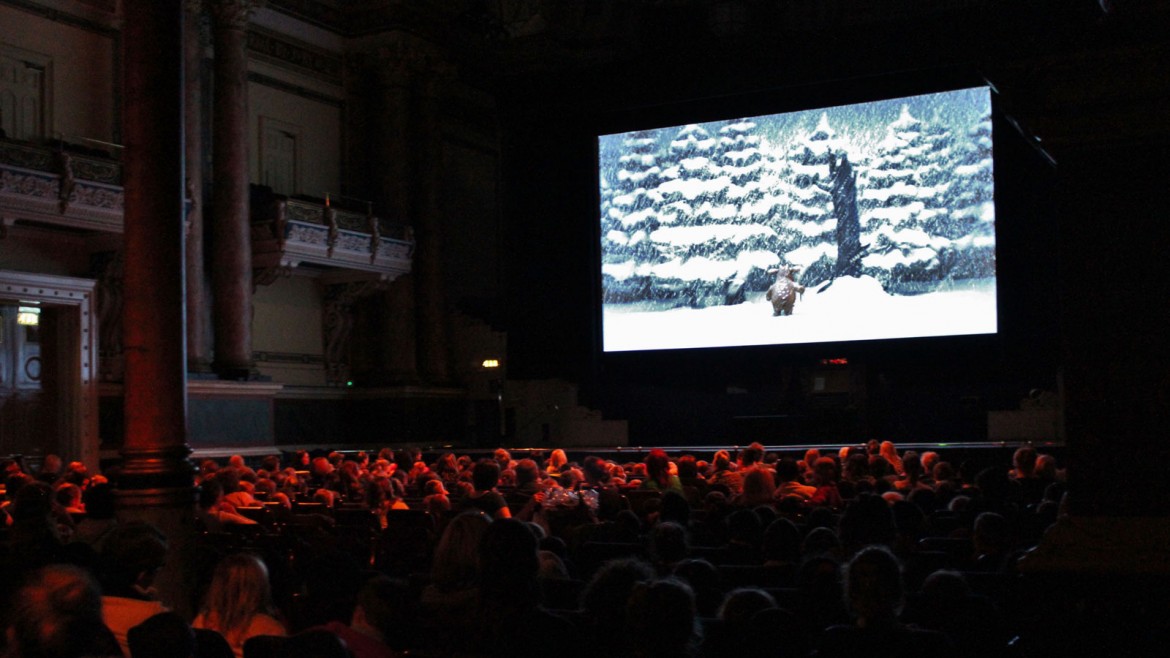
If we compare this to the view point of a spectator of a film in a cinema, it is quite a different experience. The spectator is anonymous and will be sitting in a dark setting amongst many other people. Instead of a static scene with one viewpoint, the spectators viewpoint is constantly changing as the film is edited to keep the viewers attention. Scenes change and viewpoints alter as the cameras move over the film’s duration.

Image result for picture of a full cinema
Fig 2. Inside the cinema [photograph] At https://www.intofilm.org/films/filmlist/38 Accessed 08/12/2019

In the Strand photo, the three children are directly making eye-contact with the spectator. This is common in photography because there is often a tendency for people in real life to pose for a photograph by looking down the lens of the camera. In the cinema the characters on the screen do not look directly at the camera/spectator. In film, apart from documentaries, we are observing a narrative played out before us and if the characters were to look at us it would shatter this illusion.

Of course there are exceptions to this rule! There are several films I have seen where the characters treat the camera as another person. This has been termed ‘breaking the fourth wall’. This imaginary wall keeps the actors from the audience. Rodriguez and Strassberg (2014) state that this might be achieved ‘through characters expressing inner thoughts, acknowledging they’re in a film, or venting to the camera (and in turn, the audience)’. This can be seen as an avant-garde technique or done for comedic value.

In the film ‘Ferris Bueller’s day off’ directed by John Hughes, the main character Ferris (played by Matthew Broderick) breaks the fourth wall by regularly speaking to the camera (audience) as if they were one of his friends. Ferris creates an intimacy with the audience as we are pulled out of anonymity and invited into his experience. This enhances the comedic value of the film as we follow his adventure through one day.

Image result for ferris bueller
Fig 3. Matthew Broderick in Ferris Bueller’s day off (1986) [Film still] At https://www.slashfilm.com/ferris-buellers-day-off-soundtrack/ Accessed 09/12/2019

The 1947 film ‘Lady in the Lake (dir: robert Montgomery), creates a slightly different experience for the viewer when breaking the fourth wall.

http://img36.imageshack.us/img36/1112/clipboard0329.png
Fig 4. Lady in the Lake (1947) [film still] At https://worldscinema.org/2012/03/robert-montgomery-lady-in-the-lake-1947/ Accessed 09/12/2019

The relationship between the characters and the audience is formed as the audience becomes the Private investigator Phillipe Marlowe (played by the films director). Apart from a couple of times when Marlowe is visible narrating to the audience, the audience see the story played out as though they were Marlowe himself. The other characters address the audience as though they were him by looking directly at the camera.

Reflections

It was interesting to reflect upon contemporary technology and how this effects the point of view for the spectator. Modern society is now dominated by mobile phones and tablets. With the invention of mobile phone camera technology and the ‘selfie’ we see a blurring of subject(object) and viewer as individuals now take on both roles.

List of Illustrations

Fig 1. Strand, P. (1954) Milly, John and Jean MacLellan, South Uist, Hebrides [photograph] At Dickson, A . (2016) The New Yorker : Paul S’s Sense of Things https://www.newyorker.com/culture/photo-booth/paul-strands-sense-of-things Accessed 08/12/2019

Fig 2. Inside the cinema [photograph] At https://www.intofilm.org/films/filmlist/38 Accessed 08/12/2019

Fig 3. Matthew Broderick in Ferris Bueller’s day off (1986) [Film still] At https://www.slashfilm.com/ferris-buellers-day-off-soundtrack/ Accessed 09/12/2019

Fig 4. Lady in the Lake (1947) [film still] At https://worldscinema.org/2012/03/robert-montgomery-lady-in-the-lake-1947/ Accessed 09/12/2019

Bibliography

Dickson, A . (2016) Paul Strand’s Sense of Things : The New Yorker 15/04/2016 https://www.newyorker.com/culture/photo-booth/paul-strands-sense-of-things Accessed 08/12/2019

Rodriguez, B & Strassberg, R. (2014) 14 Films That Famously Break the Fourth Wall in Backstage. 24/04/2014 At https://www.backstage.com/magazine/article/films-famously-break-fourth-wall-12051/ Accessed 09/12/2019

Sendyka, R. (2013) Scopic Regimes and Modernity:Hypotyposis in Koczanowicz D. et al (2013) Discussing Modernity, a dialogue with Martin Jay. Amsterdam:Rodopi At https://www.researchgate.net/publication/334805533_SCOPIC_REGIMES_AND_MODERNITY_HYPOTYPOSIS Accessed 12/12/2019

Exercise 2.3

What would count as examples of ‘utter flatness’. List five things an artist might do to exploit the idea. In other words what kind of things might one put on a gallery wall that could pass for an abstract or figurative painting but also reveal themselves to be everyday objects?

In Greenberg’s essay ‘Modernist painting’ (1961), he argued that modern disciplines became more competent by criticising themselves. Disciplines needed to distinguish themselves from each other and this was achieved through self- criticism.

The purity and uniqueness of painting was that it was the only art form to use a flat surface. Modernist painting orientated itself towards emphasising flatness. The tradition of creating an illusion of real life through representation was not attempted, instead artists attempted to draw attention to the fact that viewers were looking at paint on a flat canvas surface. As Greenberg suggested, this flatness could never be a literal flatness but more of an optical flatness.

So, how could an artist exploit the idea of ‘utter flatness’? I will list 5 ways that I have discovered that artists have used and provide examples to show how this has been achieved. In my research, I discovered many methods to exploit ‘utter flatness’ used by artists produced pure abstraction. In relation to the research question I shall highlight instances where artists have created works ‘that could pass for an abstract or figurative painting but also reveal themselves to be everyday objects.’

1.VISIBLE PROCESS

An artist might produce a ‘flat’ painting by displaying to the viewer how the paint has been applied to the canvas. The viewer is aware that paint has been applied to a flat surface and brush/stick/trowel strokes are visible creating texture. Perhaps the most obvious example of being able to see the process of paint applied to a flat surface is in the art of Jackson Pollock.

Number 1, 1948 by Jackson Pollock
Fig 1. Pollock, J (1948) Number 1 [Enamel, Matt and Gloss on Canvas] At https://www.jackson-pollock.org/number-1.jsp#prettyPhoto[image1]/0/ Accessed 03/12/2019

Pollock was an Abstract Expressionist painter who used action and gestures to create his paintings. Jackson removed his canvas from the wall, placed it on the floor and dripped, splattered or dragged paint with sticks in curved non-geometric forms. The paint often hit the canvas from a distance layering string like patterns. In this purely abstract piece of art we are in no doubt that we are looking at paint on a flat surface and that it has been applied with the physical energy and expression of the artist.

2. MASS BLOCKS OF COLOUR

Artists may exploit the idea of ‘utter flatness’ in painting through the use of colour and in particular mass blocks of colour. Still, flat, 2D, stable shapes destroy the illusion of the canvas as a visual window and emphasise its surface. The best example of this can be seen in the art of Abstract Expressionist Mark Rothko.

Mark Rothko, ‘Red on Maroon’ 1959
Fig 2. Rothko, M. (1959) Red on Maroon [Oil on Canvas] At https://www.tate.org.uk/art/artists/mark-rothko-1875 Accessed 03/12/2019

Rothko does not attempt visual representation in his paintings but instead using colour to convey emotional states. Unlike Pollock, Rothko creates flatness by painting still, hazy blocks of pure colour that appear to float on the canvas.

3. DECONSTRUCTING FORM

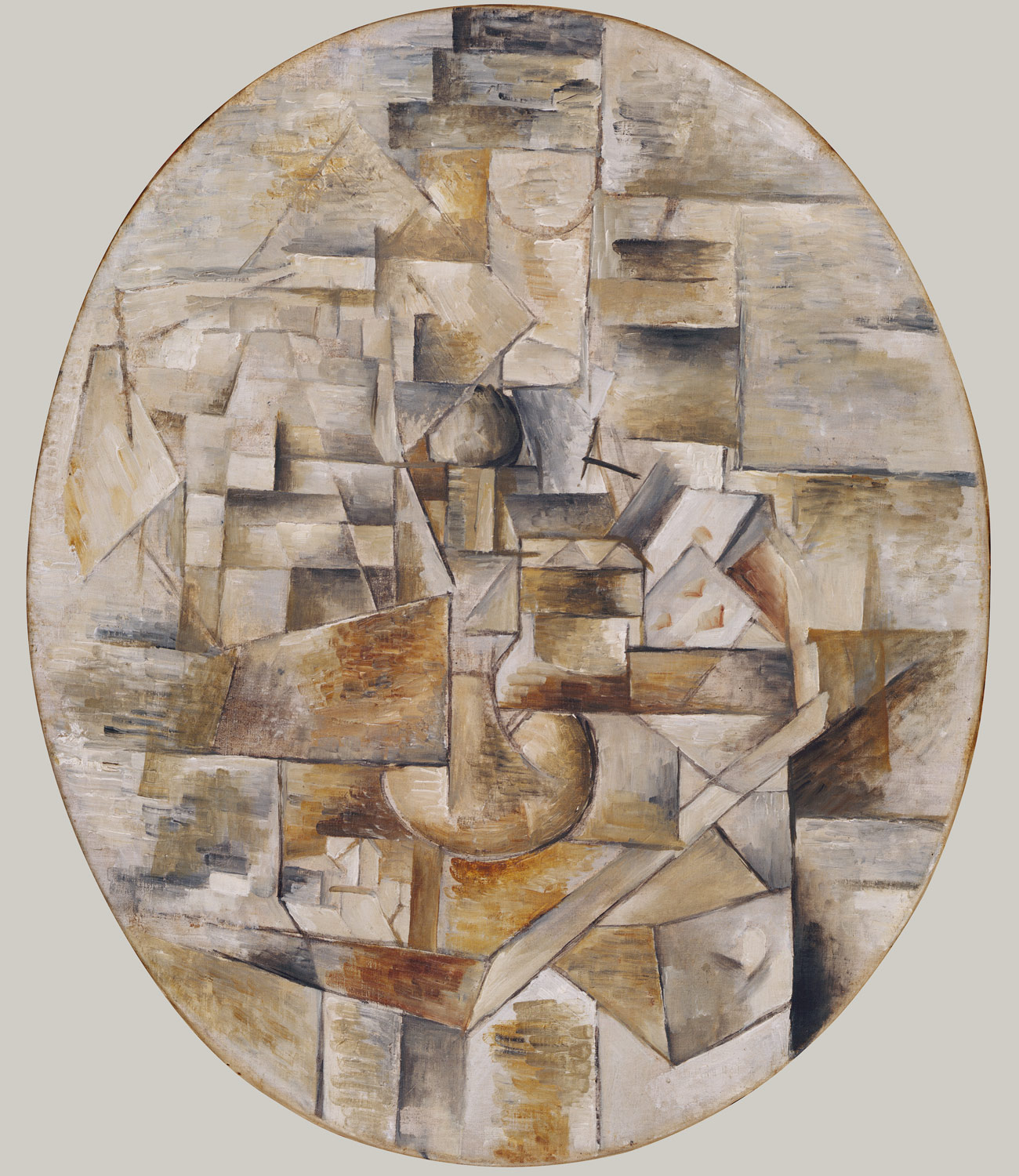
During the early 20th Century artists such as Picasso and Braque developed ‘Cubism’. This style of representing reality broke objects or figures down into distinct planes that showed multiple viewpoints at the same time within the same space. This effect emphasised the flatness of the canvas instead of creating an illusion of depth.

Candlestick and Playing Cards on a Table, 
				ArtistGeorges Braque,Paintings
Fig 3. Braque, G. (1910) Candlestick and playing cards on a table. [Oil on Canva] At https://www.metmuseum.org/toah/works-of-art/1997.149.12/ Accessed 04/12/2019

On first view, Candlestick and playing cards on a table (Braque) looks like a purely flat abstract painting. However, only after reading the title of the painting and looking closer can we start to identify the objects. The candlestick and the table appear fragmented and displayed from multiple viewpoints which creates ‘flatness’ in the painting.

4. SIMPLIFY

To exploit the ‘flatness’ of the canvas, artists could simplify their paintings using simple, geometrical shapes and/or lines using pure colour. The best example’s of paintings that use this method can be found in the minimalist movement. In the 1960’s artist Frank Stella took the idea of emphasising flatness to the extreme.

Image result for stella zambezi
Fig 4. Stella, F. (1959) Zambezi [enamel on canvas] At https://www.sfmoma.org/artwork/2001.542/ Accessed 04/12/2019

In Zambezi, Stella creates an expressionless, symmetrical, geometrical pattern using clean black and white lines. The design emphasises the fact that we are looking at a flat canvas by emphasising the corners and the centre of the rectangle. The gaps between the white stripes (black areas) are of a width that suggests the depth of the canvas and perhaps its distance from the wall (Anderson, 2011).

We can also look at the work of Paul Klee to give examples of how simplification can emphasise the flatness of the canvas. In Castle and Sun, Klee represents real objects through the placement of simple geometric forms.

Castle-and-Sun-by-Paul-Klee
Fig 5. Klee, P. (1928) Castle and Sun [Oil on Canvas] At http://totallyhistory.com/castle-and-sun/ Accessed 04/12/2019

Blocks of pure coloured squares, triangles, rectangles and circles create a mosaic effect. Unlike Stella whose minimalist style is purely patterns, Klee creates a subtle representation of a castle with the sun overhead.

5. EXPLOIT THE SHAPE OF THE CANVAS

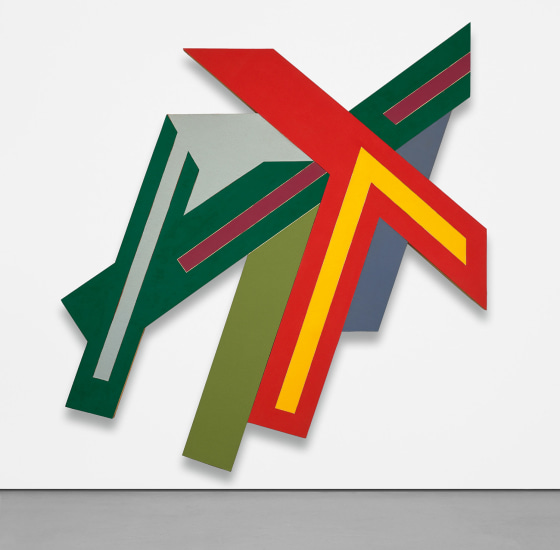
The canvas has a large part to play in creating an optical flatness. Firstly, we can argue that artists can draw attention to the canvas as a flat surface by creating an infinite space that does not have to have a central focal point ( See Fig 1. and Fig 4.). Secondly, Andrew (2012) points out that traditionally artists have the canvas representing a window shape so that we, as viewers, look through it at an 3D image that creates an illusion of representational reality. Artists can break this window effect by altering the shape of the canvas.

Narowla II
Fig 5. Stella, F. (1971) Narowla II [ acrylic, felt, canvas and paper collage on panel] At https://www.phillips.com/detail/frank-stella/NY010619/54 Accessed 04/12/2019

Finally, artists can draw the viewers attention to the rectangular shape of the canvas and it’s flat surface by defining its shape.

Fig 6. Hodgkin H. (1979-1984) Clean Sheets [Oil on wood] At https://www.tate.org.uk/art/artworks/hodgkin-clean-sheets-t06550 Accessed 04/12/2019

In many of Hodgkin’s paintings he emphasises the contours of his abstract paintings. We are in no doubt that we are looking at a flat surface. Rothko also emphasises the contours of the canvas using blocks of shape and horizontal and vertical lines (see Fig 2.)

Reflections

I found this exercise fascinating and enjoyed learning about different movements when undertaking my research. I especially found a series of lectures by Jonathon Andrews very informative as they explored Greenberg’s theories in relation to various art movements. When viewing Modern Art, Andrews advises us to ask the question ‘What does it mean to do this?’ Rather than ‘What does it mean/ What is this picture about?’ which I have now taken under my belt!

List of Illustrations

Fig 1. Pollock, J (1948) Number 1 [Enamel, Matt and Gloss on Canvas] At https://www.jackson-pollock.org/number-1.jsp#prettyPhoto[image1]/0/ Accessed 03/12/2019

Fig 2. Rothko, M. (1959) Red on Maroon [Oil on Canvas] At https://www.tate.org.uk/art/artists/mark-rothko-1875 Accessed 03/12/2019

Fig 3. Braque, G. (1910) Candlestick and playing cards on a table. [Oil on Canva] At https://www.metmuseum.org/toah/works-of-art/1997.149.12/ Accessed 04/12/2019

Fig 4. Stella, F. (1959) Zambezi [enamel on canvas] At https://www.sfmoma.org/artwork/2001.542/ Accessed 04/12/2019

Fig 5. Stella, F. (1971) Narowla II [ acrylic, felt, canvas and paper collage on panel] At https://www.phillips.com/detail/frank-stella/NY010619/54 Accessed 04/12/2019

Fig 6. Hodgkin H. (1979-1984) Clean Sheets [Oil on wood] At https://www.tate.org.uk/art/artworks/hodgkin-clean-sheets-t06550 Accessed 04/12/2019

Bibliography

Anderson, J. (2012) The (spiritual) crisis of Abstract Expressionism: Mark Rothko. [online lecture] At https://www.youtube.com/watch?v=3V1SLKsF0BE Accessed 02/12/2019

Anderson, J. (2012) Postmodern Strategies: The Canvas as an Arena: Jackson Pollock [online lecture]. At https://www.youtube.com/watch?v=k7fodAy0jbU Accessed 02/12/2019

Anderson, J. (2011) The Fully Present Object: Minimalism – Jon Anderson [online lecture]. At https://www.youtube.com/watch?v=RogfryPVWDk Accessed 02/12/2019

Greenberg. C. (1961) Modernist Painting Forum Lectures (Washington, D. C.: Voice of America), 1960. Viewed at http://www.yorku.ca/yamlau/readings/greenberg_modernistPainting.pdf

Joselit, D. (2000) Notes on Surface, Towards a Genealogy of Flatness in Kocur, Z. and Leung, S. (2012) Theory in Contemporary Art since 1985, 2nd Edition. Chichester:John Wiley & Sons, Inc. p102-117

Masterpieces of Jackson Pollock, Number 1, 1948.  Viewed at https://www.jackson-pollock.org/number-1.jsp Accessed 03/12/2019

Tate Art Term – Cubism At https://www.tate.org.uk/art/art-terms/c/cubism Accessed 04/12/2019

Wolf, J. Introduction to Flatness at The Art Story. Viewed at https://www.theartstory.org/definition/flatness/ Accessed 03/12/2019

Exercise 2.2

Describe the features in each of these paintings that you think correspond to Greenberg’s view that kitsch ‘imitates the effects of art’. In other words how has the artist made the painting look artistic – as if for a sophisticated taste.

Chinese girl tretchikoff.jpg
Fig 1. Tretchikoff, V. (1952-3) Chinese Girl’ , [oil on canvas] At https://fineartamerica.com/featured/vladimir-tretchikoffs-the-chinese-girl-the-green-lady-krystal-.html?product=art-print (Accessed 18/11/2019)
Female Painting - Do You Leave Footprints In The Sand? by Andrew Hewkin
Fig 2. Hewkin, A. (2002) ‘Do you leave footprints in the sand?’ [oil on canvas] At http://andrewhewkin.com/index.php/2001-2010/ (Accessed 18/11/2019)

Before examining these two paintings, it is important to understand Greenberg’s meaning of the terms ‘kitsch’ and its opposing counterpart ‘avant-garde.’ The term avant-garde refers to a ‘higher level’ art that keeps culture moving in modernised society by bravely advancing into unknown territory (Greenberg 1939:5). In the art world a small group of avant-garde artists removed subject matter/representation to focus on the medium of the craft in what we may term ‘abstract’ or ‘non-representational’ art. Emphasis was placed on texture, colour, spaces and surfaces. Greenberg states that this type of art is appreciated by the minority – the cultured, educated and intelligent. Avant-garde art is appreciated by the only class with time to appreciate it – the Bourgeois. He argues that the spectator of a Picasso painting, for example, would invest time and effort reflecting on the complex painting to appreciate it. This effort is what distinguishes avant-garde from kitsch.

As a Marxist critic, Greenberg explained kitsch in terms of class and capitalism. As people migrated to urban industrialised areas, they left behind rural and folk culture. The urban masses demanded society provide them with a new culture for consumption. This culture is not a genuine culture but a new ‘lower level’ commodity for the ‘exploited’ and ‘ignorant’ mass poor. (Greenberg, 1936:9-10) The consumption of mass culture kitsch borrows themes, stratagies and tricks from the avant-garde to create a formulaic, fake piece of art. Greenberg states:

‘If the avant-garde imitates the process of art, kitsch we now know, imitates the effects.’ (Greenberg (1936:15)

Kitsch is simple. It is mass-produced, cheap, vulgar, mimics beauty and provides instant gratification for the viewer without any intellectual effort. It is a market- driven profitable commodity.

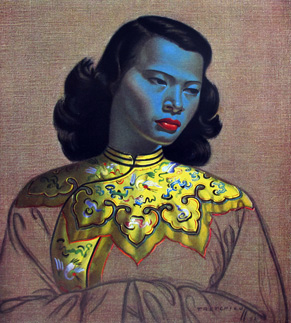
One of the best-selling mass produced prints of the 20th Century was ‘Chinese Girl’ (1952) by Vladimir Tretchikoff.

Chinese girl tretchikoff.jpg
Fig 1. Tretchikoff, V. (1952-3) Chinese Girl’ , [oil on canvas] At https://fineartamerica.com/featured/vladimir-tretchikoffs-the-chinese-girl-the-green-lady-krystal-.html?product=art-print (Accessed 18/11/2019)

Despite this it has been described harshly ‘arguably the most unpleasant work of art to be published in the 20th Century’ (Feaver, cited in Bell 2013 ‘Brilliant trechnicolour or trashicolour’ (Gorelich 2013:106). The painting shows a portrait of a Chinese girl, dressed in a part finished golden dress. Her make up and hair resemble 1950’s glamour and her face glows an unusual blue colour. The background is left unpainted.

So, what features in ‘Chinese Girl’ correspond to Greenberg’s view that kitsch ‘imitates the effects of art’?

The painting is representational. The viewer has to expend no effort interpreting the content or understanding meaning. We are presented with a portrait that uses bright striking contrasting colours. These colours heighten reality and create a more dramatic and artificial image. Freemantle, in her essay on South African icons, states that the image is very similar to 1950’s glamour photography and uses graphic and advertising techniques of high detail and loose drawing. The application of bright paint and the style of oriental mixed with 1950’s style glamour creates more of a ‘garish’ and tacky representation (Freemantle 1998: 95-96). The unfinished look of the painting with the unpainted background and dress attempt sophistication and draw the viewers gaze to the blue face. It is uncertain why the girl’s face is blue but it certainly makes the face more visible against the background.

The portrait is an unusual yet intimate representation of idealised feminine youth. She is close up and engaged with the viewer. The painting is sensual and dramatic and provides instant gratification as the girl can be seen as an exotic, romantic character, as if in a story. Sentimentality and emotion are invoked by her mysterious, sullen pose and the strong tonal contrasts used by the artist. There is a sense of falseness to these emotions though as they are easily evoked and easily forgotten.

If we examine Andrew Hewkin’s painting ‘Do you leave footprints in the sand’, we can see features similar to ‘Chinese Girl’ that correspond to Greenberg’s view that kitsch ‘imitates the effects of art’.

Female Painting - Do You Leave Footprints In The Sand? by Andrew Hewkin
Fig 2. Hewkin, A. (2002) ‘Do you leave footprints in the sand?’ [oil on canvas] At http://andrewhewkin.com/index.php/2001-2010/ (Accessed 18/11/2019)

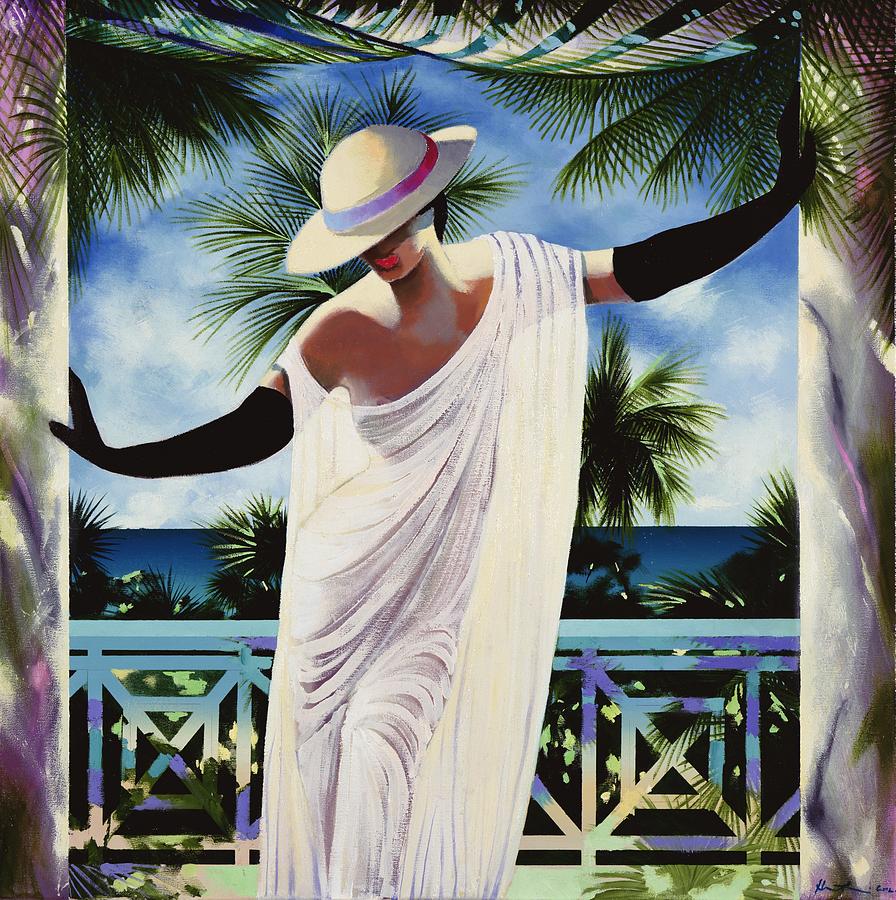
This 21st Century painting does look very ‘kitsch’ and reminds me of posters that were sold in the 1980’s in the Athena shop. A woman poses between two marble pillars on a balcony above palm trees next to the sea. She poses evocatively in loose fitting white clothing that is illuminated by the sun and gives it almost a holy or magical effect.

As Hewkin’s painting is a representational image the viewer again is not required to put in any effort understanding meaning – everything is visually there and recognisable. The viewer can be transported to an idyllic scene that may evoke memories or a desire to be somewhere else. The woman looks sophisticated with her clothing and gloves and acts mysteriously by looking down and hiding her eyes under the rim of the hat. The whole scene looks luxurious with the female figure framed by the marble. In terms of composition, strong horizontal and vertical lines are broken up by the central figure that is full of curves and diagonals which keeps the viewer focused.

The colours used create an artificial feel due to the use of strong blues and greens. I would say that it feels as though Hewkin has used graphic design techniques to create an ‘unreal’ and simple effect through his composition choice and use of colour. None of this feels natural as it promotes an ‘idealised’ version of beauty in female form and in the surroundings she occupies.

In both paintings I feel that everything has been exaggerated – (colour, fashion, pose, composition) to allow the maximum experience and effect whilst giving minimal effort.

Reflection

Clement’s theory of Avant-garde and kitsch has given me lots to think about particularly in contemporary art and I would question whether ‘kitsch’ necessarily has to belong to the masses. If we look at artists such as Jeff Koons and some of his sculptures, for example Michael Jackson and Bubbles, we can absolutely describe them as ‘kitsch’, tacky and cheap looking. In a way, the artist has almost exploited the idea of kitsch in a new way. However, Koons has not mass produced his work and it sells exclusively to wealthy art collectors at a high price. We can also look at the rise of modern art galleries that are now accessible to the masses as part of the consumer culture of experience. Previously exclusive ‘avante-garde’ artists now receive a wider viewing across a more diverse mass audience. Greenberg wrote this essay during the 1930’s and focused on abstract art as ‘avante-garde’. Since then, modern art has seen many art movements that have moved bravely into the unknown and could be seen as venturing into new territories.

List of Illustrations

Fig 1. Tretchikoff, V. (1952-3) Chinese Girl’ , [oil on canvas] At https://fineartamerica.com/featured/vladimir-tretchikoffs-the-chinese-girl-the-green-lady-krystal-.html?product=art-print (Accessed 18/11/2019)

Fig 2. Hewkin, A. (2002) ‘Do you leave footprints in the sand?’ [oil on canvas] At http://andrewhewkin.com/index.php/2001-2010/ (Accessed 18/11/2019)

Bibliography

Bell, M. (03/2013) Chinese Girl: the Mona Lisa of kitsch. In The Independent 17/03/2013 (Accessed 18/11/2019)

Freemantle, B. (2018) A Pantheon of icons: towards a South African iconology ‘viewed at: http://wiredspace.wits.ac.za/handle/10539/25904 (Accessed 18/11/2019)

Greenberg, C. (1939) Avant-garde and kitsch. At http://sites.uci.edu/form/files/2015/01/Greenberg-Clement-Avant-Garde-and-Kitsch-copy.pdf (Accessed 18/11/2019)

Harrison, C. (1996) Modernism in Nelson, Robert, S. and Shiff, Richard. ‘Critical term for art history’, (1996) University of Chicago Press.

Jon Anderson Lecture on Clement Greenberg’s Subject v Medium Debate in Modernism -You tube viewed at:

Exercise 2.1

Make your own copy of Barr’s chart ad extend it to the year 2000 by including movements such as Pop Art. In a separate column list major events in politics and culture that you think have had some bearing on the kind of art practiced at the time.

Image result for cubism barr
Fig 1. Barr, A. H (1936) Cubism and Abstract Art flow chart .At https://www.moma.org/collection/works/81386 (Accessed 16/11/10)
Fig 2. Jobson L. (2019) Copy and extension of Barr’s flow chart to the year 2000. [photograph] by author.

I found this exercise really interesting because it helped me to break down the post-modern period after 1970. It was useful to see how these modern movements have been influenced by prior art movements. However, sometimes this wasn’t always clear cut, with artists being influenced by many different movements.

The events throughout the century that I felt influenced artists and provoked new ideas, thoughts and creativity in the art world are listed on the left-hand side. I believed that the wars in the 20th Century affected the collective consciousness of the generations affected, none more so than the 1st world war. A hopeful and optimistic society that believed it would be improved by the introduction of machines was decimated by a war that wiped out a generation of young men with machines that maimed and killed in horrific circumstances. The Futurists celebrated the rise of the machine prior to WW1 wheras the aftermath gave rise to the Dadaists who reacted to the horror and devastation.

I also felt that Political and Social perspective heavily influenced the development of different art groups. The extreme rise of left (Socialist) and right (Fascist) parties and regimes throughout the 20th Century encouraged protest art and also art movements that were developed for the use of propoganda (For example Socialst Realism). The treatment and attitude towards various groups within certain societies has also influenced artists. Black citizens of USA during the 1960’s gave rise to the AfriCOBRA movement in Chicago that tried to empower it’s black citizens. The Guerilla girls of the 1980’s created protest Feminist art in response to the gender inequalities within the art world.

A rise in consumer and commercial culture had also influenced art through the 20th Century. This can be seen through the increase of Land art in the 1960’s and the rise of the counter-culture in the 1970. Perhaps the most influential development of consumer/commercial culture on modern art has been the development of computer technology and the rise of the internet allowing for a variety of new forms of Digital art.

List of Illustrations

Fig 1. Barr, A. H (1936) Cubism and Abstract Art flow chart .At https://www.moma.org/collection/works/81386 (Accessed 16/11/10)

Fig 2. Jobson L. (2019) Copy and extension of Barr’s flow chart to the year 2000. [photograph] by author.

Bibliography

Art terms at https://www.tate.org.uk

Barr, A.H (1936) Cubism and Abstract art . New York:Moma. At https://www.moma.org/documents/moma_catalogue_2748_300086869.pdf (Accessed 20/10/2019)

http://www.visual-arts-cork.com/contemporary-art-movements (Accessed 20/10/2019)

New Leipzig School at https://www.artsy.net/gene/new-leipzig-school (Accessed 20/10/2019)

Design a site like this with WordPress.com
Get started