Exercise 4.3

In your own words (one brief paragraph) say why you think creation and affirmation are linked here.

According to Deleuze, all things (sensations, animals, ideas) are creations in their own right and ‘not merely an account of their interactions with other things.’ (Hallward, 2006,1) They are all connected and yet no two things are the same. Therefore difference is creation. Difference, in an everyday sense focuses on the positive and the negatives between two things or oppositions (Williams, 2003:60-61). For example, one black cat has blue eyes and the other has brown (negative) and everything else is the same (positive). However, we do not have to see things as contrasting or in contradiction positively or negatively instead we can view difference as creation as affirmative (Belshaw, 2016:104).

Creation is the energy of transformation.It allows for continuous differentiation, mutation and change. To affirm creation and being allows for an ‘inexhaustible source of pure potential or transformation’ (Hallward,2006,37).

Bibliography

Belshaw, M. (2016) OCA UVC coursebook Barnsley

https://www.merriam-webster.com/dictionary/affirmative (Accessed 11/05/2020)

Leucrezia (2014) Deleuze, Active Nihilism & Revolt At https://theanarchistlibrary.org/library/lucrezia-deleuze-active-nihilism-revolt (Accessed 11/05/2020)

Smith, D. (2008) Gilles Deleuze Stanford Enclyclopedia of philosophy 23/5/08 Accessed at https://plato.stanford.edu/entries/deleuze/ (Accessed 11/05/2020)

Williams, J.(2003) Gilles Deleuze’s Difference and Repitition A critical introduction and guide Edinburgh University Press

Exercise 4.2

Read the text of Newman’s essay in Art in Theory and write a short summary (200 words).

In the essay ‘The first man was an artist’ (1947) by Barnett Newman, Newman argues that the original man was born an artist and poet as opposed to a social animal. Man’s first experience was aesthetic and his speech was ‘a poetic outcry’ rather than a need for communication. His first cry was a song and his address to a neighbour was a cry not a request. Men built idols out of mud before they built axes or pottery – the manual products of civilisation.

Newman prioritises the aesthetic over the social. The first humans were ‘artists before they were hunters, storytellers before scientists.’ The creative mind came before utilitarian instincts in a desire to find meaning/truth in the world (Kirkpatrick, 2010). Newman references Christianity and suggests that in the Genesis, Adam sought a creative life by eating from the tree. He wanted to be a creator like God but as a punishment he was reduced to a life of toil.

The fall of man is due to our inability to live the ‘life of a creator’. Artists today strive for a closer approach to the truth concerning the original man. They are driven to be a painter and poet in our natural human state, in defiance of scientific reasoning which restricts creativity and holds us back (Kirkpatrick, 2010).

Reflections

At the heart of Newman’s essay is the fact that the creative human is a natural state of being that we all have. All children will draw freely and without inhibition but, as we grow older, a society based on science and reasoning blocks and stunts this creative outlet. Artists, poets, writers and musicians all strive to release that pure creativity that we seem to have lost.

Bibliography

Kirkpatrick, M. (2010) Review of the First Man was An Artist http://mattkirkpatrick.blogspot.com/2010/03/review-of-newman.html (accessed 02/05/2020)

Newman, B. (1947) The first man was an artist from Tiger’s Eye (New York) No.1 (October 1947)pp.59-60 At http://theoria.art-zoo.com/the-first-man-was-an-artist-barnett-newman/ (Accessed 02/05/2020)

https://www.theartstory.org/artist/newman-barnett/life-and-legacy/ (Accessed 02/05/2020)

Exercise 4.1

Look again at Alfred Barr’s chart for Cubism and Abstract Art and say briefly how it might be understood as information in a system. Briefly compare it to Minard’s map.

La bitácora de AAT: 2019
Fig 1. Alfred Barr’s chart for cubism and abstract art (1936) At
https://www.pinterest.co.uk/pin/85357355408219226/ (Accessed 26/04/2020)

Information has been described by Gregory Bateson (1972) as ‘a difference that makes a difference’. Information needs to be seen within a system or as a product of the system. A system can be described as ‘a set of things working together as parts of a mechanism or an interconnecting network; a complex whole.‘ (Oxford online dictionary) If we view these ‘things’ as parts carrying information, they can be seen as systems in themselves composed of further parts or as part of an ever widening set of systems.

Barrs’ cubism and abstract art chart can be viewed holistically as visually representing information in a system. The parts carrying information can be seen as the different art movements with some indication of artists and locations within the movements. The system is supported by a vertical directional flow of the dates between 1890 and 1935. Arrows indicate when initial change is triggered (difference) and new parts carrying different information (new movement) are created. The flow of the information system through time allows us to gain insights into how early 20th Century art movements interconnected, evolved and triggered new movements.

Minard’s Map

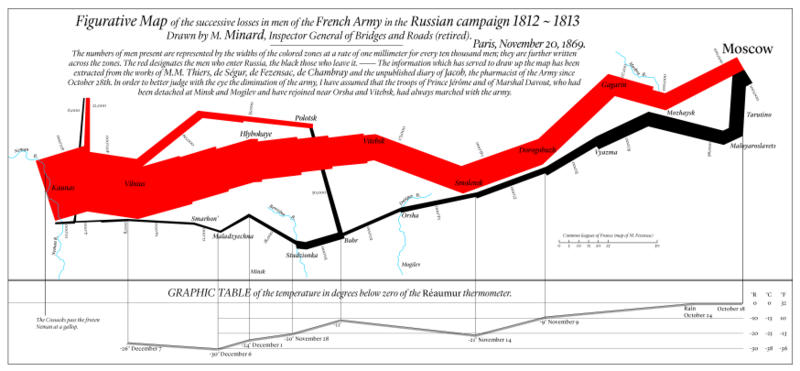
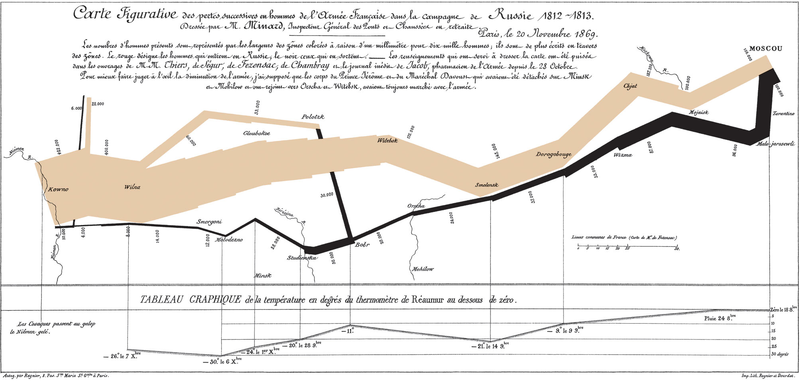
Fig 2. Charles Minard’s map of Napolean’s Russian campaign of 1812.At https://en.wikipedia.org/wiki/Charles_Joseph_Minard (Accessed 26/04/2020)
Fig 3. Modern redrawing of Charles Joseph Minard’s figurative map of the 1812 French invasion of Russia, including a table of temperatures converting degrees Reaumur to degrees Fahrenheit and Celsius. At https://en.wikipedia.org/wiki/Charles_Joseph_Minard (Accessed 26/04/2020) 

Fig 2. shows a map by Charles Minard representing information based upon Napoleon’s invasion of Russia in 1812. It can also be seen as a system of information, however it carries a lot more information than Barr’s chart in a very simple visual format. Barr’s system provides information regarding art movements, dates and locations all flowing in one vertical direction and interconnected via arrows. Minard’s map indicates the number of troops, location, dates, distance and direction travelled, as well as the temperature. The number of troops moving towards Russia are indicated through the width of the beige band (1mm for 10,000 men) and the number of troops retreating from Russia through the width of the black band. In a second’s glance, we are instantly able to detect the disastrous losses of Napolean’s troops on this campaign.

Similar to Barr, Minard’s information flows but instead of a vertical flow we have a horizontal flow and are viewing the information as if from above. Minard’s information system is highly complex due to the amount of interacting parts but Minard manages to display this system of information in a very simple and easily digestible manner.

List of illustrations

Fig 1. Alfred Barr’s chart for cubism and abstract art (1936) At
https://www.pinterest.co.uk/pin/85357355408219226/ (Accessed 26/04/2020)

Fig 2. Charles Minard’s map of Napolean’s Russian campaign of 1812.At https://en.wikipedia.org/wiki/Charles_Joseph_Minard (Accessed 26/04/2020)

Fig 3. Modern redrawing of Charles Joseph Minard’s figurative map of the 1812 French invasion of Russia, including a table of temperatures converting degrees Reaumur to degrees Fahrenheit and Celsius. At https://en.wikipedia.org/wiki/Charles_Joseph_Minard (Accessed 26/04/2020) 

Bibliography

Gregory Bateson 1904- 1980 The Information Philosopher At https://www.informationphilosopher.com/solutions/scientists/bateson/ (Accessed 16/04/2020)

https://en.wikipedia.org/wiki/Charles_Joseph_Minard (Accessed 16/04/2020)

Schroeder, M. (2017) The Difference that Makes a Difference for the
Conceptualization of Information
MDPI, Basel, Switzerland. At https://www.researchgate.net/publication/318740201_The_Difference_That_Makes_a_Difference_for_the_Conceptualization_of_Information (Accessed 12/07/2020)

Exercise 4.0

Look at the two paintings [below] and account for their similarities and differences in three columns – one for each artist – Millet and Van Gogh – either side of a column for similarities. Indicate the differences by underlining the appropriate description in the outer columns.

The Sower, 1850 - Jean-Francois Millet - WikiArt.org
Fig 1. Millet, J-F. (1850) The Sower [oil on canvas]
At https://www.wikiart.org/en/jean-francois-millet/the-sower-1850 (Accessed 23/04/2020)
The Sower (after Millet), 1889 - Vincent van Gogh - WikiArt.org
Fig 2. Van Gogh, V. (1889) The Sower (After Millet) [oil on canvas] At
https://www.wikiart.org/en/vincent-van-gogh/sower-after-millet-1889 (Accessed 23/04/2020)
Millet, The Sower (1850) Similarities Van Gogh , The Sower (1889)
Realistic and symbolic
painting.

Dark, heavy and strong presence of the sower.

Strong use of primary
colours against
natural earth tones.

Strong shadows,
especially
over the sower’s face.

The sower has
elongated limbs
and exaggerated
muscles suggesting strength

The human body is
portrayed as strong and
‘machine like’.

Crows in the
background, perhaps undoing the
sower’s efforts.

Millet caused controversy and criticism
when this painting
appeared in the
Paris salon 1850
due to the
heroic representation
of peasant life.

The sower (peasant)
dominates the canvas.

Both artists capture
the movement and spirit
of the sower as he works.


The sower can be seen
as a symbol for the
cycle of life, growth and harvest.

Viewer is given a low viewpoint.

Radiant and dominant complimentary
colours. (yellow and blue/purple.)

Visible diagonal brushstrokes.

Thickly applied paint.

Post- impressionist – spontaneous.

No visible crows in the background, but the
seeds are more visible.

Light, physical presence of the sower.

Visible face of sower.
.

Reflections

Comparing and contrasting the two different versions of ‘the sower’ was a really interesting exercise. Millet’s sower creates a heavier atmosphere with his immense physical strength – almost like a strong farm animal going about his work. Van Gogh’s on the other hand, doesn’t appear as strong and the style of painting creates a lighter atmosphere. Both paintings are celebrating peasant life – portraying the sower as part of the natural seasonal cycle of life. This was a controversial subject matter at the time and not something art collectors wanted.

List of Illustrations

Fig 1. Millet, J-F. (1850) The Sower [oil on canvas]
At https://www.wikiart.org/en/jean-francois-millet/the-sower-1850 (Accessed 23/04/2020)

Fig 2. Van Gogh, V. (1889) The Sower (After Millet) [oil on canvas] At
https://www.wikiart.org/en/vincent-van-gogh/sower-after-millet-1889 (Accessed 23/04/2020)

Bibliography

https://www.vangoghmuseum.nl/en/collection/d0443V1962

https://www.wikiart.org/en/jean-francois-millet/the-sower-1850

Jean-François Millet Artworks The Art Story At https://www.theartstory.org/artist/millet-jean-francois/artworks/ (Accessed 23/04/2020)

Reflections on Part 3

Part 3 was a real challenge and made me question a lot of my perceptions of reality. The post modern theoretical content was much more difficult to digest and I feel that it still might take a while for me to completely get to grips with it. I thoroughly enjoyed looking at art works and applying theories especially when exploring metapictures and Rachel Whiteread’s sculpture ‘house’. Assignment 3 was very informative. I had never examined Plato’s allegory of the cave before and was surprised that it could be applied to many different things. It feels like a timeless observation of human culture and feels particularly relevant in the political climate of today. I did feel that the word count was very low for the subject matter and could have written lots more about this subject. I have experimented more with some ideas in my sketchbook. I have particularly enjoyed taking an image and changing it through different mediums and PC apps.

Sketchbook example :Maple leaf [digital print]

Demonstration of subject based knowledge and understanding

I undertook a lot of reading to understand the concepts in this section of the course. Compared to modernist theory, there was a lot more to comprehend and interpret. I initially struggled with some of these concepts, especially those of Baudrillard, but feel that I have interpreted them well within my writing. I found Assignment 3 to be particularly interesting in stretching my imagination. It allowed me to express and apply theoretical knowledge to the contemporary world through the allegory.

Demonstration of Research Skills

Due to the nature of this section of this course, I felt as though there was a lot of research to undertake. I often found that I was reading far too much around a subject, but then was able to refer back to that research at a later point. I am confident at quoting relevant parts of research to support my writing and have become better at finding alternative viewpoints to balance an answer to a question.

Demonstration of critical and evaluation skills

I feel that the strength of my critical and evaluation skills are growing. I spend a lot of time thinking around a subject to help me fully understand it and gain a deeper perspective . I can evaluate information, theories and views and allow them to inform and shape my own growing perspective. I have started to be more confident expressing my own opinions and thoughts as well as those of others.

Communication

Sometimes my thoughts are difficult to put into words and I therefore spend a lot of time editing my work. I also often feel that sometimes my thoughts and organisation can become somewhat muddled. I have tried especially hard in Part 3 to rectify this through organising my notes in a coherent way. I have used subtitles in Assignment 3 to try to organise what was a very wide subject, as per advice from my tutor, to assist me.

Exercise 3.9

In what sense is Whiteread’s ‘House’ indexical and why does this matter for an interpretation of this work? Would someone overlooking this feature be wrong or would that simply be a different interpretation?

‘House’ was created by British artist Rachel Whiteread between the months of August and October 1993. It is a cast of a South East derelict London archetypal Victorian terrace surrounded by parkland. The original house had been left standing independently after surrounding tower blocks had been demolished by the local council.

Fig 1. The derelict Victorian house at Grove Road in South East London that was to provide Whiteread with a model to cast. (1993) At https://thefunambulist.net/arts/unwall-rachel-whiteread Accessed (02/04/2020)

To create her cast of the house, Whiteread and her team boarded up windows, dug new foundations for support, removed internal fixtures and sprayed the entire interior with white concrete. Finally, the exterior building materials of the house were removed leaving only the external white concrete cast visible (Bois et al. 2004:634).

Ghost House: 20 years since Rachel Whiteread's 'House' | Apollo ...
Fig 2. Whiteread, R. (1993) House [concrete] Photo Sue Omerod At https://www.apollo-magazine.com/house/ (Accessed 02/04/2020)

In what sense is this sculpture indexical and why is this important when interpreting ‘House’. A work of art operates like a sign. By referring to Charles Pierce’s theory of signs (1867-8), we can focus attention on the reference that the sign makes to an object other that itself. The signifier (or the representamen) refers to the object. Pierce maintains that the meaning of the object is created in the mind of the interpretant (Plato Stanford online. Accessed 02/04/2020)

Charles S. Pierce - Language, Linguistic code, and Speech ...
Fig 3. Pierce’s triadic semiotics model At https://languagelinguisticcodeandspeech.weebly.com/char (Acles-s-pierce.html (Accessed 02/04/2020)

Pierce identified three types of sign:

1. Icon – physical resemblance(picture or image).

2. Index – direct relation with causal link (e.g smoke is index of fire).

3 Symbol – no relation between the signified and signifier and usually socially construted/learned (traffic lights)

The indexical sign refers to marks, imprints and casts that are affects of which a process is the cause. There is a direct relation between the sign and the object and the interprentant is essential in making sense of this. For example, smoke is an indexical sign of fire (Chandler 2017).

Whiteread’s ‘House’ acts as an indexcial sign. It was a cast of a house intentionally made from sprayed concrete. Whiteread created a ‘building within a building… hardened space into mass.’ (Whiteread, 1993). The house became a concrete hardened block with no way in. Negative and invisible space had become visible. It is then for the interpretant to define meaning and understand the direct relation between the sign (cast) and the object (concept/meaning)

If we were to imagine footprints in the sand, we would associate the imprint with the concept of a human or animal having previously walked there. We can apply the same interpretation to ‘house’. An impression has been left by the construction of a temporal human habitat (the house). It draws attention to the lives lived within that now visible ‘space’.

“You live and breathe beneath the skin of the house and we’re like these little animals that have been gnawing away at the surface.” (Whiteread, 1993)

“I wanted to mummify the air in the room, stopping time, marking time. Materials that solidify. holding space, filling something up.’ (Whiteread, 2017

The ‘house’ sculpture became a sign for social home life, and in this case working class home life. ‘A mute memorial to everyday lives, opposing the transience and banality of our existence’. (Fullerton 2016:129)

The sculpture draws attention to the spaces we inhabit and how these spaces are temporal. The transient nature of these structures was highlighted when ‘house was demolished by bulldozers 80 days after its construction. Wiped away in moments, like footprints in the sand washed away by the waves.

Someone overlooking the work of art as an indexical sign would not necessarily be wrong. There are many ways to interpret art and semiotics is just one of them. The interpretant may approach the object without seeing the ‘sign’ and understand the work of art in a different way. There may be concepts relating to social inequality or concepts relating to gender and women based in the home during the 20th Century. Perhaps it is telling of a successful art work that enables the viewer to interprate the work in multiple ways.

List of Illustrations

Fig 1. The derelict Victorian house at Grove Road in South East London that was to provide Whiteread with a model to cast. (1993) At https://thefunambulist.net/arts/unwall-rachel-whiteread Accessed (02/04/2020)

Fig 2. Whiteread, R. (1993) House [concrete] Photo Sue Omerod At https://www.apollo-magazine.com/house/ (Accessed 02/04/2020)

Fig 3. Pierce’s triadic semiotics model At https://languagelinguisticcodeandspeech.weebly.com/char (Acles-s-pierce.html (Accessed 02/04/2020)

Bibliography

Bois, Y. A, (2004) with B. Buchloch, H. Foster, R. Krauss, Art since 1900. London and New York, Thames and Hudson (Accessed 02/04/2020)

Chandler, D. (2017) Semiotics for Beginners At http://visual-memory.co.uk/daniel/Documents/S4B/sem02.html?LMCL=oB0il4 (Accessed 02/04/2020)

Fullerton, E. (2016) Artrage:the story of the Britart revolution London, Thames and Hudson (Accessed 02/04/2020)

House, Rachel Whiteread documentary Artangel (1993) At https://www.youtube.com/watch?v=ZVueGlKQTE8 (Accessed 02/04/2020)

The eye. Rachel Whiteread – House illuminations media At https://www.youtube.com/watch?v=MEtsYIIIfkw(Accessed 02/04/2020)

Exercise 3.8

What does it mean to say nature is culture? Can there be one without the other? What would it be like? Look up the term ‘binary opposition’ – does this apply to nature and culture? Write this in 3 paragraphs. For, against and a conclusion.

What does it mean to say nature is culture?

To understand what it might mean to say ‘nature is culture’ it is important to understand the definition of both these terms. We can take the first definition of each word to be relevant for this discussion. The Cambridge English Dictionary (online) defines culture as:

‘The way of life, especially the general customs and beliefs, of a particular group of people.’

In terms of art, the definition of culture refers to specific disciplines such as ‘music, art, theatre and literature.’

The Oxford dictionary(online) defines nature as:

  1. The phenomena of the physical world collectively, including plants, animals, the landscape and other features and products of the earth as opposed to humans or human creations.
  2. The basic or inherent features , character or qualities of something.

So how can we say that nature (the physical world excluding humans) is culture (the way of life for a group of people)?

It is interesting that for all definitions of ‘nature’, human beings are excluded. There is a tendency for human beings to be perceived as separate from nature or the natural world. One can go for a walk in nature or explore the natural environment but as an outsider and not as a part of that world. Since Darwin’s theory of evolution, it has become widely accepted (apart from some religions) that humans are mammals in the animal kingdom and that we have evolved throughout history alongside other species of life. What we are experiencing is a detachment or estrangement from nature and perhaps if humans were included in the definition of nature we would have a better understanding of what it means to say that ‘nature is culture’.

Assuming that humans are perceived to be part of the natural world, we can start to look at human culture as part of nature. Cultural evolutionary theorists argue that the capacity for culture emerged naturally as part of human evolution (Lewens, 2017). The existence of culture is reliant on humans living in social groups, reinforcing agreed beliefs and customs that are passed down from generation to generation through genetics, social learning and imitation in a unified process (Bloch, 2012 cited in Lewens, 2017). Richerson and Boyd (2005) states that culture is :

‘.. information capable of affecting individuals behaviour that is acquired from other members of their species through teaching, imitation and other forms of social learning.’ (Richerson and Boyd 2005 cited in Lewens 2017)

Human cultures have been able to develop to an advanced level and beyond anything capable of other species.

We can only view ‘nature as culture’ and vice versa if we are to include humans in the broader definition of ‘nature’. Human beings are animals within nature’s animal kingdom and it is only our cultural perception that detaches ourselves from it.. Culture has evolved naturally with human evolution and could therefore be viewed as part of nature expressed and experienced by the behaviour of the human species.

Can there be one without the other? What would it be like?

Culture is a way of life of a particular group of people and thus only exists within the world of human beings. If there were no humans then there would be no culture and nature would therefore continue regardless. Nature without a culture that lived in harmony with nature (prehistoric, tribal, aboriginal) would look the same.

Nature without modern capitalist global culture would look completely different. It would be flourishing, unpolluted and other species would be thriving as opposed to being endangered.

Culture without nature would be impossible if we accept that humans and our culture are a part of nature. However, if we were to accept the general definition of nature that excludes humans from nature then we could (at a stretch!) see a culture existing without nature. This could be some future culture that exists in a purely mechanical and artificial world perhaps after the planet has been destroyed.

Look up the term ‘binary opposition’ – does this apply to nature and culture? Write this in 3 paragraphs. For, against and a conclusion.

The online Oxford Reference defines binary oppostion as:

‘A pair of mutually-exclusive signifiers in a paradigm set representing categories which are logically opposed and which together define a complete universe of discourse: for example, alive or dead. In such oppositions each term necessarily implies its opposite and there is no middle ground.’ (httpRs://www.oxfordreference.com/)

Nature and culture in binary opposition

Nature and culture can be seen as being in binary opposition to one another. Cambridge Dictionary (online) defines nature as ‘the physical world collectively, including plants, animals, the landscape and other features and products of the earth as opposed to humans’. Culture exists independently within the realm of the human species. It is a product of social learning that is passed down from generation to generation (Richerson & Boyd 2005 cited in Lewens 2017). This contradiction between culture and the physical world of nature is due to the fact that from the first emerging societies, humans have consciously determined their own history (culture) whereas animals take part in their own history without knowledge or desire (nature) (Engels, 1883 cited in Silvius s.d.). Freud would argue that natural human instincts have been suppressed to allow for cultural development and that this has detached or put us in opposition from nature (Freud cited in Silvius s.d).

Nature and culture are not in binary opposition

It can be argued that nature and culture are not in opposition to one another. As discussed above, the human species has evolved on earth as part of natural evolution within the animal kingdom. Culture has developed as humans have evolved to live in larger social groups. Although the development of culture allows for the manipulation of the natural environment, this is no different to beavers or elephants but is perhaps on a larger scale. Human culture is reliant and intertwined with nature for survival.

Conclusion

To determine whether nature and culture are in binary opposition is a matter open for debate. This would depend on whether you believed that humans and culture are part of nature or whether, like John Searle, you believe that the world is separated into the realms of nature and humans. It might be relevant to note that nature is defined by human culture and can therefore be defined by different cultures in different ways.

Bibliography

https://dictionary.cambridge.org/dictionary/english/culture (Accessed 30.03.2020)

https://www.lexico.com/definition/nature (Accessed 30.03.2020)

https://www.oxfordreference.com/view/10.1093/oi/authority.20110803095506296 (Accessed 30.03.2020)

Lewens, T. (2017) Human nature, human culture: the case of cultural evolution The Royal Society Publishing 18.08.2017 At https://royalsocietypublishing.org/doi/10.1098/rsfs.2017.0018 (Accessed 30.03.2020)

Rothman, J. (2014) The Meaning of Culture The New Yorker 26.12.2014 At https://www.newyorker.com/books/joshua-rothman/meaning-culture (Accessed 30/03/2020)

Silvius, J (s.d.) Man and Nature, Part III: An Excursus into the Structuralist Opposition of Nature and Culture At The Charnel House – from Bauhaus to Beinhaus At https://thecharnelhouse.org/2011/03/24/man-and-nature-part-iii-an-excursus-into-the-structuralist-opposition-of-nature-and-culture/ (Accessed 30/03/2020)

Exercise 3.7

Write a paragraph on a single work by Koons according to what you understand of the simulacrum.

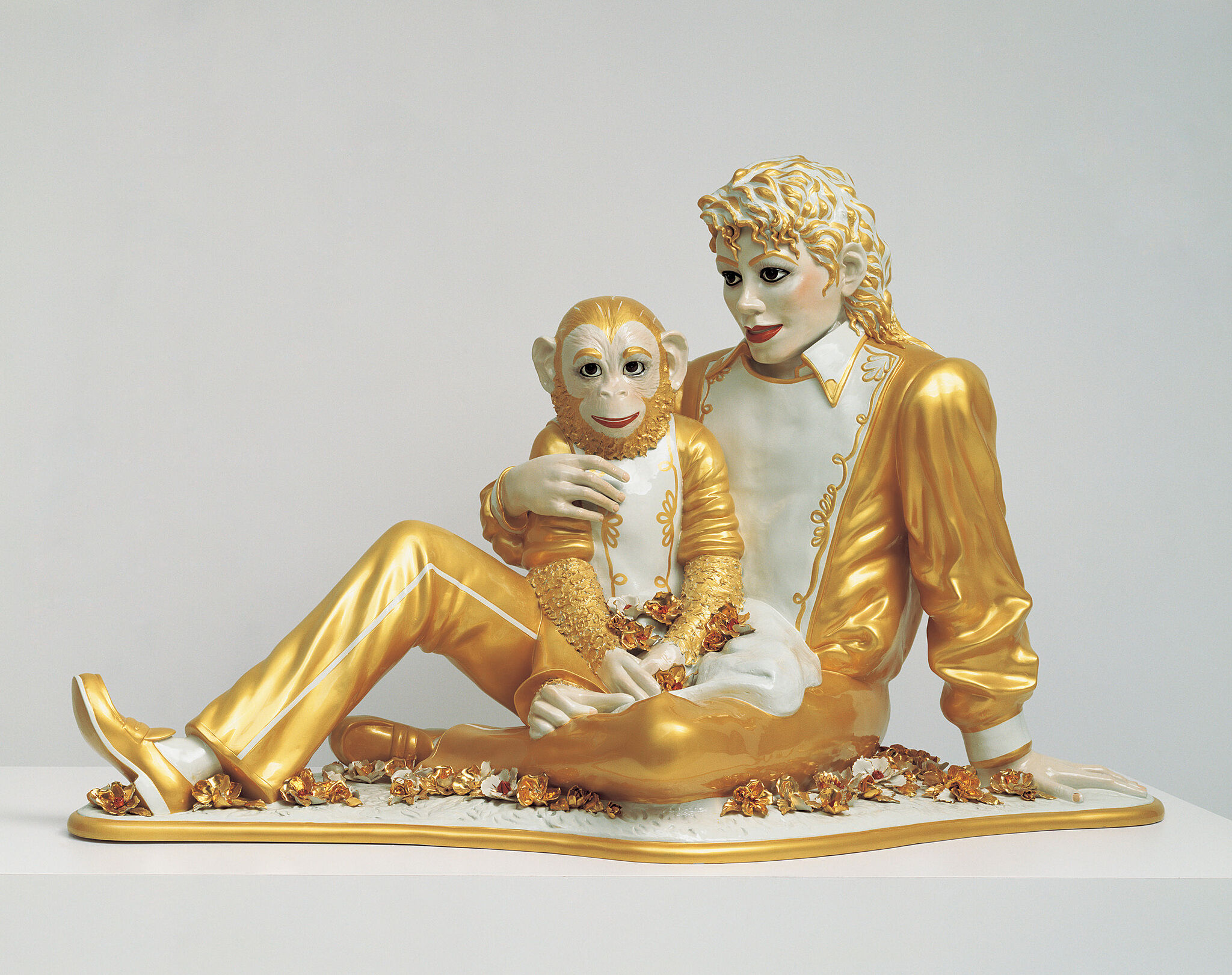
A sculpture of Michael Jackson and his pet chimpanzee Bubbles.
Fig 1. Koons J. (1988) Michael Jackson and Bubbles [porcelain] At https://whitneymedia.org/assets/image/592192/large_banality_e.2013.0080_michael_jackson_and_bubbles.jpg (Accessed 23/03/2020)

The Greek philosopher Plato described the simulacrum as a corrupt copy that has lost connection with its original (Allen & Handley 2018). The post-modern sociologist and theorist Jean Baudrillard claims that in the age of the hyper-real the image precedes the real and that this is know as the ‘precession’ of simulacrum (Baudrillard, 1981). The copy is not treated as representation but as reality.

Koons’s porcelain sculpture of the deceased pop star Michael Jackson and his pet chimp can be seen as an example of the simulacrum in post-modern culture. This sculpture is reminiscent of a ‘tacky’ gift shop model with its golden paint, unnatural pose and exaggerated features. The only difference is that Koons’s sculpture is of an exaggerated size – nearly 2 metres wide. As an example of celebrity portrayed through the mass media, we do not know the ‘real’ Michael Jackson we only know the image or the simulation of this person. Dinallo (s.d. Accessed 23/03/20) states that ‘The simulacra is a simulation of the original which eventually proves dominant becoming the only truth and its own entity’. Deleuze (1983) explains that a copy of a copy is pushed to a point where it changes and is reversed into simulacrum. The reversal of copy and model means that resemblance comes to an end and this can be seen in the pop art movement. What is bought and sold in post-modern culture is the image and not the object.

The simulacrum can be related to Greenberg’s theory of avante-garde and kitsch (Greenberg 1960). Koon’s Michael Jackson and Bubbles model has an air of sentimentality and nostalgia that imitates the effects of art. It draws on external effects to achieve its ends. It doesn’t copy but imitates and bears no relation to the real.

“The simulacra is a simulation of the original which eventually proves dominant becoming the only truth and entity.” (Lidia Dinallo, s.d Accessed 23/03/20)

Illustrations

Fig 1. Koons J. (1988) Michael Jackson and Bubbles [porcelain] At https://whitneymedia.org/assets/image/592192/large_banality_e.2013.0080_michael_jackson_and_bubbles.jpg (Accessed 23/03/2020)

Bibliography

Allen, D. & Handley, A. (2018) ‘The most photographed Barn in America’: Simulacra of the sublime in American Art and photography Text Matters Vol.8 No.8 2018 At https://www.researchgate.net/publication/328672957_The_Most_Photographed_Barn_in_America_Simulacra_of_the_Sublime_in_American_Art_and_Photography (Accessed 23/03/2020

Baudrillard, J. (1981) Simulacra and Simulations From Jean Baudrillard, Selected Writings, ed. Mark Poster (Stanford; Stanford University Press, 1988). At https://pdfs.semanticscholar.org/5ae3/a24f445c44655a14da3048254885e3d13373.pdf?_ga=2.227913885.1050673049.1584982660-1385428089.1579533044 (Accessed 23/03/2020)

Deleuze, G. Krauss, R. (1983) Plato and the Simuacrum MIT Press October, Vol 27. (Winter, 1983) pp45-56 At https://www.jstor.org/stable/778495?seq=1 (Accessed 23/03/2020)

Dinallo, L. (s.d) Warhol’s work thesis At http://concordiaproject.tripod.com/essay2.html (Accessed 23/03/2020)

https://cla.purdue.edu/academic/english/theory/postmodernism/modules/baudrillardsimulation.html (Accessed 23/03/2020)

https://whitney.org/Exhibitions/JeffKoons#exhibition-artworks (Accessed 23/03/2020)

Shorey, P. (1963) The Allegory of the Cave trans. from Plato: Collected dialogues, ed. Hamilton & Cairns. Random House

Exercise 3.6

“One cannot say the world is socially constructed and say there are misrepresentations.”

Reflect on this last sentence in as many words as necessary to form your own judgement.

In his book ‘The Construction of Social reality’, John Searle states that in our world there are ‘brute’ facts and ‘institutional facts’. ‘Brute’ facts exist regardless of human beings (mountains, rivers) but ‘institutional’ facts are specific to human existence. Through the development of language, discourse and agreement, ‘institutional’ facts exist to construct our social reality. Money, marriage, nations are examples of socially constructed ‘facts’ (Searle 1995:2).

By stating that the world is socially constructed through the agreement of human beings, then the representations of that world must be an accurate reflection of reality. It would seem that it is not possible for realities to be misrepresented.

However, perhaps this is not quite as clear cut as it first seems and requires further investigation.

Most societies remained unchanged over many centuries/millenia allowing for a solid reality based on the agreement of ‘institutional’ facts. Socially constructed reality could be seen as fairly static. The modern world can be seen as a constantly changing one – no two decades are the same. Globalisation has meant we are no longer part of one society but are also part of an even larger world society. We are now aware of other realities that differ to our own and have the opportunity to question our own culturally accepted institutional facts.

The mass media explosion has given the opportunity for misrepresentations of reality to infiltrate into society. Masquerading as representations of reality, false realities are appearing in image, text and discourse on a wide and far reaching scale.

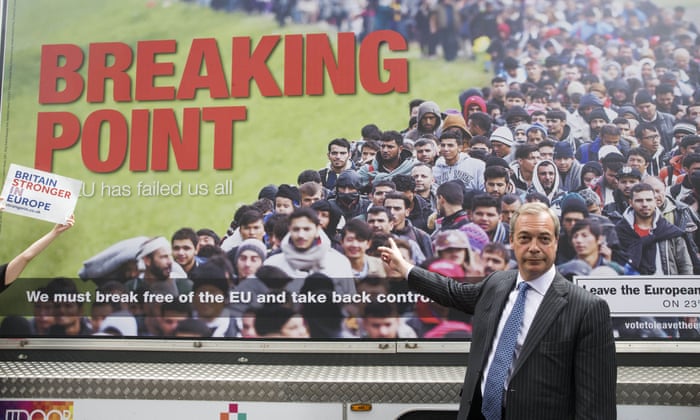
One example that could illustrate this infiltration is an image of Nigel Farage during the Brexit campaign.

Image result for nigel farage poster
Fig 1. Nigel Farage’s anti-immigrant poster during the Brexit campaign. Photograph: Mark Thomas/Rex/Shutterstock At https://www.theguardian.com/politics/2016/jun/16/nigel-farage-defends-ukip-breaking-point-poster-queue-of-migrants (Accessed 11/03/2020)

Farage is standing in front of a poster, claiming that the UK is at breaking point due to mass migration. This very strong image shows a long line of people heading towards the viewer. It suggests that we are becoming overwhelmed by immigrants who are ‘taking over our jobs and our country’ as they virtually stampede into the UK. However, if we learn that this isn’t actually a picture of migrants but refugees fleeing from a war zone elsewhere in the world we can see that this image is a misrepresentation (Stewart & Mason 2016). Unfortunately, the damage is already done, and some of society have already accepted this new image as a true representation of reality.

A split then occurs within society. Some people accept this false image as a representation as reality, whilst others can clearly see its false status. What we then get is two perceptions of reality. Both groups agree that immigration is the movement of people across borders, but one accepts the misrepresentation and sees migrants as job and home stealers wheras the other rejects the image and sees migrants as positively supporting and enriching their economy.

Image preview
Fig 2. Diagram to show the effects of misrepresentations within a socially constructed society. [personal sketchbook notes}

It is possible to claim that the world is socially constructed and say there are misrepresentations. These misrepresentations are able to actively ‘warp’ realities. The theory of the social construction of reality would need to encompass the fact that established ‘institutional facts’ are now under threat due to new world of mass media and globalisation that has the power and ability to alter human consciousness and reality.

Reflections

The concepts and thoughts that arose in this exercise required a lot or reflection. It was hard to articulate thoughts coherently and thus diagrams were created to enable and retain comprehension.

List of illustrations

Fig 1. Nigel Farage’s anti-immigrant poster during the Brexit campaign. Photograph: Mark Thomas/Rex/Shutterstock At https://www.theguardian.com/politics/2016/jun/16/nigel-farage-defends-ukip-breaking-point-poster-queue-of-migrants (Accessed 11/03/2020)

Fig 2. Diagram to show the effects of misrepresentations within a socially constructed society. [personal sketchbook notes]

Bibliography

Searle, J. R. (1995) The Construction of Social Reality GB: Penguin

Mason, R. & Stewart H. (2016) Nigel Farage’s anti-migrant poster reported to police The Gurdian online 16/6/2016 Accessed 11/03/2020)

Wikipedia Representation At https://en.wikipedia.org/wiki/Representation_(arts) (Accessed 11/03/2020)

Exercise 3.5

Does the prospect of artificial intelligence make us doubt the authenticity of human intelligence or is it forever a copy or fake version of human intelligence?

During the industrial revolution, humans invented and built machines as ‘artificial substitutes for human body functions such as lifting and transporting’ (Moravec 1988:2) to boost productivity beyond human physical capabilities. According to Moravec, approximately 100 years ago, humans started to develop and create practical calculating machines to simulate the abilities of the human mind.

In the post-modern period of the 20th Century, this imitation of human intelligence accelerated via the development of new technology to a point where artificial intelligence is now part of our everyday life. Artificial intelligence is currently imitating certain functions of the human brain for a variety of functions and purposes in our contemporary society. In fact, it has become so integrated into daily life (in digital devices such as Alexa, Siri and google maps) that most people are unaware when it is being used.

So what exactly is intelligence and in what way is it artificially imitated. According to Educba online (accessed 03/03/2020) , intelligence is the mental ability for reasoning, problem solving and learning through the use of perception, memory, language and planning. Humans are able to learn from past experiences, use that knowledge to adapt to new problems/situations and create abstract ideas. Alongside this runs emotional intelligence and the ability to self-regulate, be self-aware, acquire motivation, empathy and social skills. (David Goleman, 1999). Artificial intelligence mimics some of our mental abilities as it learns to process data from sensors and electronic components to simulate the human brain, similar to the functioning of a human infant brain (Science Times 2020).

Currently, AI is in an infantile stage in comparison to human intelligence and can be seen as copy, or a fake version that imitates only some functions of the human brain. However, the prospect of AI in the future, if society continues to allow for development and advances in technology, may lead us to doubt the authenticity of human intelligence. , AI tends to be fragmented and placed separately within machines such as computers, tablets etc. but what would happen to that intelligence if it was placed in one ‘holistic’ artificial machine that resembled a human being – a cyborg?

Science-fiction writers have speculated about the future of artificial intelligence for decades and attempted to tackle this problem of human authenticity. In Ridley Scott’s 1982 sci-fi film Blade Runner (based on Philip K. Dick’s novel Do Androids Dream of Electric Sheep) we are introduced to a dystopian future in which artificial intelligence, in the form of humanoids, are created and used as ‘slaves’ for the purposes of their human creators. They are so identical to humans – physically and intellectually that they are virtually impossible to detect and are referred to as replicants.

Image result for blade runner roy  stills
Fig 1. Rutger Hauer (1982) as the replicant Roy Batty in Blade Runner (film blu ray still) At https://twitter.com/OnePerfectShot/status/1014559472579211270 (Accessed 03/03/2020)

The replicants only have a lifespan of 4 years and are then programmed to self-terminate to prevent them from developing emotional responses. In this fictional account of the future of AI, we are presented with identical replicas of human beings and human intelligence. What allows the replicants to become genuine versions of human intelligence and not mere fake copies is the ability for them to experience a physical life. As the replicant Roy states ‘ We’re not computers, we’re physical’ (Hauer, 1982 Blade Runner ) This physical experience of AI allows the replicants to develop memories, experiences and social interactions that allows for the development of emotional responses. If this were to become a reality in the future it would make AI indistinguishable from its human creators.

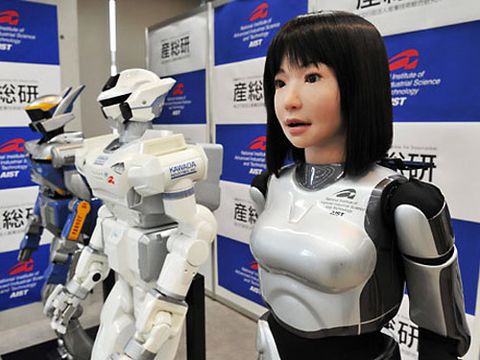
It is interesting that AI in human form could be considered more acceptable to humans than AI in machine form. In 1970 the Japanese roboticist Mashiro Mori developed a theory called the uncanny valley. In this theory there is a point where we find the robot/cyborg unsettling and start to reject it. This might be where they resemble humans but have jerky movements or artificial eyes. If the robot is perfect and replicates the human form we are more likely to accept it (Grabianowski s.d.).

Mori's graph of the uncanny valley.
Fig 2. Mori’s graph of the uncanny valley. At https://science.howstuffworks.com/science-vs-myth/unexplained-phenomena/uncanny-valley1.htm (Accessed 02/03/2020)

Mori’s uncanny valley suggests that the imperfect AI in humanoid form is perceived as a copy or a fake version of human intelligence. We are fully aware that it is artificial and this can make us feel ill at ease.

image
Fig 3. Example of an AI robot in human form within Mori’s uncanny valley. The robot does not quite look fully human and thus creates a sense of unease. At https://www.popularmechanics.com/technology/robots/a5001/4343054/ (Accessed 03/03/2020)

Another point to consider when considering the authenticity of human intelligence is when AI develops or evolves away from the original (human). One example of this can be found in the film the Matrix. This 1999 movie by the Wachowski brothers shows another future world in which the humans are oblivious to the fact that they are living in a computer simulated illusion. The AI has surpassed the limitations of human intelligence and has enslaved the minds of humans in this virtual world whilst they harvest their bodies for energy. AI no longer resembles the original version of human intelligence it once replicated. It has evolved and developed into something authentic in it’s own right (The Matrix,1999).

The Matrix
Fig 4. Keanu Reeves as Neo in The Matrix (1999) Warner Bros pictures. At https://www.syfy.com/syfywire/science-behind-the-fiction-humans-as-batteries-as-in-the-matrix-probably-not-gonna-happen (Accessed 02/03/2020)

To conclude, at this present point in time, I would argue that human intelligence is authentic and AI can be seen as fake versions of brain functioning and capability. However, in the future there is the possibility that AI could become so close to human intelligence it will threaten its authenticity. If AI is embodied in human form that can experience a physical existence ( like Blade Runners replicas), they could have the ability to experience and act in the world exactly as humans do. It is also possible, in the future, for AI to exceed and develop beyond the limitations of human intelligence. Human intelligence would become irrelevant and again, lose its authenticity.

Reflections

I felt as though this was a very big question to answer. ‘..the prospect of AI…’ means that there is a lot of speculation about what AI will be like in the future and whether this would compromise the authenticity of human intelligence. A lot of these speculations have been made by science fiction film directors and writers and so it was interesting to explore some of the possible scenarios that tackle this question.

Reading back through my responses to this question, I am not sure the section about the uncanny valley is relevant but I have kept it in none-the-less.

List of illustrations

Fig 1. Rutger Hauer (1982) as the replicant Roy Batty in Blade Runner (film blu ray still) At https://www.syfy.com/syfywire/science-behind-the-fiction-humans-as-batteries-as-in-the-matrix-probably-not-gonna-happen (Accessed 02/03/2020)

Fig 2. Mori’s graph of the uncanny valley. At https://science.howstuffworks.com/science-vs-myth/unexplained-phenomena/uncanny-valley1.htm (Accessed 02/03/2020)

Fig 3. Example of an AI robot in human form within Mori’s uncanny valley. The robot does not quite look fully human and thus creates a sense of unease. At https://www.popularmechanics.com/technology/robots/a5001/4343054/ (Accessed 03/03/2020)

Fig 4. Keanu Reeves as Neo in The Matrix (1999) Warner Bros pictures. At https://www.syfy.com/syfywire/science-behind-the-fiction-humans-as-batteries-as-in-the-matrix-probably-not-gonna-happen (Accessed 02/03/2020)

Bibliography

Allen, D. & Handley A. (2018) “The Most Photographed Barn
in America”: Simulacra of the Sublime in American Art and Photography
Text Matters, Volume 8, Number 8, 2018 At https://www.jstor.org/stable/20025138?seq=1 (Accessed 03/03/2020)

Blade Runner (1982) Directed by Scott R. (Blu ray) Warner Bros. (Accessed 03/03/2020)

Grabianowski E. How the uncanny valley works At https://science.howstuffworks.com/science-vs-myth/unexplained-phenomena/uncanny-valley4.htm (Accessed 03/03/2020)

https://www.imdb.com (Accessed 03/03/2020)

Moravec, H. (1988) Mind Children: The Future of Robot and Human Intelligence London: Harvard University Press. At https://books.google.co.uk/books/about/Mind_Children.html?id=56mb7XuSx3QC (Accessed 03/03/2020)

Sofge, E. (2020) The Truth About Robots and the Uncanny Valley: Analysis. Popular Mechanics At https://www.popularmechanics.com/technology/robots/a5001/4343054/ (Accessed 03/03/2020)

Staff reporter (2020) Understanding AI: Artificial Intelligence and How it Works Made Easy The Science Times 10.01.2020 At https://www.sciencetimes.com/articles/24651/20200110/artificial-intelligence-work-what-will-replace.htm (Accessed 03/03/2020)

An Introduction to Baudrillard (2019) online video At https://www.youtube.com/watch?v=1Yxg2_6_YLs (Accessed 03/03/2020)

http://www.educba.com/what-is-artificial-intelligence/ (Accessed 03/03/2020)

Design a site like this with WordPress.com
Get started