 | Open College of the Arts |
| Tutor report |
| Student name | Lara Jobson | Student number | 519703 |
| Course/Module | UVC1Tutorial/video | Assignment number | 4 |
Overall Comments
In this section of the course you have worked with some complex ideas and engaged with them in a real way using critical thinking and analysis to evaluate and interpret. It shows that your confidence is growing and you have managed to traverse a good range of sources to help your understanding to grow and develop, so considering ‘difference’ and it’s varied aspects/applications recognised through discernment and accepting the complexities of it. Also, remaining open to ideas has enabled you to apply ideas and concepts to appropriate works and consider the 21c values from your position today. Well done.
Feedback on assignment Demonstration of technical and Visual Skills, Quality of Outcome, Demonstration of Creativity
Assignment:
You have considered the complex aspects of ‘difference’ and have defined this very well through application and through the articulation in the essay, meaning that your approaches to critical thinking are developing. You have recognised the nature of complex ideas and theories, and have used disparate sources to help you to navigate this (including lectures and so on on You Tube) This shows your developing research adeptness and ability to begin to articulate the ideas and application of ideas. It is good that you have used a wide base to gain understanding. Remember to be sure of the value of the source in terms of academic provenance, which you are doing, but just as a reminder as you move forwards.
Although the actual essay is clear and pragmatic, you have not used a rigorous method of referencing. We have discussed this and how you can remedy it.
OCA uses UCA’s Harvard Referencing guide which can always be found by Googling UCA Harvard Reference Guide.
Or you can click on the link here: http://webdocs.ucreative.ac.uk/Handbook-Harvard%20Referencing-1571674800035.pdf
In our tutorial we went back over the essay and looked at how and where you should reference fully.
This can then be applied to Ass3 and also to your blog posts for Ass4 and 5 in particular- if you have time go back over the posts for Ass3 and the essay. This will help you set up a firm base for your future courses as well. If you would like me to look at a sample just send me a fresh link and I will ‘pop’ in and have a look for you.
In your blog there are good examples that you have achieved such as:

Although you may want to attribute a page number?
The ref below needs to have the accessed date on attributed in the ref list- check this in the Harvard guide.

These are examples of instances where you can go back and just sure up, then attribute where you might not have in other instances.
The reason for this ‘combing through’ what you have already achieved, is that you need to show your good research and attribute your learning. Without this at assessment you will be falling short of academic standards.
I suggested making some sample references and putting them near your computer as a print out, so that you can readily refer to them as you are writing, rather than having to peel back. This will save you time and also means that you are questioning yourself as you are moving forwards.
In Ass4 the thinking around Wilson and difference is clear and articulated well as I have said above, but there are a couple of areas that you can develop.
- Be careful to both reference and define the use of synthesis at the start of the essay.
- It would be worth noting the social context that the work was made in in the 90’s (in brief), as it was a movement against- so this involved difference and the action of difference. This will help the conclusion to round up as well.
- Remember to write into and out of your quotes. Question the value of them to what you are writing about- how does the quote add to the argument or line of reasoning?
In your exercises I have picked up on a few examples so that you can go back and amend, applying the sentiment/observations to the work in Ass4 and going forwards into Ass5. This will help you to develop the critical writing aspects.
- Orphism/synthesis section is very clear, and I enjoyed reading this, the parts where you relate the colour to emotion needed some further unpacking but overall successful. Maybe just go back and add a paragraph explaining this interrelationship between colour and emotion from the Orphist perspective.
- There was a nice explanation in the Judas/Deleuze exercise (although it needs a ref for ‘monstrous’ the first time you use the word as it was a concept. Can you link monstrous to open out as to in what way was Deleuze was opposed? He described the effect like this because…

Below is a good paragraph as well, that is clear with good correlations made to Greenburg- you need to say what these comparisons consist of it you can- it is an interesting observation so make the most of it. (Ref Greenburg to here)
The relationship between background and figure creates an ‘indifferent difference’ (Olkowski, 1999) between contradictory and inseparable entities. Olkowski describes this as a ‘highly differentiated kind of pictorial space[s] that draws attention to the surface of the picture’. Comparisons can be made to Greenberg’s theory on modernist art where the emphasis was places on drawing attention to the flat surface of the canvas.
Sketchbooks Demonstration of technical and Visual Skills, Demonstration of Creativity
Learning Logs or Blogs/Critical essays Context
Concepts and ideas are developing in your sketchbook, keep going with this and enjoy the process.
Suggested reading/viewing Context
As you are considering painting for your next course a good read is Painting Now. Suzanne Hudson, and although not new it is pertinent.
A book for the summer- Summers of Discontent. The purpose of the Arts Today. Raymond Tallis. Bitter Lemon Press. Good read collated together by Julian Spalding. Paperback.
There is good review below.
Pointers for the next assignment
Remember to go back and sure up your references across the materials that we have discussed.
| Tutor name: | Michele Whiting |
| Date | 10 JULY 2020 |
| Next assignment due | 28th August 2020. 12.30 |
Response to Feedback
Overall, I am very pleased with the feedback from my tutor and it was really nice to chat and be able to ask questions over the face to face tutorial. My main prior concern was that I had not fully understood the theories of difference and so felt delighted when my tutor said that my ideas and interpretations were well thought out. As previously stated, I had struggled to interpret and fully grasp some of the theories on difference and spent a long time attempting to understand primary sources. I now know that if this is problematic in the future, I can look to secondary sources to assist my comprehension. Again, a good and well planned structure and use of illustrations helped me to articulate my ideas and construct a well presented assignment.
After looking through some paragraphs in Assignment 4 with my tutor, it became apparent that I had not been referencing accurately. I have thoroughly re-read the Harvard referencing guide and ensured that all the thoughts that were not my own have been referenced back to their source. In future I shall ensure that referencing is undertaken during note-taking to include page numbers so that I can easily reference my sources.
I shall amend Assignment 4 and then revisit my amended essay for part 3 to ensure it is referenced properly. My tutor has advised me to go back over my blog posts for part 4 and, if time permits, part 3 and ensure these are also referenced accurately.
Amendments to Assignment 4
All amendments are underlined. I was unable to date some of my references which led me to question the academic value of a few of my internet based sources.
Explore Fred Wilson ‘Mining the Museum’ and it’s possible interpretations in terms of difference. (no word count specified)
Introduction
The artist Fred Wilson was born in New York in 1954 and describes himself as of “African, Native American, European and Amerindian” descent. In the early 1990’s, The Contemporary Museum of Baltimore and Maryland Historical Society invited Wilson to create a museum installation in which he was given free reign of their collection and any archived objects with the opportunity to display them in any way he chose. The installation ran from 4th April 1992 to February 28th 1993 and mimicked the usual technique for museum displays – labels, wall texts, lighting, audio material yet his installation created a different experience for the viewer. The exhibition took place just before and during the violent unrest in Las Angeles following the killing of the African-American citizen -Rodney King.

The title of his exhibition ‘Mining the Museum’ can be interpreted in different ways and suggests a deliberate play on words. It could mean Wilson ‘mined’ the museum, perhaps with controversy, ‘mined’ the museum for hidden artefacts or literally made the museum his own (mine) (Garfield,1993). There are many different theories about ‘difference’ from philosophers throughout history. It is possible to interpret ‘Mining the Museum’ in terms of difference by looking at how Wilson managed to create a synthesis of black and white history (Hegel, 1817), indicated differences in power through selected objects (Hegel, 1807) and enabled a consciousness shift in the viewer by rejecting traditional museum categorisation (Deleuze, 1968) .
Synthesis of black and white history
The 19th Century philosopher G.W.F. Hegel (1817), argued that for the world to progress it required unification of two opposing or different forces. The thesis and antithesis would unite in the synthesis to provide a more balanced truth. This process would repeat infinitely as the synthesis became the thesis. Wilson was able to unite two opposing or different histories in ‘Mining the Museum’and create a new synthesis of the black and white history of Maryland.
The traditional exhibitions of the Maryland Historical Society museum focused on a mainly white past that excluded a whole history of African and Native Americans. Wilson retrieved forgotten and archived artefacts from these neglected people’s history and placed them in his installation (Halle, 1993:170). He was able to bring light to a ‘history and cultural presence that had been buried beneath layers of neglect and deliberate exclusion‘ (Halle, 1993:170). This burial of history and artefacts was now unearthed and presented in Wilson’s displays.

In ‘Metalwork 1793-1880’ (Fig 1.) Wilson placed two different types of metal-ware together in a display case. By surrounding slave shackles with silverware from wealthy white families of the 19th Century we are confronted with two different and opposing experiences of local history (Fig 1.). One history representing the white population – its wealth, exuberant luxury and superiority. The other representing the black, inferior and enslaved population forcibly taken from Africa and shackled in American life.
According to the Hegelian dialectic, the opposing and contradictory thesis (white, visible history) and antithesis (black, hidden history) were reconciled in ‘Metalwork 1793-1880’ to create a synthesis that gave Maryland’s history a higher level of truth. The two objects juxtaposed created tension for the viewer by illuminating the two experiences of Maryland history side by side (Ginsberg:accessed 20/06/2020)

In ‘Pedestals, Globe and Busts’, Wilson placed a gold and silver Globe bearing the word truth – an old trophy given to advertising clubs in the early 20th Century, between two sets of pedestals. On the left of the Globe were three empty pedestals labelled ‘Frederick Douglas’, ‘Harriet Tubman’ and ‘Benjamin Banneker’. All three were major African-American historical figures who at one time lived in Maryland. On the right of the globe were three pedestals that contained the busts of Henry Clay, Napoleon Bonaparte and Andrew Jackson. The three busts were of white political or military figures, none of which had any connection to the local history of Maryland. In this unity of historical people, the absence of the busts of significant local black historical figures indicates an invisible history running parallel to a visible white male history that was in a position to record its own version of history (Corrin 1993:306). The ‘Truth Trophy’ invites the viewer to see the truth about how history is recorded and portrayed by the institutions concerned. The weakness of recording an accurate history comparable to the weakness of advertising (Halle, 1993:171).
Differences in power
In his book ‘Phenomenology of Spirit’ (1807), Hegel wrote about the Master and Slave Dialectic that describes the power relationships between groups of people. In this relationship there is a superior and a subordinate group of people which can be based according to criteria such as race, gender or wealth. The Master is always independent, privileged and able to decision-make. The slave, however, is dependant, ignorant, controlled and alienated (Sadler, 2013:accessed 20/06/2020).
Wilson’s installation can be seen to have emphasised the differences in power experienced by the people of Maryland’s past. In terms of Master and Slave dialectic, Maryland’s history would have experienced opposing forces of superior and inferior people. The white population (master) were the privileged, decision makers with all of the power, wealth and control. The black Africans (slaves), and also the indigenous population were dependant, kept in ignorance and poverty with no power or influence.

The contrasting sizes and careful placement of objects by Wilson would have signified this power inequality to the viewer (Corrin, 1993: 309). In ‘Modes of Transport 1770-1910’ (Fig 4. ) the room was dominated by a large ornately decorated Sedan chair that was used to carry the powerful Governor Eden of Maryland during the 18th Century. (Fig.5)

Behind the Sedan chair and of a significantly smaller scale was a model of the Baltimore clipper that was converted to a slave ship after 1812. The visual impact of this very small model of a ship used to carry thousands of slaves and the large single seated chair suggested the power inequalities of the two groups. (Corrin, 1993:309) In ‘Metalwork 1793-1880’ (Fig 2.) the slave shackles themselves were placed in the cabinet in a way that suggests oppression. The objects could almost symbolize the bodies of the past – the black shackles crumpled on the ground with the ornate bright silverware encircling and dominating over the top of them.
Aristotle and Institutional categorisation
Prior to ‘Mining the Museum’ Wilson had created installations that drew attention to curatorial practices and the affect that these had on the viewers interpretation and understanding of history (Corrin, 1993:303-4). In ‘Mining the Museum’, Wilson focused on the museum as a formal space and its perceived neutrality when displaying objects from the past. He was able to challenge the traditions of ordering and presenting objects from history. The installation explored not what objects mean but how meaning is created when they are placed within the museum (Corrin, 1993:306).
Museums and other institutions categorise objects and things on their identity. This traditional way of organising different objects or things goes back to Aristotle and his ideas on ‘specific’ difference. Objects are categorised according to negation and their opposition to one another, for example can fly/can’t fly or silver/not silver. Aristotle claimed that there were divisions within being that divided things into categories, genres, and species etc. We are then able to fit objects into this system of categorisation. (Williams, 2003:63-64) Museums tend to categorise their items and display them according to this principle.
In ‘Mining the Museum’, the placing of different objects together by Wilson disrupted this traditional categorisation within the museum. It gave us a post-structuralist view of objects and the history they represent. Wilson allowed ” …the power of objects to speak when the ‘laws’ governing museum practices [were] expanded and the artificial boundaries museums build [were] removed.” (Ginsberg s.d accessed 20/06/2020) Displaying artefacts unconventionally allowed Wilson to portray a deeper and more honest version of the past.
Heightening awareness through difference (Deleuze)
Wilson’s exhibition allowed viewers to interpret a new and truer version of history by exhibiting items from the black and native american people that were previously not on display. He also created the potential to heighten the viewer’s awareness of history by disrupting the traditional categorisation of historical objects based on identity. The French philosopher Gilles Deleuze (1925-1995) rejected Aristotle and Hegel’s theories of difference – both based on specific differences and opposition (Williams, 2003). Deleuze believed that ‘to be’ is the same for all things and that being is in a constant state of motion. Generalising does not take into account ‘newness’ or the ability of things to evolve and change (Martin-Jones &Sutton, 2008:46). Wilson’s installation resisted categorisation based on negation and created room for newness- of perspective and concepts in the form of affirmation.
Wilson created tension in his installation by juxtaposing different objects to create new concepts (Halle, 1993:170). The viewer was no longer passive but active in interpreting objects placed in an unconventional manner.

In ‘Modes of transport (1770-1910) Wilson placed a klu klux Klan head inside a 19th Century white baby’s pram. What did these two unrelated objects mean to the viewer? The concept signified here suggested that racism was inherited and passed from parent to child. This simple placement of two different objects together allowed the viewer to question where racism originates from and created the potential for a new perspective to evolve. Wilson has effectively, encouraged the shackled people in Plato’s cave to turn around and question the shadows displayed before them.
Conclusion
It is possible to interpret ‘Mining the Museum’ in terms of difference in several ways. Firstly, the installation was able to tell the history of Maryland that wasn’t bias towards the ‘white’ culture. Placement or non-placement (Installation of Pedestals, Truth Globe and Busts) of items together created a synthesis of white, superior visible history and black, inferior invisible history. The viewers were given a more honest representation of their history. Secondly, the installation was able to indicate differences in power between African and the indigenous Americans and the white population through the positioning and sizing of the artefacts. Lastly, Wilson was able to heighten awareness of his viewers by rejecting the traditional classification of objects and allowing a more Deleuzian approach to his installation.
Wilson’s installation is sadly still as relevant today as it was in the 1990’s. The L.A unrest of the 1990’s has been echoed by the sad killing of African-American George Floyd by a white Police Officer earlier this year. The differing experiences of the citizens of Maryland’s past, as seen in ‘Mining the Museum’, are still rippling and underlying the fabric of American society.
Reflections
I am extremely pleased that I selected ‘Mining the Museum’ for this Assignment as it was a very powerful installation. It seems especially relevant at the moment in light of the Black Lives Matter Movement and the murder of George Lloyd. I find it fascinating and deeply satisfying that people are removing and demanding the removal of statues of individuals with a history related to the slave trade, the exploitation of other nations or even for holding racist views. I personally am shocked that these statues exist and feel quite ignorant that I was unaware of them. Again, these physical protests bring to light the question of who records and documents our history? Why were these people immortalised in a statue and whose version of history is on display? Yet, as Wilson implies in Modes of Transport, were the views of these individuals (such as Robert Baden-Powell )inherited and something that was ‘bred’ into them? Would we have had the same views towards others if we had been socialised and conditioned in the same way?
It was extremely challenging to bring philosophical theories of difference into Wilson’s installation as I found the theories extremely complex.
List of Illustrations
Fig 1. Artist Fred Wilson (b.1954) At http://www.archivesandcreativepractice.com/fred-wilson (Accessed 04/062020)
Fig 2. Wilson, F. (1992) installation “Metalwork 1793-1880.” [Historical objects form the Maryland Historical Society] ‘Mining the Museum exhibition’ At https://beautifultrouble.org/case/mining-the-museum/ (Accessed 10/06/2020)
Fig 3. Wilson, F. (1992) Installation of Pedestals, Truth Globe and Busts [Historical objects form the Maryland Historical Society] ‘Mining the Museum exhibition’ At https://www.researchgate.net/figure/Figura-4-Fred-Wilson-Vista-da-Instalacao-Mining-the-Museum-Garimpando-o-Museu-The_fig4_335084044 (Accessed 14/06/2020)
Fig 4. Wilson, F. (1992) Modes of Transport 1770-1910) [Historical objects form the Maryland Historical Society] ‘Mining the Museum exhibition’ At http://www.artnet.com/magazineus/books/nathan/martha-buskirk-creative-enterprise-6-4-12_detail.asp?picnum=2 (Accessed 13/06/2020)
Fig 5. Sir Robert Eden, 1st Baronet, of Maryland (1741-1784) At https://en.wikipedia.org/wiki/Sir_Robert_Eden,_1st_Baronet,_of_Maryland Accessed (14/06/2020)
Fig 6. Wilson, F. (1992) Modes of Transport (1770-1910) [Historical objects form the Maryland Historical Society] ‘Mining the Museum exhibition’ At https://www.on-curating.org/issue-45-reader/non-things-or-why-nostalgia-for-the-thing-is-always-reactionary.html#.Xu3olERKjcc (Accessed 20/06/2020)
Bibliography
Corrin, L. (1993) Mining the museum. An Installation confronting history in Anderson, G. (2004) Reinventing the Museum Altamira Press: Oxford p.248-256 At http://historyinpublic.blogs.brynmawr.edu/files/2016/01/Curator_Mining-the-Museum.pdf (Accessed 11/07/2020)
Descombes, V. (1980) Modern French Philosophy. Cambridge, Cambridge University Press
Garfield, D. (1993) Making the museum mine:An interview with Fred Wilson Museum News At https://msu.edu/course/ha/452/wilsoninterview.htm (Accessed 20/06/2020)
Ginsberg, E. Case study : Mining the museum At Beautiful Trouble https://beautifultrouble.org/case/mining-the-museum/ (Accessed 20/06/2020)
Sadler, Dr. G.B (2013) Marist College Lectures – G.W.F. Hegel Phenomenology of spirit You tube lecture At https://www.youtube.com/watch?v=6Fi7g5Ncy5U (Accessed 20/06/2020)
Halle, H. (1993) Mining the Museum ‘Grand Street Journal’ No.44 pp151-172 At https://www.jstor.org/stable/25007622?seq=1 (Accessed 20/06/2020
https://en.wikipedia.org/wiki/Sir_Robert_Eden,_1st_Baronet,_of_Maryland (Accessed 20/06/2020)
https://en.wikipedia.org/wiki/The_Phenomenology_of_Spirit (Accessed 20/06/2020)
http://www.archivesandcreativepractice.com/fred-wilson (Accessed 20/06/2020)
https://www.mdhs.org/digitalimage/installation-view-mining-museum (Accessed 20/06/2020)
https://plat.stanford.edu/entries/deleuze/ (Accessed 20/06/2020)
https://plato.stanford.edu/entries/hegel-dialectics/ (Accessed 20/06/2020)
https://www.tate.org.uk/art/artists/fred-wilson-15855 (Accessed 20/06/2020)
Martin-Jones, D. &Sutton D. (2008) Deleuze Reframed New York I.B Tauris & Co.Ltd.
Williams, J. (2003) Gilles Deleuze’s “Difference and Repetition”. A critical introduction and guide. Edinburgh University Press
Amendments to Part 4 Exercises
EXERCISE 4.5
Apply the dialectic diagram to Barr’s. What would count as a thesis, an antithesis and a synthesis. You will need to refer to images of art works for a persuasive answer.

By studying Barr’s chart, it can be shown that at the beginning of the 20th Century Cubism acts as a thesis whilst Fauvism acts as an opposing antithesis. The emergence of Orphism can be seen as a synthesis of both of these two movements, being influenced by and using elements of both. To demonstrate this synthesis, the fundamentals of each movement will be discussed and art works indicated.
Cubism (Thesis)
Cubism was invented around the year 1907 by artists Pablo Picasso and Georges Braque. Analytical cubism gave way to synthetic cubism as the artists developed their ideas. Picasso and Braque developed a new form of realism that abandoned the traditional single point perspective form of representation. Instead they created a new form of realism to convey form and structure more accurately and convincingly. Inspired by Cezanne, who constructed forms out of different planes, Analytical Cubism used multiple viewpoints that created an experience of three dimensional objects in space and time. Movement is continuous as the viewer constructs, not just through sight but through thought as well, the suggestion of an object (Dempsey, 2002:85). Objects were reduced and fragmented to depict volume and mass in space.

Mandora (Fig 3.) illustrates the new perspective explored in analytical cubism. Overlapping planes, fragmented form and structure give the illusion of a more realistic depiction of subjects in space and time (Tate online , Accessed 20/05/2020). It reflects our experience of life that flows through movement in time rather than exists in a static state.
In both Braque’s Mandora (Fig 3) and Picasso’s The Accordionist (Fig 4) the subject matter is similar. The two artists focused on neutral subject matter (still life) and completed their images in a subdued and monochromatic palette. This ensured that the whole of the viewers’ attention was focused upon the structure of the form and the density of the image (Tate online, accessed 20/05/2020)

In Synthetic Cubism (Fig 5), the artists started to flatten the image rather than breaking it down into multiple viewpoints. Experiments with collage, textures and patterns in their art helped to achieve this, alongside large blocks of colour (Dempsey, 2002:85).

Fuavism (Antithesis)
Fauvism was a movement that existed between 1905 and 1910 and included artists such as Henri Matisse and Andre Derain. After an exhibition at the salon d’automne in Paris, in 1905, the critic Louis Vauxcelles labelled this group of artists Les Fauves (wild beasts) due to their use of bold colours and wild brushstrokes. Unlike the cubists, who focused on realism of form, depth and structure through movement and time, the belief amongst this group of artists was that art should evoke emotional sensations through form and colour. The artists primarily expressed themselves through the use of bold, unnatural, strong colours which served to create atmosphere.

Matisse’s Joy of Life (Fig 6) illustrates the Fauvist’s strong use of colour which creates a warm, inviting atmosphere. The curving simple lines create the forms of bodies reclining and relaxing amongst nature. The expression through colour and the simplified forms evokes sensations of pleasure and physical delight. Similar to the cubists, the fauvists rejected traditional three-dimensional space and used flat areas of colour and spontaneous brushwork to flatten the surface of the canvas.
Scientific colour theory was important to the Fauvists and they paid particular interest in the 19th Century colour theories relating to the effects of complementary colours (Essaulova, accessed 20/05/2020). In Bridge to Charing Cross (Fig 7), Derain uses complementary colours to heighten the scene and allow the contrasting colours to heighten the impact of the painting.

Orphism (Synthesis)
The thesis (Analytical cubism) and the antithesis (Fauvism) act in opposition to one another. Cubism focuses on the structure of form and mass through time and space whereas Fauvism focuses on the expression of emotion through the use of colour and simple forms. Both movements reject the traditional forms of representation and flatten or give depth to the image. The synthesis for these two art movements is that of Orphism.
Orphism, that evolved from about 1912, included artists such as Frantisek Kupka, Robert Delauney and Sonia Delauney. These artists were highly influenced by the cubist and Fauvist movements taking elements from each. Fig 8. illustrates Delauney’s Red Tower which shows the representation of the subject matter from multiple viewpoints but also shows some Fauvist qualities by introducing a more striking subject matter and the use of bright bold colours.

As Orphism progressed, they started to move beyond reality into pure abstraction. There was a mystical and spiritual element to their paintings through the use of colour and shape. Like the Fauvists, colour theory became very important as they learnt the interrelationships of colour, light and movement and applied it to their work. Contrasting colours, colour harmonies and rhythms create expression that gives depth, form, movement and an emotional content (The art story accessed 20/05/2020). The Orphist artist Guillaume Appollinaire(1880-1918) developed an anlalogy between music and painting. He believed that pure colour abstractions had a similar effect on the emotions of the viewer as to the listener (Dempsey, 2002:99)
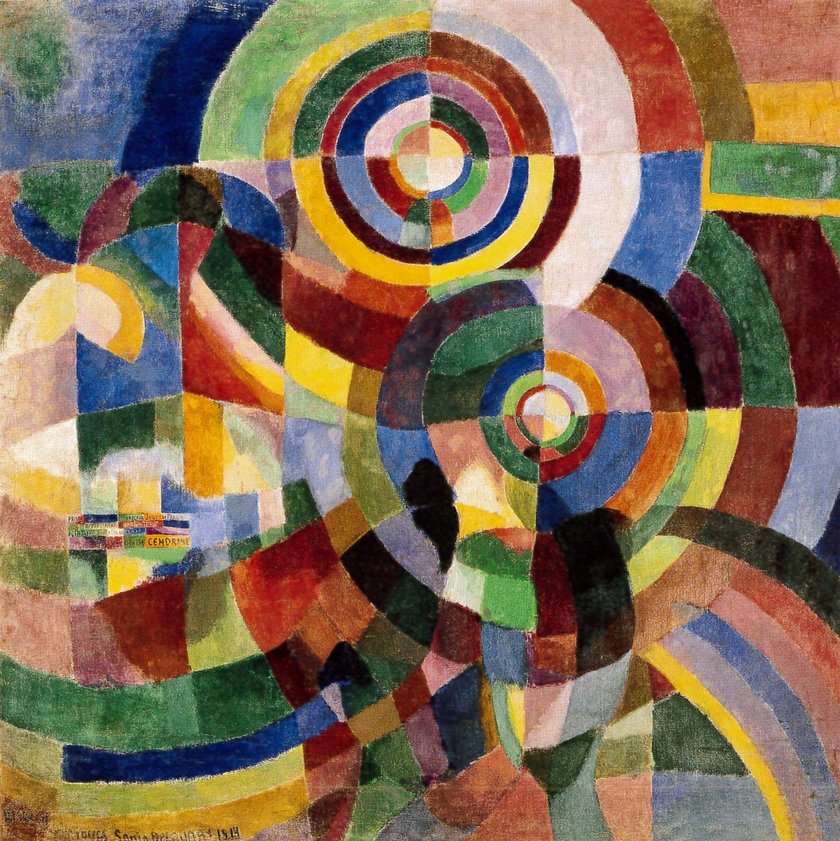
In the later stages of Orphism we can see a fusion of pure abstracted forms and an expressive interplay of colour (Fig 9. Prismes electriques) (Tate online, accessed 20/05/2020). The result is an expressive form of abstract art that draws attention to the flat surface of the canvas.
Orphism is a synthesis of Analytical cubism and Fauvism. Both movements rejected the traditional representation of three dimensional reality pushing them both towards near abstraction of form and a flattening of the image. The Orphists expressed themselves through bold bright colours based on colour theories of the time (Fauvism) and embraced the multiple fragmented viewpoints of cubism that ultimately led to pure abstraction.
Reflections
This was a very interesting exercise and it was fascinating to see how two movements could influence artists of the time. There seemed to be more opposing forces between Fauvism and Cubism than similarities, yet the two movements seemed to inspire the Orphists to create one of the earliest approaches to complete abstraction.
List of Illustrations
Fig 1. Diagram to illustrate Hegel’s dialectic of subjectivity and objectivity. At https://calmapossawi.tk/113-hegel-thesis-antithesis-synthesis-dialectic.php (Accessed 20/05/2020)
Fig 2. Barr, A.H. (1936) Cubism and Abstract Art. At https://www.moma.org/calendar/exhibitions/2748 (Accessed 20/05/2020)
Fig 3. Braque, G. (1909-10) Mandora [oil on canvas] At https://www.tate.org.uk/art/artworks/braque-mandora-t00833 (Accessed 20/05/2020)
Fig 4. Picasso, P. (1911) The Accordionist [oil on canvas] At https://www.guggenheim.org/artwork/3426 (Accessed 20/05/2020)
Fig 5. Gris, J. (1914) The Sunblind [oil on canvas] At https://www.tate.org.uk/art/art-terms/s/synthetic-cubism (Accessed 21/05/2020)
Fig 6. Matisse, H (1905) Joy of Life (Bonheur de Vivre) [oil on canvas] At https://www.henrimatisse.org/joy-of-life.jsp (Accessed 20/05/2020)
Fig 7. Derain, A. (1906) Bridge to Charing Cross [oil on canvas] At https://arthive.com/andrederain/works/323773~Bridge_To_Charing_Cross (Accessed 20/05/2020)
Fig 8. Delauney, R.(1912) The Red Tower [oil on canvas] At https://www.guggenheim.org/artwork/1020 (Accessed 20/05/2020)
Fig 9. Delauney, S. (1914)Prismes electriques [oil on canvas] At https://www.tate.org.uk/press/press-releases/ey-exhibition-sonia-delaunay (Accessed 20/05/2020)
Bibliography
Bois, Y-A (2004) with B.Buchloh, H. Foster, R. Krauss. Art since 1900 London and New York, Thames and Hudson.
Dempsey, A. (2002) Styles, Schools and Movements Thames and Hudson Ltd. London.
Esaulova, A. Bridge to Charing Cross At https://arthive.com/andrederain/works/323773~Bridge_To_Charing_Cross (Accessed 20/05/2020)
https://en.wikipedia.org/wiki/Orphism_(art) (Accessed 20/05/2020)
https://www.tate.org.uk/art/art-terms (Accessed 20/05/2020)
https://www.theartstory.org/movement/orphism/artworks/ (Accessed 20/05/2020)
https://www.metmuseum.org/toah/hd/fauv/hd_fauv.htm (Accessed 20/05/2020)
EXERCISE 4.4
Say to what extent Giotti’s painting can serve to illustrate the quote be Deleuze. (200 words)

“Let us imagine something which is distinguished – and yet that from which it is distinguished is not distinguished from it. The flash of lightening for example, is distinguished from the black sky, but must carry the sky along with it… One would say that the bottom rises to the surface, without ceasing to be the bottom. There is, on both sides, something cruel – and even monstrous – in this struggle against an elusive adversary, where the distinguished is opposed to something which cannot be distinguished from it, and which continues to embrace that which is divorced from it.” (Deleuze, 2014:361 cited in OCA UVC handbook 2016:105)
In Giotti’s painting ‘The Kiss of Judas’ (1305), we are able differentiate the figure and the background. As there is no use of single point perspective or illusion of three dimensions, there is no ordering of the space (Olkowski, 1999:17). This means that the bottom of the painting (or the distinguished background) rises up to the surface of the canvas, just as;
‘The flash of lightening… is distinguished from the black sky, but must carry the sky along with it… One would say that the bottom rises to the surface without ceasing to be the bottom.’ (Deleuze, 2014:361 cited in OCA UVC handbook 2016:105)
The figures in the painting are distinguished from the background yet carry the background with it. Deleuze describes this effect as ‘monstrous’ (Deleuze, 2014:361 cited in OCA UVC handbook 2016:105). This is quite a strong word to use and it would suggest that Deleuze disliked the flatness and distortion it created in the image. Form and representation have been destroyed through the creation of a depth-less surface and a flattening of the image.
The figures in the ‘The King of Judas’ fresco have all been painted form a side on perspective which further emphasises the flatness of the image. This resonates with the Ancient Egyptian art and writing which places the human form in a similar manner. Alongside the figures, the background has risen to the surface. The relationship between background and figure creates an ‘indifferent difference’ (Olkowski, 1999) between contradictory and inseparable entities. Olkowski describes this as a ‘highly differentiated kind of pictorial space[s] that draws attention to the surface of the picture’. Comparisons can be made to Greenberg’s theory on modernist art where the emphasis was places on drawing attention to the flat surface of the canvas (Greenberg, 1965). Due to the abandonment of the traditional depiction of three dimensional space, the images in modernist painting became flattened in a way similar to ‘The Kiss of Judas’. We are in no doubt that we are looking at images painted onto a flat surface .
List of Illustrations
Fig 1. Bodone di Giotto, (1305) The Kiss of Judas [Fresco] Scrovegni Chapel, Padua, Italy At https://en.wikipedia.org/wiki/Kiss_of_Judas (Accessed 15/05/2020)
Bibliography
Olkowski, D. (1999) Difference and Organic Representation in Gilles Deleuze and the Ruin of Representation (p.15-32) University of California Press: London At https://books.google.co.uk/books?id=xdzqBgAAQBAJ&pg=PA24&lpg=PA24&dq=difference+and+organic+representation+olkowski&source=bl&ots=OFdeHocgZY&sig=ACfU3U3GI7cLKySlrXjPMjoc3RWJTJO-XQ&hl=en&sa=X&ved=2ahUKEwjo3KDd9rXpAhW0uXEKHSBJDt8Q6AEwAHoECAgQAQ#v=onepage&q=difference%20and%20organic%20representation%20olkowski&f=false (Accessed 15/05/2020)


 Lara's Understanding Visual culture (Visual Studies 1) blog