In this section I am responding to advice from my tutor to revisit exercises and assignment 1 and add extra information, thoughts and research. The new text has been underlined.
Exercise 2.2
Describe the features in each of these paintings that you think correspond to Greenberg’s view that kitsch ‘imitates the effects of art’. In other words how has the artist made the painting look artistic – as if for a sophisticated taste.
Before examining these two paintings, it is important to understand Greenberg’s meaning of the terms ‘kitsch’ and its opposing counterpart ‘avant-garde.’ The term avant-garde refers to a ‘higher level’ art that keeps culture moving in modernised society by bravely advancing into unknown territory (Greenberg 1939:5). In the art world a small group of avant-garde artists removed subject matter/representation to focus on the medium of the craft in what we may term ‘abstract’ or ‘non-representational’ art. Emphasis was placed on texture, colour, spaces and surfaces. Greenberg states that this type of art is appreciated by the minority – the cultured, educated and intelligent. Avant-garde art is appreciated by the only class with time to appreciate it – the Bourgeois. He argues that the spectator of a Picasso painting, for example, would invest time and effort reflecting on the complex painting to appreciate it. This effort is what distinguishes avant-garde from kitsch.
As a Marxist critic, Greenberg explained kitsch in terms of class and capitalism. As people migrated to urban industrialised areas, they left behind rural and folk culture. The urban masses demanded society provide them with a new culture for consumption. This culture is not a genuine culture but a new ‘lower level’ commodity for the ‘exploited’ and ‘ignorant’ mass poor. (Greenberg, 1936:9-10) The consumption of mass culture kitsch borrows themes, stratagies and tricks from the avant-garde to create a formulaic, fake piece of art. Greenberg states:
‘If the avant-garde imitates the process of art, kitsch we now know, imitates the effects.’ (Greenberg (1936:15)
Kitsch is simple. It is mass-produced, cheap, vulgar, mimics beauty and provides instant gratification for the viewer without any intellectual effort. It is a market- driven profitable commodity.
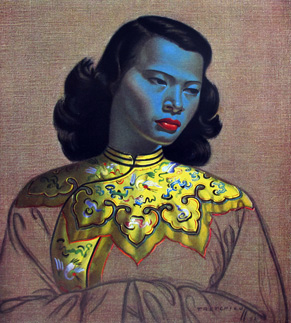
One of the best-selling mass produced prints of the 20th Century was ‘Chinese Girl’ (1952) by Vladimir Tretchikoff.
Despite this it has been described harshly ‘arguably the most unpleasant work of art to be published in the 20th Century’ (Feaver, cited in Bell 2013 ‘Brilliant trechnicolour or trashicolour’ (Gorelich 2013:106). The painting shows a portrait of a Chinese girl, dressed in a part finished golden dress. Her make up and hair resemble 1950’s glamour and her face glows an unusual blue colour. The background is left unpainted.
So, what features in ‘Chinese Girl’ correspond to Greenberg’s view that kitsch ‘imitates the effects of art’?
The painting is representational. The viewer has to expend no effort interpreting the content or understanding meaning. We are presented with a portrait that uses bright striking contrasting colours. These colours heighten reality and create a more dramatic and artificial image. Freemantle, in her essay on South African icons, states that the image is very similar to 1950’s glamour photography and uses graphic and advertising techniques of high detail and loose drawing. The application of bright paint and the style of oriental mixed with 1950’s style glamour creates more of a ‘garish’ and tacky representation (Freemantle 1998: 95-96). The unfinished look of the painting with the unpainted background and dress attempt sophistication and draw the viewers gaze to the blue face. It is uncertain why the girl’s face is blue but it certainly makes the face more visible against the background.
The portrait is an unusual yet intimate representation of idealised feminine youth. She is close up and engaged with the viewer. The painting is sensual and dramatic and provides instant gratification as the girl can be seen as an exotic, romantic character, as if in a story. Sentimentality and emotion are invoked by her mysterious, sullen pose and the strong tonal contrasts used by the artist. There is a sense of falseness to these emotions though as they are easily evoked and easily forgotten.
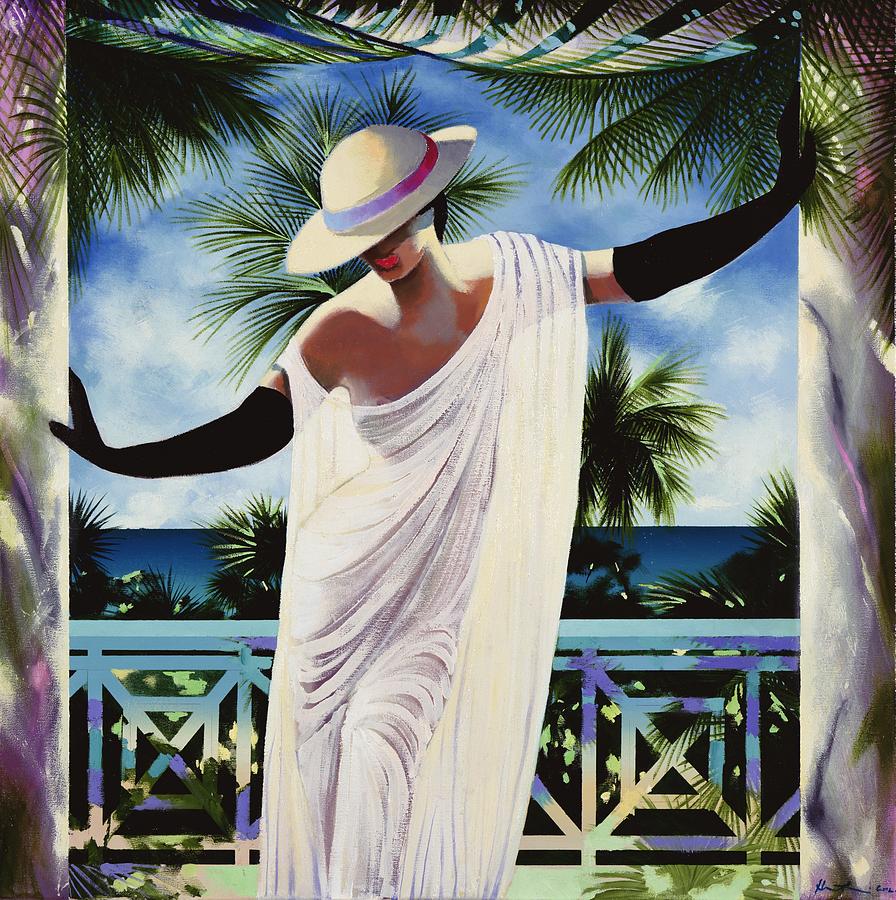
If we examine Andrew Hewkin’s painting ‘Do you leave footprints in the sand’, we can see features similar to ‘Chinese Girl’ that correspond to Greenberg’s view that kitsch ‘imitates the effects of art’.
This 21st Century painting does look very ‘kitsch’ and is reminiscent of posters that were sold in the 1980’s in the Athena shop. A woman poses between two marble pillars on a balcony above palm trees next to the sea. She poses evocatively in loose fitting white clothing that is illuminated by the sun and gives it almost a holy or magical effect.
As Hewkin’s painting is a representational image the viewer again is not required to put in any effort understanding meaning – everything is visually there and recognisable. The viewer can be transported to an idyllic scene that may evoke memories or a desire to be somewhere else. The relaxed feel, the sun and the sea and the marble could trigger former times of when the viewer was in an environment like this (perhaps on a holiday) or create a desire to be in this environment. The viewer is reminded of carefree times, perhaps away from the general ‘hum-drum’ of daily life a – break in the routine. The artist is deliberately creating a feeling of nostalgia in the viewer – visually transporting them to an idyllic environment.
The woman looks sophisticated with her clothing and gloves and acts mysteriously by looking down and hiding her eyes under the rim of the hat. The whole scene looks luxurious with the female figure framed by the marble. In terms of composition, strong horizontal and vertical lines are broken up by the central figure that is full of curves and diagonals which keeps the viewer focused.
The colours used create an artificial feel due to the use of strong blues and greens. I would say that it feels as though Hewkin has used graphic design techniques to create an ‘unreal’ and simple effect through his composition choice and use of colour. None of this feels natural as it promotes an ‘idealised’ version of beauty in female form and in the surroundings she occupies.
In both paintings I feel that everything has been exaggerated – (colour, fashion, pose, composition) to allow the maximum experience and effect whilst giving minimal effort.
Both Chinese Girl and Do you leave footprints in the sand?’ are good examples of ‘kitsch’ paintings. They are both representational requiring the viewer to invest minimal intellectual effort. Both paintings, use very ‘garish’ bright colours giving them an artificial feel. In terms of composition, they are very simplistic and the subject matter evokes a nostalgic feeling in the viewer. A nostalgia that suggests an exotic fantasy life, perhaps from the past (Chinese girl) or a period in the viewers life that they might have fond memories of (Do you leave footprints in the sand?). Both paintings are mass-produced on a large scale and available to the mass market at a low cost.
Reflection
Clement’s theory of Avant-garde and kitsch has given me lots to think about particularly in contemporary art and I would question whether ‘kitsch’ necessarily has to belong to the masses. If we look at artists such as Jeff Koons and some of his sculptures, for example Michael Jackson and Bubbles, we can absolutely describe them as ‘kitsch’, tacky and cheap looking. In a way, the artist has almost exploited the idea of kitsch in a new way. However, Koons has not mass produced his work and it sells exclusively to wealthy art collectors at a high price. We can also look at the rise of modern art galleries that are now accessible to the masses as part of the consumer culture of experience. Previously exclusive ‘avante-garde’ artists now receive a wider viewing across a more diverse mass audience. Greenberg wrote this essay during the 1930’s and focused on abstract art as ‘avante-garde’. Since then, modern art has seen many art movements that have moved bravely into the unknown and could be seen as venturing into new territories.
List of Illustrations
Fig 1. Tretchikoff, V. (1952-3) Chinese Girl’ , [oil on canvas] At https://fineartamerica.com/featured/vladimir-tretchikoffs-the-chinese-girl-the-green-lady-krystal-.html?product=art-print (Accessed 18/11/2019)
Fig 2. Hewkin, A. (2002) ‘Do you leave footprints in the sand?’ [oil on canvas] At http://andrewhewkin.com/index.php/2001-2010/ (Accessed 18/11/2019)
Bibliography
Bell, M. (03/2013) Chinese Girl: the Mona Lisa of kitsch. In The Independent 17/03/2013 (Accessed 18/11/2019)
Freemantle, B. (2018) A Pantheon of icons: towards a South African iconology ‘viewed at: http://wiredspace.wits.ac.za/handle/10539/25904 (Accessed 18/11/2019)
Greenberg, C. (1939) Avant-garde and kitsch. At http://sites.uci.edu/form/files/2015/01/Greenberg-Clement-Avant-Garde-and-Kitsch-copy.pdf (Accessed 18/11/2019)
Harrison, C. (1996) Modernism in Nelson, Robert, S. and Shiff, Richard. ‘Critical term for art history’, (1996) University of Chicago Press.
Jon Anderson Lecture on Clement Greenberg’s Subject v Medium Debate in Modernism -You tube viewed at:
Assignment 2
Look at Allan McCollum’s work ‘Plaster Surrogates’ and explain its relationship to Modernist art and theory.
Created in the early 1980’s, ‘Plaster Surrogates’ is a series of works by L.A born artist Allan McCollum. Collections of what appear to be framed monochrome canvases are displayed in galleries in large groups with no picture being the same in terms of size or colour.

At https://www.pinterest.co.uk/pin/254031235202132677/?lp=true (Accessed 18/01/2020)
In Collection of 40 plaster surrogates, Mccollum has used black enamel for the picture and varying shades of grey/black for the frame. The title ‘plaster surrogates’ becomes self-explanatory when we realise that McCollum’s paintings aren’t actually paintings at all but rectangular plaster shapes cast in moulds of varying sizes in the shape of a picture and it’s frame. What we are viewing are ‘plaster surrogates’ or imitations of framed monochrome paintings mounted to a wall.
When ‘Plaster Surrogates’ is displayed in galleries, it is hung in various ways depending on the specifics of the gallery space. For example, it has been hung to resemble an 18th or 19th Century salon (Fig 1. and Fig 2.), wrapped around wall space (Fig 3. ) or ordered in near horizontal or vertical lines (Fig 4.)


Shown in different ways, we start to pay an interest in what the ‘plaster surrogates’ are or represent. They are not specific objects and could be representative of anything placed in a frame – photo, painting, diploma etc. McCollum (2016) refers to them as ‘signs’ for paintings and that the viewer is looking at a ‘bigger picture’ of the social convention for hanging these collectible objects on our walls.
Relationship to Modernist art
McCollum paints most of his imitation canvas’s in pure black enamel and by exploring this use of monochrome we can start to understand Plaster Surrogate’s relationship to Modernist art and theory. Clement Greenberg in his 1961 essay ‘Modernist Painting’ claimed that ‘the essence of modernism lies… in the use of the characteristic methods of a discipline to criticize the discipline itself…’ Each discipline of the arts needed to exhibit and make explicit ‘that which was unique and irreducible.’ (Greenberg 1960 2-3) In painting, this uniqueness or limiting conditions was found to be its optical flatness or two- dimensionality.
“The flat surface, the shape of the support, the properties of pigment – were treated by the Old Masters as negative factors, that could be acknowledged only implicitly or indirectly, Modernist painting has come to regard these same limitations as positive factors.” (Greenberg 1960, 2)
Traditional painting had endeavoured to create an illusion of three-dimensional representational space but Modernist art abandoned recognizable representation and became self-referential by drawing attention to the flatness of the canvas.
Greenberg was a strong advocate of abstract artists such as Pollock and Rothko who he believed were pure Modernist artists embracing the flat surface of the canvas. However, an emerging group of artists in the 1950’s and 60’s started to push Greenberg’s Modernsim to a logical extreme by producing pure monochrome canvases.
Monochrome
Robert Rauschenberg created a series of pure painted white panels in 1951, that were meant to look pure and untouched by human hands. As a precursor to minimalism and conceptualism, these panels act like reflective screens and require the viewer to observe life around the screens – particles of dust, changing light, shadows. Rauschenbergs screens were not pure but acted as a receptive surface of life and the culture around it. (Anderson, 2011)

 At https://www.sfmoma.org/artwork/98.308.A-C/ (Accessed 12/01/2020)
Minimalist painter Frank Stella produced a series of monochrome 'Black Paintings' that were completely self-referential.
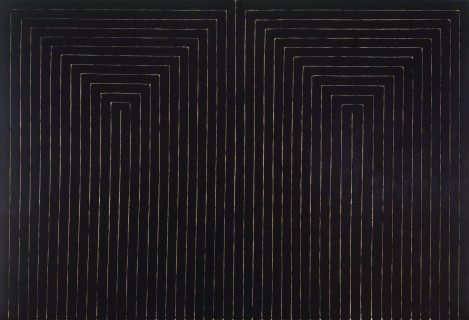
The Marriage of Reason and Squalor II (1959) consists of simple black bands that leave gaps of pure canvas. The stripes reference the rectangular shape of the canvas and when viewing we are looking purely at the painting as paint on a canvas and nothing else. Greenberg(1960) did not initially accept Stella's canvas's as modernist. He had stated that ' Modernism has found that these limiting conditions can be pushed back indefinitely before a picture stops being a picture and turns into an arbitrary object.' De Duve states that:
"Greenberg's taste stopped short of including Stella's black paintings. Is it because they transgressed this ultimate limit and became 'arbitrary objects'. But it would then mean that this limit could not 'be pushed back indefinitely' and that the history of Modernist painting might be terminated.' (De Duve, 1996:247)
According to Tate, monochromes are painted for either spiritual or formal reasons. Rauschenberg's white panels were painted for reflection and abstract purity yet Stella's 'Black Paintings' were reducing painting to its most simplest form focusing on the pure physical elements; colour, form and texture. We can see that McCollum has used black monochrome in Plaster Surrogates to achieve a particular effect (formal or spiritual), yet we still need to understand the development of modernist art to fully understand what this is.
Hybrid Art?
Plaster Surrogates is neither a painting nor a sculpture, yet it appears to be both - a fusion of two disciplines. As previously discussed, in Modernism each discipline of the arts needed to exhibit and make explicit 'that which was unique and irreducible.' (Greenberg 1960 2-3) There was no overlapping between disciplines allowed in Modernism, each was separate and distinct. So how did this fusion of two disciplines become actualised? The Minimalist movement of the 1960's pushed back the limiting conditions of paintings so far that it started to move closer to the discipline of sculpture by moving into the 3rd dimension. Generic art was created.

In the piece titled 'Piano' by Richard Smith (Fig 6.) we are literally able to see this new hybrid art emerging. The art work is still on the wall yet seems to burst out from the canvas and onto the gallery floor. Further work by minimalists saw art completely leave the gallery wall and become freestanding painted sculptures. Artist Donald Judd wished to secure the legitimacy of this kind of art. According to de Duve (1996:268)'it is essential to Judd that Modernism should be allowed to progress beyond the limit set by the literal monochrome.' Eventually Greenberg accepted this new non-modernist hybrid of painting and sculpture which in turn opened new opportunities for artists creating interspecific art (including conceptual and performance). This seemed a natural progression for painting once modernism had reached and transgressed the monochrome.
The concept of Plaster Surrogates
So Plaster Surrogates has a direct relationship with Modernist art and theory. Firstly, McCollum has used a black monochrome on his 'surrogate' canvas and secondly, it is a hybrid of disciplines - a painting and a sculpture. Plaster Surrogates is not a modernist or a minimal piece of art but has its origins in both. McCollum could easily have used real monochrome framed canvases to create his art, but the fact that he has used mass produced objects invites us to look at the concept of his work.
McCollum describes his 'surrogates' as emblems or a sign for a painting/ picture.
"There is some parody, I think, in the way I reduce all paintings to a single “kind,” to a universal sign-for-a-painting; the gesture can be read as an ironic mimicry of modernist reduction, for instance, or as some kind of reference to the relations between modern art and modern industrial production." (McCollum 1985)
Unlike Greenberg, whose Modernist theory focused on purity of discipline, McCollum is more interested in the 'emotional' content that occurs between the viewer and the object/s. By creating an object resembling a painting with all content removed (monochrome), he is allowing the viewer to approach the work of art and experience expectations, emotions and desires. What transaction is taking place? McCollum (1985) states that the effect creates 'the experience of subjectivity rather than creating subjective experience.' He is inviting the viewer to question 'What kind of an object a painting is in an emotional sense and without the patriarchal noise of aesthetics intruding into the relationship.'
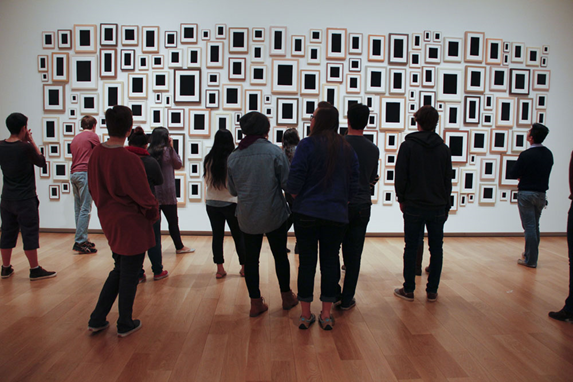
McCollum describes his 'plaster surrogates' as props, the gallery as a theatre and the spectators as actors. What are these rectangular shaped objects and why do we place them on our walls. (Traditionally in ancient and tribal art, painting was placed on the body, directly on the walls or embodied in architecture). A painting is a convention of our culture and we as individuals relate to that convention.
Plaster Surrogates has emerged from Modernist theory by exploiting the monochrome canvas and embracing the generic art of fused disciplines. McCollum rejects Greenberg's theory of Modernist Painting by deflecting self-awareness away from the painting and onto the spectator. It is what is happening around the Plaster Surrogates that is emphasised in this piece of art work rather than the art work itself.
Reflection
I felt as though I could write a lot more about this piece of art work and ended up omitting a lot of research. McCollum has a fascination with objects and the way humans interact with them. It would have been interesting to explore the manufacture of the Plaster surrogates and their relationship to the capitalist consumer society that we live in. . McCollum also has a perspective that looks at the ‘bigger picture’ and I find it fascinating that what initially seems like a simple piece of work can expand our understanding of life and ourselves.
List of Illustrations
Fig 1. McCollum, A. (1982) Collection of 40 Plaster Surrogates [ Enamel on cast Hydrostone] At https://www.pinterest.co.uk/pin/254031235202132677/?lp=true (Accessed 18/01/2020)
Fig 2. Lemmonier A.C.G (1755) Madame Geoffrin`s salon [oil on canvas] At https://www.pinterest.it/pin/483292603754661385/ (Accessed 06/03/2020)
Fig 3. McCollum, A. (1982) Collection of 40 Plaster Surrogates [ Enamel on cast Hydrostone] Installation: Metro Pictures, New York, 1985-86 At http://allanmccollum.net/allanmcnyc/Dietmar_Elger.html (Accessed 11/01/2020)
Fig 4. McCollum, A. (1982) Collection of 40 Plaster Surrogates [ Enamel on cast Hydrostone] At http://www.artnet.com/artists/allan-mccollum/100-plaster-surrogates-YQRkUziinrA_pzOU2iMAtw2 (Accessed 11/01/2020)
Fig 5. Rauschenberg R. (1951) Three Panels
Fig 6. Stella F. (1959) The Marriage of Reason and Squalor II [enamel on canvas] At https://uk.phaidon.com/agenda/art/articles/2018/february/08/understanding-stella-the-black-paintings/ (Accessed 12/01/2020)
Fig 7. Smith R. (1963) Piano [pva paint on canvas] At https://www.tate.org.uk/art/artworks/smith-piano-t02003 (Acessed 13/01/2020)
Fig 8. McCollum, A. (1982/3-5) Two Hunderd Plaster Surrogates [Enamel on cast Hydrostone] At https://www.themodern.org/tap/11214-day-4-randy-guthmiller (Accessed 15/01/2020)
Bibliography
Bois, Y.A et al (2004) Art Since 1900 London and New York, Thames and Hudson
Anderson, J (2012) [ARTS 315] The Fully Present Object: Minimalism. Contemporary art trends lecture series. Biola University, California 9/07/2012 At https://www.youtube.com/watch?v=RogfryPVWDk (Accessed 15/01/2020)
Anderson, J (2012) [ARTS 315] Duchamp's Legacy: Robert Rauschenberg and John Cage. Contemporary art trends lecture series. Biola University, California. At https://www.youtube.com/watch?v=TF-MuonISAk (Accessed 15/01/2020)
Dellinger, J. (2013), A Conversation with Allan McCollum: MASS-PRODUCING INDIVIDUAL WORKS in Sculpture; Washington Vol 32 Iss 2., (Mar 2013): 44-49. At https://search-proquest-com.ucreative.idm.oclc.org/docview/1347528180?pq-origsite=summon (Accessed 15/01/2020)
De Duve, T. (1996) 'The Monochrome and the Blank canvas' in Guilbaut, S. (ed) Reconstructing Modernism’. MIT: Univers and Bodini pp.244-310 At https://monoskop.org/File:Guilbaut_Serge_ed_Reconstructing_Modernism_Art_in_New_York_Paris_and_Montreal_1945-1964.pdf Accessed 15/01/2020)
Greenberg, C. (1961) Modernist Painting At http://www.yorku.ca/yamlau/readings/greenberg_modernistPainting.pdf (Accessed 15/01/2020)
https://www.tate.org.uk/art/art-terms/m/monochrome (Accessed 15/01/2020)
Moma Learning, McCollum, A. (1982) Collection of Forty plaster Surrogates At https://www.moma.org/collection/works/79653 (Accessed 15/01/2020)
Moma Learning, Stella F. (1959) The Marriage of Reason and Squalor II [enamel on canvas] At https://uk.phaidon.com/agenda/art/articles/2018/february/08/understanding-stella-the-black-paintings/ (Accessed 12/01/2020)
Robbins D. A. (1984) An Interview with Allan McCollum In Arts Magazine 1985 At http://web.mit.edu/allanmc/www/amcarticles/McCollum-Robbins.pdf (Accessed 15/01/2020
Starke, T. (2012) Allan McCollum originally published in:
This Will Have Been: Art, Love & Politics in the 1980s
At http://allanmccollum.net/allanmcnyc/McCollum-Starke.html (Accessed 15/01/2020)
- Document
- Block
No block selected.Open publish panel
- Document

 Lara's Understanding Visual culture (Visual Studies 1) blog