This section of the course seemed to flow well for you and it has hit some notes of interest for you which you will be able to follow up on.
Your research and academic skills have developed over the course and I hope that you will continue to enjoy this aspect and bring it soundly into your contextual investigations. Well done.
Feedback on assignment Demonstration of technical and Visual Skills, Quality of Outcome, Demonstration of Creativity
Assignment:
This assignment had a lot going for it, you had used a good structure and good examples particularly. Overall it just needed the aesthetic experience ‘difference’ brought to the fore. It is a balance thing and we discussed it. The contexts are good, examples good and you have developed your thinking of the two forms.
Use your Taliaferro text to help you to discuss the aesthetic. First go through the essay and highlight the areas where this can happen. Then develop those areas. Lastly just bring this into the summation clearly. This will then fully answer the Essay question. Well done on the overall- it was a good read and with this aspect further brought to the fore it will be a sound piece of writing.
Exercises:
Looking across the exercises which on the whole are clear and pragmatic,in particular, I would have another go at 5.3 as the outcome of this wasn’t very clear and it lack contextual pre-cursors- we talked about Duchamp for instance and also the sketchy history of the painted bed- so there are precedence as to why this might be considered ‘art’. When we don’t consider it art what is it? We had a little discussion around this- but if you are not clear then do email me.
5.4 works well, and you have used good examples of institutional critique, with a nice summation at the end. I do particularly enjoy Fred Wilson- got any more images?
I also particularly liked your rationalization of BARR- this is tricky and you have pushed through- power!!
Of note this paragraph.
We could also view the reversal of the chart as moving from the internal world of the mind, passing through emotional states (Fauvism and Expressionism) to the external world (Neo-impressionism) -Visually passing from the unconscious world to the conscious one. It is almost as though (going forwards from conscious to unconscious) artists were trying to purify their art and find some deeper human truth.
And the reflection at the end is super clear-
Well done.
Remember that:
OCA uses UCA’s Harvard Referencing guide which can always be found by Googling UCA Harvard Reference Guide.
Sketchbooks Demonstration of technical and Visual Skills, Demonstration of Creativity
Learning Logs or Blogs/Critical essays Context
Concepts and ideas are developing in your sketchbook, keep going with this and enjoy the process. We discussed synthesis and going forwards into your practical course, so remember to use your research skills now to feed your contextual and philosophic awareness of painting.
Suggested reading/viewing Context
Pointers for the next assignment
Remember to go back and sure up your references across the materials that we have discussed.
Tutor name:
Michele Whiting
Date
10 JULY 2020
Next assignment due
28th August 2020. 12.30
Response to Feedback
I was overall pleased with my feedback from my tutor and understood immediately the areas that I needed to amend and add to. We talked about aesthetics and how I needed to develop this area in Assignment 5 in relation to video installations and the experience of the viewer. We also looked at Exercise 5.3 which lacked any contextual perspective. I shall rework these two pieces addressing these elements and underline any amended and new text.
Assignment 5
In what way do video installations differ from films shown in cinema? List the physical differences and use these as evidence to explain the differences in experience and aesthetic appreciation.
Think about the environment as well as the immediate space in which film is shown. Consider the types of film and select an example for more detailed discussion. (1000 words)
Introduction
Introduction
Films shown in cinemas have been an accessible form of entertainment for the masses over the past 100 years. After the development of hand held recorders in the 1960’s, artists started to create films that differed greatly from those shown in the cinema. As the two have progressed, differences have remained between the two types of film and the environment in which they are displayed. These differences allow for a different experience and aesthetic appreciation in the viewer.
Differences between cinema films and video installations
Films that are played at the cinema tend to fall into one of two categories – narrative and documentary. The main type of narrative film is organised in chronological order (reflective of real life) and in real time. Fictional stories tend to be based on a main line of action with a beginning, middle and an end (elementsofcinema.com accessed 03/08/2020). Viewers connect to the story through the use of characters played by actors following a rehearsed script. Less common are documentary films which expose reality and come from an investigative perspective. (elementsofcinema.com accessed 03/08/2020
Video installations are generally not narrative based or filmed in a linear perspective. They often explore the boundaries of the medium itself (Lee, s.d.) and are varied in their construction. Structuralist artists such as Michael Snow explored the specific characteristics of the medium in their videos. Videos were slowed down/speeded up, edited, played on a loop etc. (Kotz 2008:137). Other video art can produce a maximum sensory impact on the viewer through the use of sound, motion or light. Whereas cinema films have the purpose of entertainment and emotional engagement, video art’s purpose is very much reliant on the intent of the artist and the experience and the interpretation of the viewer.
Different Environments
The environment of films shown in the cinema and installation videos varies enormously and has a large effect on the experience of the viewer. In the theatrical environment of the cinema, the viewers have allocated seats facing forwards towards the large single screen. Lights are eliminated as the screening begins and the audience are immersed in their fairly passive experience (figure 1). They are expected to remain seated and silent for the duration of the film (usually 2 hours).
The cinema itself is part of the entertainment and leisure industry, usually surrounded by restaurants and other venues purpose built for ‘entertainment’.
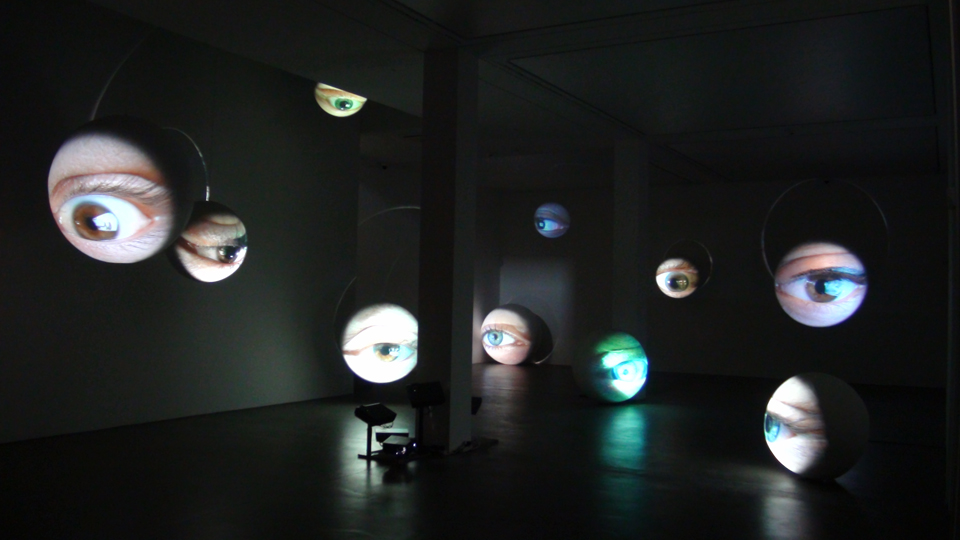
When viewing a video installation in a gallery, the viewers are free to wander in to the room at any point. Sometimes the rooms are bright and lit and sometimes they are darkened. There is no expectation to stay for the duration of the video and there are usually no or few seats. Projectors might be visible/invisible and screens can be multiple or none – white walls work just as well. There is no norm and so presentation depends on the effect the artist is trying to create. There is even no prerequisite for projections to be shown on a flat surface. The artist Tony Oursler frees his images from the screen and its technical support by projecting them onto three-dimensional surfaces (Kotz 2008:131). ‘Obscura’ consisted of large blinking eyeballs floating on spherical objects. This would create a different aesthetic appreciation in the viewer who is confronted with a new visual experience. The freedom of the gallery allows the viewer to physically explore these 3D projections by moving around the installation. This might create a new experience or perspective in the viewer.
Oursler also took video installation out of the gallery. Site specific work such as The Influence Machine (2000) staged in London’s Soho Square allowed the viewers to move through the installation and experience the urban environment in a new way (Tate online, Accessed 04/08/2020).
The Godfather vs Martyrs
To illustrate the different experiences and aesthetic appreciation of the two types of film, the art installation Martyrs by Bill Viola and the film The Godfather directed by Francis Ford Coppolla will be discussed. The Godfather (1972) is an Oscar winning film about a mafia family and has since been celebrated as one of the best films ever made (Empire:2018). The audience, who at the time of release would have experienced this in the cinema, would be completely immersed in the life of the Corleone family. They would have emotionally responded to events and characters on the screen as they watched this illusion of real life on the large flat screen before them.
In contrast to this cinema film, the work of Bill Viola creates a different experience and aesthetic appreciation in the viewer. Martyrs (Earth, Air, Fire,Water)(2014) is a site specific work of four screens placed in St Paul’s Cathedral, London. Each screen shows an individual who is gradually overwhelmed by the force of an element.
The four screens create a fragmented viewing experience. There is no seating so the viewer has to recieve the work standing or in a fleeting moment whilst passing through the cathedral – emgagment is one of choice/curiosity. The duration of the film is unknown and the viewer can start viewing at any point in the films loop. Viola (2017) explains that martyrs ‘exemplify the human capacity to bear pain, hardship, and even death in order to remain faithful to their values, beliefs, and principles.’ The piece creates a sense of suffering but also a sense of hope (Londonhuawiki online:2017). In reflection, the viewer is able to interpret and appreciate the art work in a way that is personal to them, their beliefs and their spirituality.
Occasionally, there is blurring between the characteristics of films shown in cinema and video installations. One example of this could be 2001: A Space Odyssey by director Stanley Kubrick. Kubrick plays with a loose narrative and includes long meditative visual sequences. At one point the viewer is immersed in a 10 minute sequence of visuals in the ‘star gate sequence’ that would not look out of place in an art gallery.
Video installations and films shown in cinemas create a different experience and aesthetic appreciation in the viewer. This is largely due to the different physical environments of the cinema and the gallery or site-specific placing for the video installation. Cinema films follow a prescribed formula allowing the viewers to appreciate a fairly predictable experience. Video installations, however, place the viewer in a position of uncertainty. The artist ( with no prescribed formula) can manipulate the media in unique ways that allow the viewer to experience the installation in new ways.
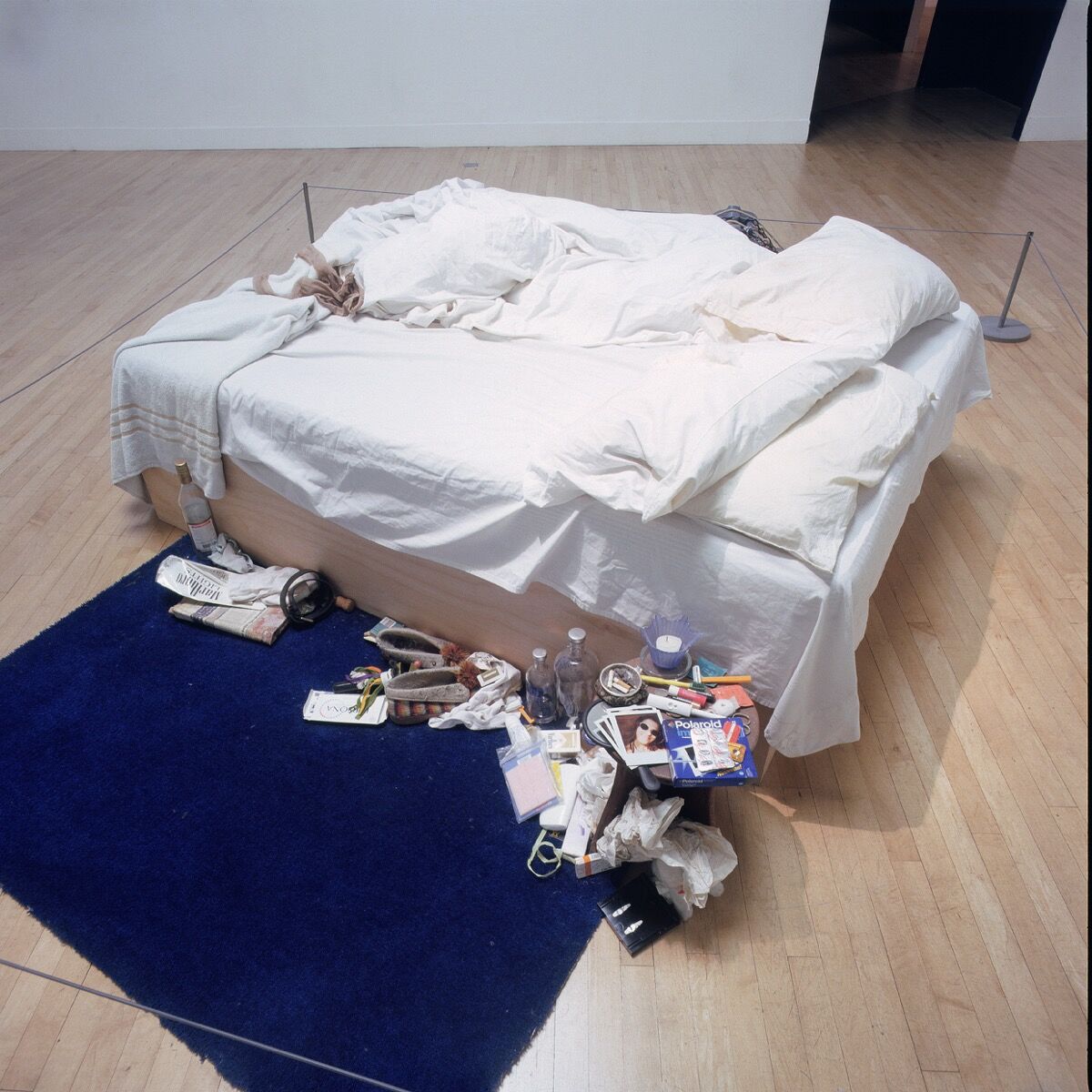
My Bed (1988) by Tracy Emin is a gallery installation of Emin’s own bed surrounded by her clutter/objects. The objects hint at Emin’s mental state at the time. Emin’s bed could be termed a ‘readymade’ piece of art similar to Duchamp’s Fountain (1917). The factors which make this bed a work of art are defined by the Tate. The choice of the object by Emin is a creative act in itself. It’s presentation and title give the object a new meaning along with the cancelling out of its usefulness.
The subject matter, a bed, could be seen as an uninteresting and ordinary object but through modern history this subject matter has been explored by artists such as Van Gogh in Bedroom in Arles (1888) and Claude Monet in Cat sleeping on a bed (1865-1870). Without this historical context of the readymade as art and artists painting ordinary objects, Emin’s bed would most likely not be considered a work of art.
I have really enjoyed Part 5 of the course and feel as though it has sparked an interest in contemporary art. I was particularly drawn to the site-specific sculptures of Richard Serra and Nancy Holt. It has also encouraged me to explore video installations and I particularly felt as though I connected with the work of Bill Viola. Overall the whole of the Understanding Visual Culture course has been very rewarding as my knowledge and understanding of art has deepened significantly. I was especially interested in the modern art movement and how this developed. I have not visited an art gallery for over a year due to an injury and the Covid-19 pandemic so am very much looking forward to visiting the Tate Modern with a ‘new perspective’ and a better understanding of the works displayed there.
Assessment Criteria
Demonstration of subjectbased knowledge and understanding
I believe that my knowledge and understanding regarding contemporary art has improved dramatically and that this is reflected in my writing. I have spent a lot of time exploring subjects such as the genre of ‘institutional critique’. I had previously not heard of this term and quickly became aware that this type of art is something that I feel passionately about. Assignment 5 demonstrated my ability to compare and contrast two different uses of the same medium and how the use and placing of this medium creates different effects for the viewer.
Demonstration of Research skills
I am confident that my research skills have improved throughout this course as I am able to locate resources that help me to understand a subject. I have significantly improved my referencing as I take notes during research, I ensure that everything is referenced to author, location of work, date and page number. This helps me to reference accurately and easily when I am writing an exercise or assignment.
Demonstration of critical and evaluation skills
I have been successful thinking critically around a subject. I often research an area and then spend a lot of time thinking and reflecting upon it before I start to write. I feel as though I can apply concepts and wider current issues to the exercises and assignments which, I feel, helps my understanding on a deeper level.
Communication
Following feedback from my tutor, I now feel that my communication and presentation skills are well developed. I am able to organise ideas and thoughts by using subheadings. I effectively use illustrations to visually support the writing element of my work and this helps to engage the reader. I have become better at fully exploring ideas and insights and writing around quotes so that they are fully understood.
In what way do video installations differ from films shown in cinema? List the physical differences and use these as evidence to explain the differences in experience and aesthetic appreciation.
Think about the environment as well as the immediate space in which film is shown. Consider the types of film and select an example for more detailed discussion. (1000 words)
Introduction
Films shown in cinemas have been an accessible form of entertainment for the masses over the past 100 years. After the development of hand held recorders in the 1960’s, artists started to create films that differed greatly from those shown in the cinema. As the two have progressed, differences have remained between the two types of film and the environment in which they are displayed. These differences allow for a different experience and aesthetic appreciation in the viewer.
Differences between cinema films and video installations
Films that are played at the cinema tend to fall into one of two categories – narrative and documentary. The main type of narrative film is organised in chronological order (reflective of real life) and in real time. Fictional stories tend to be based on a main line of action with a beginning, middle and an end (elementsofcinema.com accessed 03/08/2020). Viewers connect to the story through the use of characters played by actors following a rehearsed script. Less common are documentary films which expose reality and come from an investigative perspective. (elementsofcinema.com accessed 03/08/2020
Video installations are generally not narrative based or filmed in a linear perspective. They often explore the boundaries of the medium itself (Lee, s.d.) and are varied in their construction. Structuralist artists such as Michael Snow explored the specific characteristics of the medium in their videos. Videos were slowed down/speeded up, edited, played on a loop etc. (Kotz 2008:137). Other video art can produce a maximum sensory impact on the viewer through the use of sound, motion or light. Whereas cinema films have the purpose of entertainment and emotional engagement, video art’s purpose is very much reliant on the intent of the artist and the experience and the interpretation of the viewer.
Different Environments
The environment of films shown in the cinema and installation videos varies enormously and has a large effect on the experience of the viewer. In the theatrical environment of the cinema, the viewers have allocated seats facing forwards towards the large single screen. Lights are eliminated as the screening begins and the audience are immersed in their fairly passive experience (figure 1). They are expected to remain seated and silent for the duration of the film (usually 2 hours).
The cinema itself is part of the entertainment and leisure industry, usually surrounded by restaurants and other venues purpose built for ‘entertainment’.
When viewing a video installation in a gallery, the viewers are free to wander in to the room at any point. Sometimes the rooms are bright and lit and sometimes they are darkened. There is no expectation to stay for the duration of the video and there are usually no or few seats. Projectors might be visible/invisible and screens can be multiple or none – white walls work just as well. There is no norm and so presentation depends on the effect the artist is trying to create. There is even no prerequisite for projections to be shown on a flat surface. The artist Tony Oursler frees his images from the screen and its technical support by projecting them onto three-dimensional surfaces (Kotz 2008:131). For example, ‘Obscura’ consisted of large blinking eyeballs floating on spherical objects allowing the viewer to experience the isolating effects of technological inter-connectivity as the eyes consume data and information (Tate online, Accessed 04/08/2020).
Oursler also took video installation out of the gallery. Site specific work such as The Influence Machine (2000) staged in London’s Soho Square allowed the viewers to move through the installation and experience the urban environment in a new way (Tate online, Accessed 04/08/2020).
The Godfather vs Martyrs
To illustrate the different experiences and aesthetic appreciation of the two types of film, the art installation Martyrs by Bill Viola and the film The Godfather directed by Francis Ford Coppolla will be discussed. The Godfather (1972) is an Oscar winning film about a mafia family and has since been celebrated as one of the best films ever made (Empire:2018). The audience, who at the time of release would have experienced this in the cinema, would be completely immersed in the life of the Corleone family. They would have emotionally responded to events and characters on the screen as they watched this illusion of real life on the large flat screen before them.
In contrast to this cinema film, the work of Bill Viola creates a different experience for the viewer. Martyrs (Earth, Air, Fire,Water)(2014) is a site specific work of four screens placed in St Paul’s Cathedral, London. Each screen shows an individual who is gradually overwhelmed by the force of an element.
The placing of this work is such that it may just be stumbled across accidentally. There is no seating and viewers can watch as much or as little as they wish. We are presented with the suffering of four individuals at the hands of the elements as they gradually increase and decrease their force. The spiritual environment of this video installation invites a quiet contemplation. Viola (2017) explains that martyrs ‘exemplify the human capacity to bear pain, hardship, and even death in order to remain faithful to their values, beliefs, and principles.’ The piece creates a sense of suffering but also a sense of hope (Londonhuawiki online:2017). In reflection, the viewer is able to interpret the art work in a way that is personal to them, their beliefs and their spirituality.
Occasionally, there is blurring between the characteristics of films shown in cinema and video installations. One example of this could be 2001: A Space Odyssey by director Stanley Kubrick. Kubrick plays with a loose narrative and includes long meditative visual sequences. At one point the viewer is immersed in a 10 minute sequence of visuals in the ‘star gate sequence’ that would not look out of place in an art gallery.
The medium of film is very different when experienced in the cinema than when it is experienced as part of an art installation. The format and environment for cinema films is the same across the world. Viewers know exactly what to expect when they purchase their tickets. When viewers enter a gallery or encounter a site-specific video there is an element of uncertainty. There are no rules or specified formats that the artist has to adhere to. There is room for the viewer to interpret the work in their own way that is personal to them.
Reflections
Last year I visited St. Paul’s cathedral with my niece and nephew for the first time since I was a child. I remember being very overwhelmed by the peaceful and energising atmosphere of the building and stumbling across Martyrs by accident. It had a very powerful effect on myself and my niece and we spent a long time watching it. Had I seen this in a gallery on the internet I don’t believe that it would have been so captivating. The juxtaposition of the bright crystal clear images on the screens with the historical art and sculpture and the hushed atmosphere of the cathedral made it mesmerising.
There was a lot to write about in this assignment. I didn’t include the institutional aspects of the different types of film due to the word count, but felt that this would definitely affect the types of films made. The artist has less pressure to create blockbusting mass-consumed films and therefore has a lot more freedom than traditional film-makers.
Watch Richard Serra’s films ‘Hand catching Lead’ and ‘Boomerang’. Familiarize yourself with his work and say why you think he made these films.
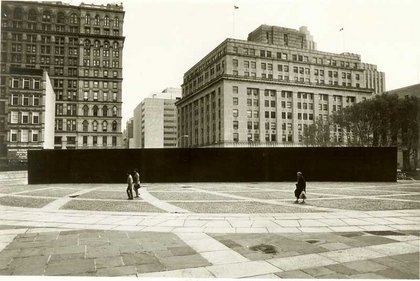
Richard Serra is mostly known for his minimalist sculptures that include works such as Tilted arc(1988) and Fulcrum(1987). Serra’s work was often site specific that gave the viewers an experience that was not just visual but physical as well. The placement of Tilted arc, a 12ft tall,120 foot long 15 ton slab of steel, across Federal Plaza in New York altered people’s experience of the space they inhabited. Instead of a sculpture that was looked at from a distance, Serra’s sculptures interacted and immersed themselves with the everyday lives of the inhabitants whilst altering their experience and perspective of that space (Dosh, M. s.d).
During the 1960’s Serra explored the new medium of film to create art. Two of such films were Hand catching lead (1968) and Boomerang (1974) with artist Nancy Holt. By exploring these films it is possible to understand why Serra made them.
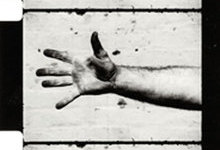
Hand Catching Lead (1968) is a short silent 3 minute black and white 16mm film in which an outstretched hand attempts to catch pieces of lead that appear to drop from above. The entire film is focused just on the hand as it opens and closes sometimes catching the lead (then dropping it) and sometimes not. The film records a repetitive and continuous action without any climax (Bukhari, 2017).
Serra was interested in the working processes of creating sculpture, whether by hand or through industrial means, and seems to explore this through film (Clark, M.E s.d. Accessed 31/07/2020). The artist’s 1967 “Verb List Compilation: Actions to Relate to Oneself” included verbs such as “to roll,” “to crease” and “to fold,”. Chayka (2011) explains that ‘the action, signified by the verb, becomes the art, rather than the resultant object.’ In the case of Hand catching lead the artist is focused on the action catching. Other works of this period capture the actions of the verbs splashing and scraping.
In Boomerang (1974) the artist Nancy Holt was recorded by Serra whilst hearing her words repeated back to her after a one second delay through headphones. The effects are quite extraordinary and Holt is able to articulate her experience during the 10 minute video.
Holt states ‘I am once removed from myself’, ‘I have a feeling that I am not where I am,’ ‘words become like things’, and ‘I feel that this place is removed from reality.’ Her thought process becomes interrupted and she starts to experience an altered sense of reality. Her experience of displacement and altered reality mirrors the effects that Serra creates through his sculptures that aim to disrupt and alter the perspectives of the people interacting with it.
It is likely that Serra produced these films to explore the creation of art through a newly available medium. His interests in the processes of creating sculpture are evident in Hand catching lead and the repeated effects of displacement caused by site specific sculpture are reproduced in Boomerang.
Bukhari, K. (2017) Movements of Media in Yvonne Rainer’s Hand Movie (1966) and Richard Serra’s Hand Catching Lead (1968) In: The Internationl Journal of Screendance Vol 8 (2017) At: https://screendancejournal.org/article/view/5366/4641 (Accessed 31/07/2020)
Does institutional critique presuppose an ‘insider’ audience requiring familiarity with artworld topics and issues or can it be understood by almost anyone spending an hour or two in a gallery?
Institutional critique is a genre of art that draws attention to the institutional framework of the art world. This can include the sale, display and value of art, the structures and commercial agendas that underlie art galleries, and the social, political, cultural and economic factors that determine what fine art is (Price: 2018). By examining some art work from this genre it is possible to determine whether a viewer would require ‘insider’ knowledge of the art world to understand it or if this type of art is accessible to all.
A movement that started in the 1960’s, artists such as Michael Asher and Hans Haacke started to question how neutral the museum, as an institution, was. In Untitled intervention (Fig 1.) Asher removed the partitioning wall in a gallery exhibition room to reveal an administrative area of the gallery normally unseen (Price 2018).
No prior inside knowledge of art would be required to understand that this was drawing attention to and revealing the behind the scenes inner workings of the running of the gallery. As a viewer though one would need some indication that this was actually an art installation or they might think that they had wandered into an empty room!
In the same year, Haans Haacke drew attention to the relationships that galleries/museums have with certain private individuals. In Solomon R. Guggenheim Museum Board of trustees (1974) , 7 panels of framed text revealing connections between a number of the trustees of the Guggenheim museum and the Kennecott Copper Corporation in Chile were revealed. (Bois et. al. 2004:547). The neutrality and morality of these unseen influential individuals were open for debate. The accessibility for the viewer understanding this artwork would be questionable. Firstly, framed text is not usually expected in an art gallery and secondly, one would have to have some prior knowledge of the political situation in Chile and the role and influence played by the trustees.
During the 1980’s artists such as Fred Wilson critiqued the institution through exhibitions such as mining the museum (1992). The installation critiqued the neutrality of the museum when exhibiting artefacts that underrepresented Black and Native American local history. If the viewer was a regular museum visitor they would notice that the artefacts and the placing of them were unusual. They enlightened the viewer in a new way that raised awareness of a more honest version of history. Wilson also exhibited Guarded View at the Whitney museum in 1991.
Fig 2. Wilson, F. (1991) Guarded View [wood, paint, steel and fabric] exhibited at the Whitney museum 1991 At https://whitney.org/collection/works/11433 (accessed 27/02/2020)
These black mannequins (with no heads) in museum guard clothing demonstrated the social inequalities experienced by the Black community within the art world. A Black person was more likely to work as an anonymous security guard or a cafe assistant than be an artist or a visitor to the gallery/museum (Price, 2018). Would the meaning behind Guarded View be accessible to the average gallery visitor? Perhaps this would require more thought and an awareness of Black and Minority Ethnic inequalities from the viewer.
Perhaps the most easily accessible art that critiques the institution is that of the Guerilla girls. This New York based activist group of anonymous female artists was formed in 1985. Their aim was to critique individuals and institutions within the art world that excluded or underrepresented women and minority groups (Dempsey, 2002:292).
With bright posters and statistics that highlight their critique of the institution (Fig 3.) any viewer can easily access the point being made by the Guerrila Girls. No insider knowledge of the art world is required as the facts are clearly stated and easily interpreted.
Conclusion
The genre of institutional critique does not require an audience to be familiar with art world topics and issues. However, some works (The Guerilla girls) are more accessible than others (Haacke). The aim of the works is to draw attention to the viewer the institutional structure and workings of the art world. The audience therefore needs to spend some time with the art work to enable a new way of looking and understanding. However, if the audience member is not open to new ways of looking and perhaps doesn’t consider the social, political and class issues in the wider society, they may struggle to see the significance of some of these pieces.
Fig 2. Wilson, F. (1991) Guarded View [wood, paint, steel and fabric] exhibited at the Whitney museum 1991 At: https://whitney.org/collection/works/11433 (accessed 27/02/2020)
If Tracy Emin’s My Bed (1998) had not become a work of art, it would just be part of someones (in this case the artist’s) personal living space. The clutter around the bed is unique to the individual concerned and their personal experience of life. Every human being has a sleeping space so a bed surrounded by clutter/objects would just be seen as a part of everyday living.
Bringing the ‘taken for granted’ out of its functioning position and placing it within a gallery setting isolates it in a way that allows us to observe this private living space openly and in a new way. By being a work of art, we have been given permission to scrutinise the objects scattered around the bed and deduce the character and state of mind of the individual who inhabited it.
If this installation was not in a gallery it would not be seen as art. In a gallery where it can be viewed and analysed it now becomes art.
Reflections
I think that Emin’s work becomes a piece of art in the gallery due to the symbolism associated with the objects surrounding the bed and how they represent the emotional state and experiences of an individual over a period of time. Would this art installation work if Emin was not in emotional turmoil at the time? Probably not.
What would be the significance of reversing the arrows in Barr’s chart? Make two columns – one ‘forwards’ the other ‘back.’ List as many relevant concepts as you are able to develop the contrast between the two columns. Feel free to ‘cheat’ with a thesaurus.
By comparing the two columns, it is possible to see that going forwards through the chart suggests a move towards primitive art and that going backwards sees a reversal of this – from primitive to socialised or civilised. Neo-impressionist art was representative of the object with traditional perspective and often urban subject matter. There was a scientific and logical approach to optical colour mixing theories (Dempsey, 2002:27). In Fauvism and Expressionism, emotional content became more important, firstly in the viewer and then in the artist. Dadaism rejected reason an logic and the systems enforcing them, replacing them with anarchy and the irrational (Dempsey, 2002: 115). Art was an an idea, made from anything. Surrealism attempted to liberate the unconscious(Dempsey, 2002:153) and to revolutionise human experience (Tate online Accessed 22/07/2020). As a revolt against society, Surrealism was described as ‘thought expressed in the absence of all control exerted by reason, and outside all moral and aesthetic consideration’ (Breton 1924 cited in Dempsey 2002:151). Logic and reason were seen to block the natural human state accessed via the unconscious mind.
By reversing Barr’s chart, art moves from a primitive state (Surrealism) to a more logical and rational one (Neo-Impressionism). Going forwards, logic gives way to the primitive which is a reversal of how the human race has developed!
We could also view the reversal of the chart as moving from the internal world of the mind, passing through emotional states (Fauvism and Expressionism) to the external world (Neo-impressionism) -Visually passing from the unconscious world to the conscious one. It is almost as though (going forwards from conscious to unconscious) artists were trying to purify their art and find some deeper human truth.
Reflections
I wasn’t entirely sure that I understood the exercise above. I had no idea what concepts I was supposed to find and just had to go with what I observed when I reversed the chart. By reversing the charts some quite big concepts became apparent. By looking backwards and then forwards again I could see the transition of this period in art that moved towards rejecting social constructs and realities. By shedding conventions, the artists were moving back towards a more natural and primitive state. They were attempting to capture the pure human condition, residing in the emotions and the unconscious mind.
Bibliography
Dempsey, A. (2002) Styles, Schools and Movements Thames and Hudson:London
In this section of the course you have worked with some complex ideas and engaged with them in a real way using critical thinking and analysis to evaluate and interpret. It shows that your confidence is growing and you have managed to traverse a good range of sources to help your understanding to grow and develop, so considering ‘difference’ and it’s varied aspects/applications recognised through discernment and accepting the complexities of it. Also, remaining open to ideas has enabled you to apply ideas and concepts to appropriate works and consider the 21c values from your position today. Well done.
Feedback on assignment Demonstration of technical and Visual Skills, Quality of Outcome, Demonstration of Creativity
Assignment:
You have considered the complex aspects of ‘difference’ and have defined this very well through application and through the articulation in the essay, meaning that your approaches to critical thinking are developing. You have recognised the nature of complex ideas and theories, and have used disparate sources to help you to navigate this (including lectures and so on on You Tube) This shows your developing research adeptness and ability to begin to articulate the ideas and application of ideas. It is good that you have used a wide base to gain understanding. Remember to be sure of the value of the source in terms of academic provenance, which you are doing, but just as a reminder as you move forwards.
Although the actual essay is clear and pragmatic, you have not used a rigorous method of referencing. We have discussed this and how you can remedy it.
OCA uses UCA’s Harvard Referencing guide which can always be found by Googling UCA Harvard Reference Guide.
In our tutorial we went back over the essay and looked at how and where you should reference fully.
This can then be applied to Ass3 and also to your blog posts for Ass4 and 5 in particular- if you have time go back over the posts for Ass3 and the essay. This will help you set up a firm base for your future courses as well. If you would like me to look at a sample just send me a fresh link and I will ‘pop’ in and have a look for you.
In your blog there are good examples that you have achieved such as:
Although you may want to attribute a page number?
The ref below needs to have the accessed date on attributed in the ref list- check this in the Harvard guide.
These are examples of instances where you can go back and just sure up, then attribute where you might not have in other instances.
The reason for this ‘combing through’ what you have already achieved, is that you need to show your good research and attribute your learning. Without this at assessment you will be falling short of academic standards.
I suggested making some sample references and putting them near your computer as a print out, so that you can readily refer to them as you are writing, rather than having to peel back. This will save you time and also means that you are questioning yourself as you are moving forwards.
In Ass4 the thinking around Wilson and difference is clear and articulated well as I have said above, but there are a couple of areas that you can develop.
Be careful to both reference and define the use of synthesis at the start of the essay.
It would be worth noting the social context that the work was made in in the 90’s (in brief), as it was a movement against- so this involved difference and the action of difference. This will help the conclusion to round up as well.
Remember to write into and out of your quotes. Question the value of them to what you are writing about- how does the quote add to the argument or line of reasoning?
In your exercises I have picked up on a few examples so that you can go back and amend, applying the sentiment/observations to the work in Ass4 and going forwards into Ass5. This will help you to develop the critical writing aspects.
Orphism/synthesis section is very clear, and I enjoyed reading this, the parts where you relate the colour to emotion needed some further unpacking but overall successful. Maybe just go back and add a paragraph explaining this interrelationship between colour and emotion from the Orphist perspective.
There was a nice explanation in the Judas/Deleuze exercise (although it needs a ref for ‘monstrous’ the first time you use the word as it was a concept. Can you link monstrous to open out as to in what way was Deleuze was opposed? He described the effect like this because…
Below is a good paragraph as well, that is clear with good correlations made to Greenburg- you need to say what these comparisons consist of it you can- it is an interesting observation so make the most of it. (Ref Greenburg to here)
The relationship between background and figure creates an ‘indifferent difference’ (Olkowski, 1999) between contradictory and inseparable entities. Olkowski describes this as a ‘highly differentiated kind of pictorial space[s] that draws attention to the surface of the picture’. Comparisons can be made to Greenberg’s theory on modernist art where the emphasis was places on drawing attention to the flat surface of the canvas.
Sketchbooks Demonstration of technical and Visual Skills, Demonstration of Creativity
Learning Logs or Blogs/Critical essays Context
Concepts and ideas are developing in your sketchbook, keep going with this and enjoy the process.
Suggested reading/viewing Context
As you are considering painting for your next course a good read is Painting Now. Suzanne Hudson, and although not new it is pertinent.
A book for the summer- Summers of Discontent. The purpose of the Arts Today. Raymond Tallis. Bitter Lemon Press. Good read collated together by Julian Spalding. Paperback.
Remember to go back and sure up your references across the materials that we have discussed.
Tutor name:
Michele Whiting
Date
10 JULY 2020
Next assignment due
28th August 2020. 12.30
Response to Feedback
Overall, I am very pleased with the feedback from my tutor and it was really nice to chat and be able to ask questions over the face to face tutorial. My main prior concern was that I had not fully understood the theories of difference and so felt delighted when my tutor said that my ideas and interpretations were well thought out. As previously stated, I had struggled to interpret and fully grasp some of the theories on difference and spent a long time attempting to understand primary sources. I now know that if this is problematic in the future, I can look to secondary sources to assist my comprehension. Again, a good and well planned structure and use of illustrations helped me to articulate my ideas and construct a well presented assignment.
After looking through some paragraphs in Assignment 4 with my tutor, it became apparent that I had not been referencing accurately. I have thoroughly re-read the Harvard referencing guide and ensured that all the thoughts that were not my own have been referenced back to their source. In future I shall ensure that referencing is undertaken during note-taking to include page numbers so that I can easily reference my sources.
I shall amend Assignment 4 and then revisit my amended essay for part 3 to ensure it is referenced properly. My tutor has advised me to go back over my blog posts for part 4 and, if time permits, part 3 and ensure these are also referenced accurately.
Amendments to Assignment 4
All amendments are underlined. I was unable to date some of my references which led me to question the academic value of a few of my internet based sources.
Explore Fred Wilson ‘Mining the Museum’ and it’s possible interpretations in terms of difference. (no word count specified)
Introduction
The artist Fred Wilson was born in New York in 1954 and describes himself as of “African, Native American, European and Amerindian” descent. In the early 1990’s, The Contemporary Museum of Baltimore and Maryland Historical Society invited Wilson to create a museum installation in which he was given free reign of their collection and any archived objects with the opportunity to display them in any way he chose. The installation ran from 4th April 1992 to February 28th 1993 and mimicked the usual technique for museum displays – labels, wall texts, lighting, audio material yet his installation created a different experience for the viewer. The exhibition took place just before and during the violent unrest in Las Angeles following the killing of the African-American citizen -Rodney King.
The title of his exhibition ‘Mining the Museum’ can be interpreted in different ways and suggests a deliberate play on words. It could mean Wilson ‘mined’ the museum, perhaps with controversy, ‘mined’ the museum for hidden artefacts or literally made the museum his own (mine) (Garfield,1993). There are many different theories about ‘difference’ from philosophers throughout history. It is possible to interpret ‘Mining the Museum’ in terms of difference by looking at how Wilson managed to create a synthesis of black and white history (Hegel, 1817), indicated differences in power through selected objects (Hegel, 1807) and enabled a consciousness shift in the viewer by rejecting traditional museum categorisation (Deleuze, 1968) .
Synthesis of black and white history
The 19th Century philosopher G.W.F. Hegel (1817), argued that for the world to progress it required unification of two opposing or different forces. The thesis and antithesis would unite in the synthesis to provide a more balanced truth. This process would repeat infinitely as the synthesis became the thesis. Wilson was able to unite two opposing or different histories in ‘Mining the Museum’and create a new synthesis of the black and white history of Maryland.
The traditional exhibitions of the Maryland Historical Society museum focused on a mainly white past that excluded a whole history of African and Native Americans. Wilson retrieved forgotten and archived artefacts from these neglected people’s history and placed them in his installation (Halle, 1993:170). He was able to bring light to a ‘history and cultural presence that had been buried beneath layers of neglect and deliberate exclusion‘ (Halle, 1993:170). This burial of history and artefacts was now unearthed and presented in Wilson’s displays.
Fig 2. Wilson, F. (1992) installation “Metalwork 1793-1880.” [Historical objects form the Maryland Historical Society] ‘Mining the Museum exhibition’ At https://beautifultrouble.org/case/mining-the-museum/ (Accessed 10/06/2020)
In ‘Metalwork 1793-1880’ (Fig 1.) Wilson placed two different types of metal-ware together in a display case. By surrounding slave shackles with silverware from wealthy white families of the 19th Century we are confronted with two different and opposing experiences of local history (Fig 1.). One history representing the white population – its wealth, exuberant luxury and superiority. The other representing the black, inferior and enslaved population forcibly taken from Africa and shackled in American life.
According to the Hegelian dialectic, the opposing and contradictory thesis (white, visible history) and antithesis (black, hidden history) were reconciled in ‘Metalwork 1793-1880’ to create a synthesis that gave Maryland’s history a higher level of truth. The two objects juxtaposed created tension for the viewer by illuminating the two experiences of Maryland history side by side (Ginsberg:accessed 20/06/2020)
In ‘Pedestals, Globe and Busts’, Wilson placed a gold and silver Globe bearing the word truth – an old trophy given to advertising clubs in the early 20th Century, between two sets of pedestals. On the left of the Globe were three empty pedestals labelled ‘Frederick Douglas’, ‘Harriet Tubman’ and ‘Benjamin Banneker’. All three were major African-American historical figures who at one time lived in Maryland. On the right of the globe were three pedestals that contained the busts of Henry Clay, Napoleon Bonaparte and Andrew Jackson. The three busts were of white political or military figures, none of which had any connection to the local history of Maryland. In this unity of historical people, the absence of the busts of significant local black historical figures indicates an invisible history running parallel to a visible white male history that was in a position to record its own version of history (Corrin 1993:306). The ‘Truth Trophy’ invites the viewer to see the truth about how history is recorded and portrayed by the institutions concerned. The weakness of recording an accurate history comparable to the weakness of advertising (Halle, 1993:171).
Differences in power
In his book ‘Phenomenology of Spirit’ (1807), Hegel wrote about the Master and Slave Dialectic that describes the power relationships between groups of people. In this relationship there is a superior and a subordinate group of people which can be based according to criteria such as race, gender or wealth. The Master is always independent, privileged and able to decision-make. The slave, however, is dependant, ignorant, controlled and alienated (Sadler, 2013:accessed 20/06/2020).
Wilson’s installation can be seen to have emphasised the differences in power experienced by the people of Maryland’s past. In terms of Master and Slave dialectic, Maryland’s history would have experienced opposing forces of superior and inferior people. The white population (master) were the privileged, decision makers with all of the power, wealth and control. The black Africans (slaves), and also the indigenous population were dependant, kept in ignorance and poverty with no power or influence.
The contrasting sizes and careful placement of objects by Wilson would have signified this power inequality to the viewer (Corrin, 1993: 309). In ‘Modes of Transport 1770-1910’ (Fig 4. ) the room was dominated by a large ornately decorated Sedan chair that was used to carry the powerful Governor Eden of Maryland during the 18th Century. (Fig.5)
Behind the Sedan chair and of a significantly smaller scale was a model of the Baltimore clipper that was converted to a slave ship after 1812. The visual impact of this very small model of a ship used to carry thousands of slaves and the large single seated chair suggested the power inequalities of the two groups. (Corrin, 1993:309) In ‘Metalwork 1793-1880’ (Fig 2.) the slave shackles themselves were placed in the cabinet in a way that suggests oppression. The objects could almost symbolize the bodies of the past – the black shackles crumpled on the ground with the ornate bright silverware encircling and dominating over the top of them.
Aristotle andInstitutional categorisation
Prior to ‘Mining the Museum’ Wilson had created installations that drew attention to curatorial practices and the affect that these had on the viewers interpretation and understanding of history (Corrin, 1993:303-4). In ‘Mining the Museum’, Wilson focused on the museum as a formal space and its perceived neutrality when displaying objects from the past. He was able to challenge the traditions of ordering and presenting objects from history. The installation explored not what objects mean but how meaning is created when they are placed within the museum (Corrin, 1993:306).
Museums and other institutions categorise objects and things on their identity. This traditional way of organising different objects or things goes back to Aristotle and his ideas on ‘specific’ difference. Objects are categorised according to negation and their opposition to one another, for example can fly/can’t fly or silver/not silver. Aristotle claimed that there were divisions within being that divided things into categories, genres, and species etc. We are then able to fit objects into this system of categorisation. (Williams, 2003:63-64) Museums tend to categorise their items and display them according to this principle.
In ‘Mining the Museum’, the placing of different objects together by Wilson disrupted this traditional categorisation within the museum. It gave us a post-structuralist view of objects and the history they represent. Wilson allowed ” …the power of objects to speak when the ‘laws’ governing museum practices [were] expanded and the artificial boundaries museums build [were] removed.” (Ginsberg s.d accessed 20/06/2020)Displaying artefacts unconventionally allowed Wilson to portray a deeper and more honest version of the past.
Heightening awareness through difference(Deleuze)
Wilson’s exhibition allowed viewers to interpret a new and truer version of history by exhibiting items from the black and native american people that were previously not on display. He also created the potential to heighten the viewer’s awareness of history by disrupting the traditional categorisation of historical objects based on identity. The French philosopher Gilles Deleuze (1925-1995) rejected Aristotle and Hegel’s theories of difference – both based on specific differences and opposition (Williams, 2003). Deleuze believed that ‘to be’ is the same for all things and that being is in a constant state of motion. Generalising does not take into account ‘newness’ or the ability of things to evolve and change (Martin-Jones &Sutton, 2008:46). Wilson’s installation resisted categorisation based on negation and created room for newness- of perspective and concepts in the form of affirmation.
Wilson created tension in his installation by juxtaposing different objects to create new concepts (Halle, 1993:170). The viewer was no longer passive but active in interpreting objects placed in an unconventional manner.
In ‘Modes of transport (1770-1910) Wilson placed a klu klux Klan head inside a 19th Century white baby’s pram. What did these two unrelated objects mean to the viewer? The concept signified here suggested that racism was inherited and passed from parent to child. This simple placement of two different objects together allowed the viewer to question where racism originates from and created the potential for a new perspective to evolve. Wilson has effectively, encouraged the shackled people in Plato’s cave to turn around and question the shadows displayed before them.
Conclusion
It is possible to interpret ‘Mining the Museum’ in terms of difference in several ways. Firstly, the installation was able to tell the history of Maryland that wasn’t bias towards the ‘white’ culture. Placement or non-placement (Installation of Pedestals, Truth Globe and Busts) of items together created a synthesis of white, superior visible history and black, inferior invisible history. The viewers were given a more honest representation of their history. Secondly, the installation was able to indicate differences in power between African and the indigenous Americans and the white population through the positioning and sizing of the artefacts. Lastly, Wilson was able to heighten awareness of his viewers by rejecting the traditional classification of objects and allowing a more Deleuzian approach to his installation.
Wilson’s installation is sadly still as relevant today as it was in the 1990’s. The L.A unrest of the 1990’s has been echoed by the sad killing of African-American George Floyd by a white Police Officer earlier this year. The differing experiences of the citizens of Maryland’s past, as seen in ‘Mining the Museum’, are still rippling and underlying the fabric of American society.
Reflections
I am extremely pleased that I selected ‘Mining the Museum’ for this Assignment as it was a very powerful installation. It seems especially relevant at the moment in light of the Black Lives Matter Movement and the murder of George Lloyd. I find it fascinating and deeply satisfying that people are removing and demanding the removal of statues of individuals with a history related to the slave trade, the exploitation of other nations or even for holding racist views. I personally am shocked that these statues exist and feel quite ignorant that I was unaware of them. Again, these physical protests bring to light the question of who records and documents our history? Why were these people immortalised in a statue and whose version of history is on display? Yet, as Wilson implies in Modes of Transport, were the views of these individuals (such as Robert Baden-Powell )inherited and something that was ‘bred’ into them? Would we have had the same views towards others if we had been socialised and conditioned in the same way?
It was extremely challenging to bring philosophical theories of difference into Wilson’s installation as I found the theories extremely complex.
Fig 2. Wilson, F. (1992) installation “Metalwork 1793-1880.” [Historical objects form the Maryland Historical Society] ‘Mining the Museum exhibition’ At https://beautifultrouble.org/case/mining-the-museum/ (Accessed 10/06/2020)
Martin-Jones, D. &Sutton D. (2008) Deleuze Reframed New York I.B Tauris & Co.Ltd.
Williams, J. (2003) Gilles Deleuze’s “Difference and Repetition”. A critical introduction and guide. Edinburgh University Press
Amendments to Part 4 Exercises
EXERCISE 4.5
Apply the dialectic diagram to Barr’s. What would count as a thesis, an antithesis and a synthesis. You will need to refer to images of art works for a persuasive answer.
By studying Barr’s chart, it can be shown that at the beginning of the 20th Century Cubism acts as a thesis whilst Fauvism acts as an opposing antithesis. The emergence of Orphism can be seen as a synthesis of both of these two movements, being influenced by and using elements of both. To demonstrate this synthesis, the fundamentals of each movement will be discussed and art works indicated.
Cubism (Thesis)
Cubism was invented around the year 1907 by artists Pablo Picasso and Georges Braque. Analytical cubism gave way to synthetic cubism as the artists developed their ideas. Picasso and Braque developed a new form of realism that abandoned the traditional single point perspective form of representation. Instead they created a new form of realism to convey form and structure more accurately and convincingly. Inspired by Cezanne, who constructed forms out of different planes, Analytical Cubism used multiple viewpoints that created an experience of three dimensional objects in space and time. Movement is continuous as the viewer constructs, not just through sight but through thought as well, the suggestion of an object (Dempsey, 2002:85). Objects were reduced and fragmented to depict volume and mass in space.
Mandora (Fig 3.) illustrates the new perspective explored in analytical cubism. Overlapping planes, fragmented form and structure give the illusion of a more realistic depiction of subjects in space and time (Tate online , Accessed 20/05/2020). It reflects our experience of life that flows through movement in time rather than exists in a static state.
In both Braque’s Mandora (Fig 3) and Picasso’s The Accordionist (Fig 4) the subject matter is similar. The two artists focused on neutral subject matter (still life) and completed their images in a subdued and monochromatic palette. This ensured that the whole of the viewers’ attention was focused upon the structure of the form and the density of the image (Tate online, accessed 20/05/2020)
In Synthetic Cubism (Fig 5), the artists started to flatten the image rather than breaking it down into multiple viewpoints. Experiments with collage, textures and patterns in their art helped to achieve this, alongside large blocks of colour (Dempsey, 2002:85).
Fauvism was a movement that existed between 1905 and 1910 and included artists such as Henri Matisse and Andre Derain. After an exhibition at the salon d’automne in Paris, in 1905, the critic Louis Vauxcelles labelled this group of artists Les Fauves (wild beasts) due to their use of bold colours and wild brushstrokes. Unlike the cubists, who focused on realism of form, depth and structure through movement and time, the belief amongst this group of artists was that art should evoke emotional sensations through form and colour. The artists primarily expressed themselves through the use of bold, unnatural, strong colours which served to create atmosphere.
Matisse’s Joy of Life (Fig 6) illustrates the Fauvist’s strong use of colour which creates a warm, inviting atmosphere. The curving simple lines create the forms of bodies reclining and relaxing amongst nature. The expression through colour and the simplified forms evokes sensations of pleasure and physical delight. Similar to the cubists, the fauvists rejected traditional three-dimensional space and used flat areas of colour and spontaneous brushwork to flatten the surface of the canvas.
Scientific colour theory was important to the Fauvists and they paid particular interest in the 19th Century colour theories relating to the effects of complementary colours (Essaulova, accessed 20/05/2020). In Bridge to Charing Cross (Fig 7), Derain uses complementary colours to heighten the scene and allow the contrasting colours to heighten the impact of the painting.
The thesis (Analytical cubism) and the antithesis (Fauvism) act in opposition to one another. Cubism focuses on the structure of form and mass through time and space whereas Fauvism focuses on the expression of emotion through the use of colour and simple forms. Both movements reject the traditional forms of representation and flatten or give depth to the image. The synthesis for these two art movements is that of Orphism.
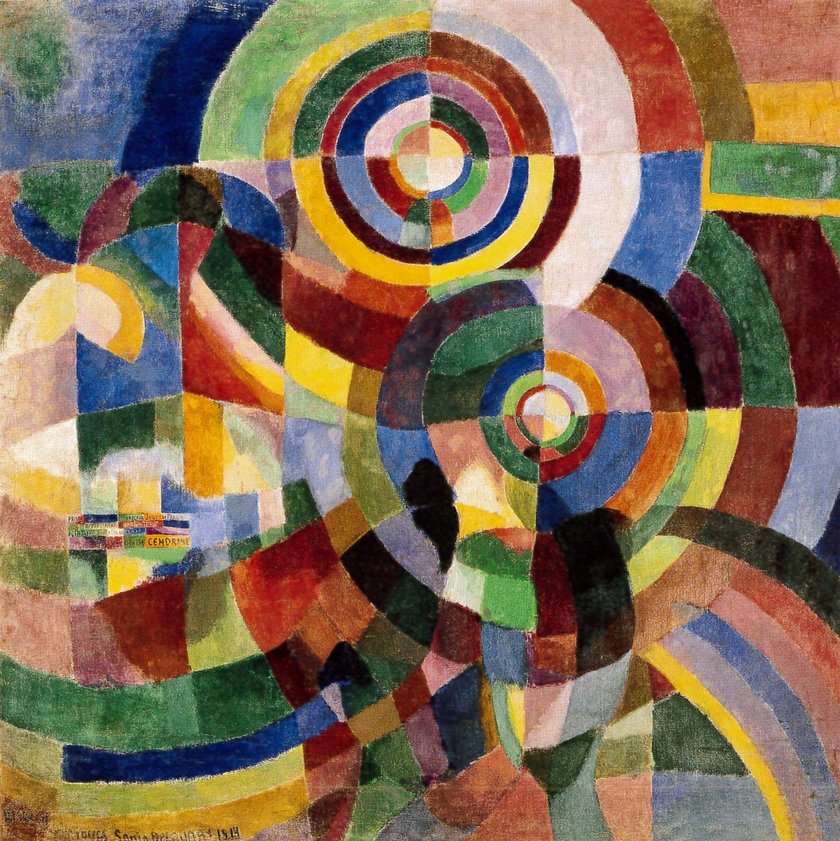
Orphism, that evolved from about 1912, included artists such as Frantisek Kupka, Robert Delauney and Sonia Delauney. These artists were highly influenced by the cubist and Fauvist movements taking elements from each. Fig 8. illustrates Delauney’s Red Tower which shows the representation of the subject matter from multiple viewpoints but also shows some Fauvist qualities by introducing a more striking subject matter and the use of bright bold colours.
As Orphism progressed, they started to move beyond reality into pure abstraction. There was a mystical and spiritual element to their paintings through the use of colour and shape. Like the Fauvists, colour theory became very important as they learnt the interrelationships of colour, light and movement and applied it to their work. Contrasting colours, colour harmonies and rhythms create expression that gives depth, form, movement and an emotional content (The art story accessed 20/05/2020). The Orphist artist Guillaume Appollinaire(1880-1918) developed an anlalogy between music and painting. He believed that pure colour abstractions had a similar effect on the emotions of the viewer as to the listener (Dempsey, 2002:99)
In the later stages of Orphism we can see a fusion of pure abstracted forms and an expressive interplay of colour (Fig 9. Prismes electriques) (Tate online, accessed 20/05/2020). The result is an expressive form of abstract art that draws attention to the flat surface of the canvas.
Orphism is a synthesis of Analytical cubism and Fauvism. Both movements rejected the traditional representation of three dimensional reality pushing them both towards near abstraction of form and a flattening of the image. The Orphists expressed themselves through bold bright colours based on colour theories of the time (Fauvism) and embraced the multiple fragmented viewpoints of cubism that ultimately led to pure abstraction.
Reflections
This was a very interesting exercise and it was fascinating to see how two movements could influence artists of the time. There seemed to be more opposing forces between Fauvism and Cubism than similarities, yet the two movements seemed to inspire the Orphists to create one of the earliest approaches to complete abstraction.
“Let us imagine something which is distinguished – and yet that from which it is distinguished is not distinguished from it. The flash of lightening for example, is distinguished from the black sky, but must carry the sky along with it… One would say that the bottom rises to the surface, without ceasing to be the bottom. There is, on both sides, something cruel – and even monstrous – in this struggle against an elusive adversary, where the distinguished is opposed to something which cannot be distinguished from it, and which continues to embrace that which is divorced from it.” (Deleuze, 2014:361 cited in OCA UVC handbook 2016:105)
In Giotti’s painting ‘The Kiss of Judas’ (1305), we are able differentiate the figure and the background. As there is no use of single point perspective or illusion of three dimensions, there is no ordering of the space (Olkowski, 1999:17). This means that the bottom of the painting (or the distinguished background) rises up to the surface of the canvas, just as;
‘The flash of lightening… is distinguished from the black sky, but must carry the sky along with it… One would say that the bottom rises to the surface without ceasing to be the bottom.’ (Deleuze, 2014:361 cited in OCA UVC handbook 2016:105)
The figures in the painting are distinguished from the background yet carry the background with it. Deleuze describes this effect as ‘monstrous’ (Deleuze, 2014:361 cited in OCA UVC handbook 2016:105). This is quite a strong word to use and it would suggest that Deleuze disliked the flatness and distortion it created in the image. Form and representation have been destroyed through the creation of a depth-less surface and a flattening of the image.
The figures in the ‘The King of Judas’ fresco have all been painted form a side on perspective which further emphasises the flatness of the image. This resonates with the Ancient Egyptian art and writing which places the human form in a similar manner. Alongside the figures, the background has risen to the surface. The relationship between background and figure creates an ‘indifferent difference’ (Olkowski, 1999) between contradictory and inseparable entities. Olkowski describes this as a ‘highly differentiated kind of pictorial space[s] that draws attention to the surface of the picture’. Comparisons can be made to Greenberg’s theory on modernist art where the emphasis was places on drawing attention to the flat surface of the canvas (Greenberg, 1965). Due to the abandonment of the traditional depiction of three dimensional space, the images in modernist painting became flattened in a way similar to ‘The Kiss of Judas’. We are in no doubt that we are looking at images painted onto a flat surface .
Access a summary of Kant’s Critique of Judgement and select three key points that you should then further summarise in approximately 50 words each.
Judgements of Beauty/Taste (Aesthetic judgements)
A judgement of beauty/taste is based on an individual’s feelings. The object is perceived by the subject so the judgement is therefore subjective. Kant explains that this judgement is ‘disinterested’ as it has no purpose and is an end in itself. A flower is just ‘beautiful’. Aesthetic judgements are universally felt (sparknotes, accessed 12/02/2020).
Judgements of the sublime
The experience of the sublime goes beyond the limits of human comprehension and holds an air of mystery. Experiences of the sublime are never negative and are usually attached to nature. For example, the movement of clouds or mist on a river. Experiences of the sublime are also subjective, universal judgements. Kant argues that the sublime rests in the realms of reason and not in the object itself (sparknotes, accessed 12/02/2020).
The critique of Teleological judgment
The concept of Teleology is concerned with the ‘explanation of phenomena in term of the purpose things serve rather than of the cause by which they arise.’ (Lexico, Oxford online, accessed 12/07/2020). Kant argues that this is useful in scientific study but that the principles are not at work in nature. Organisms must be viewed in teleological terms as ‘natural purposes’ (Stanford Encyclopedia of Philosophy, accessed 12/07/2020).









 Lara's Understanding Visual culture (Visual Studies 1) blog