In what way do video installations differ from films shown in cinema? List the physical differences and use these as evidence to explain the differences in experience and aesthetic appreciation.
Think about the environment as well as the immediate space in which film is shown. Consider the types of film and select an example for more detailed discussion. (1000 words)
Introduction
Films shown in cinemas have been an accessible form of entertainment for the masses over the past 100 years. After the development of hand held recorders in the 1960’s, artists started to create films that differed greatly from those shown in the cinema. As the two have progressed, differences have remained between the two types of film and the environment in which they are displayed. These differences allow for a different experience and aesthetic appreciation in the viewer.
Differences between cinema films and video installations
Films that are played at the cinema tend to fall into one of two categories – narrative and documentary. The main type of narrative film is organised in chronological order (reflective of real life) and in real time. Fictional stories tend to be based on a main line of action with a beginning, middle and an end (elementsofcinema.com accessed 03/08/2020). Viewers connect to the story through the use of characters played by actors following a rehearsed script. Less common are documentary films which expose reality and come from an investigative perspective. (elementsofcinema.com accessed 03/08/2020
Video installations are generally not narrative based or filmed in a linear perspective. They often explore the boundaries of the medium itself (Lee, s.d.) and are varied in their construction. Structuralist artists such as Michael Snow explored the specific characteristics of the medium in their videos. Videos were slowed down/speeded up, edited, played on a loop etc. (Kotz 2008:137). Other video art can produce a maximum sensory impact on the viewer through the use of sound, motion or light. Whereas cinema films have the purpose of entertainment and emotional engagement, video art’s purpose is very much reliant on the intent of the artist and the experience and the interpretation of the viewer.
Different Environments
The environment of films shown in the cinema and installation videos varies enormously and has a large effect on the experience of the viewer. In the theatrical environment of the cinema, the viewers have allocated seats facing forwards towards the large single screen. Lights are eliminated as the screening begins and the audience are immersed in their fairly passive experience (figure 1). They are expected to remain seated and silent for the duration of the film (usually 2 hours).

The cinema itself is part of the entertainment and leisure industry, usually surrounded by restaurants and other venues purpose built for ‘entertainment’.
When viewing a video installation in a gallery, the viewers are free to wander in to the room at any point. Sometimes the rooms are bright and lit and sometimes they are darkened. There is no expectation to stay for the duration of the video and there are usually no or few seats. Projectors might be visible/invisible and screens can be multiple or none – white walls work just as well. There is no norm and so presentation depends on the effect the artist is trying to create. There is even no prerequisite for projections to be shown on a flat surface. The artist Tony Oursler frees his images from the screen and its technical support by projecting them onto three-dimensional surfaces (Kotz 2008:131). For example, ‘Obscura’ consisted of large blinking eyeballs floating on spherical objects allowing the viewer to experience the isolating effects of technological inter-connectivity as the eyes consume data and information (Tate online, Accessed 04/08/2020).
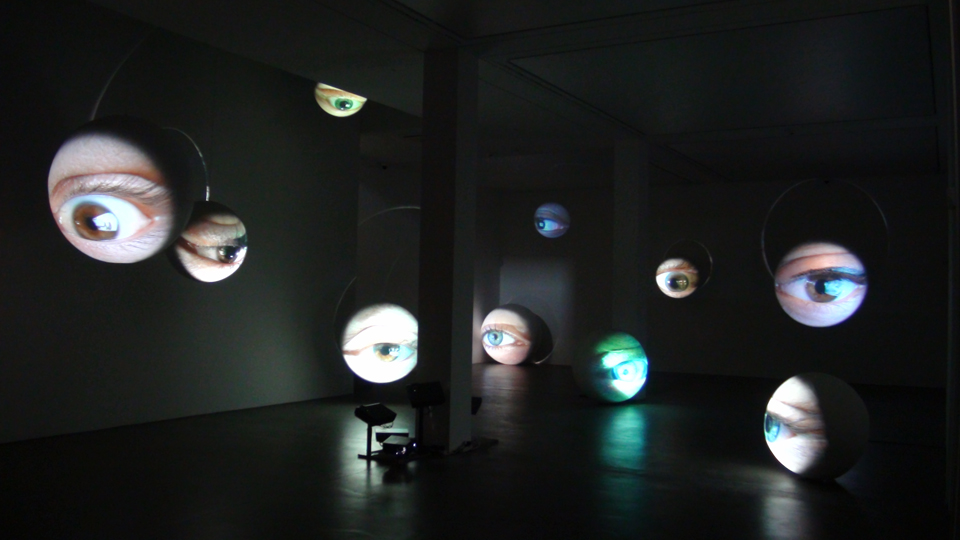
Oursler also took video installation out of the gallery. Site specific work such as The Influence Machine (2000) staged in London’s Soho Square allowed the viewers to move through the installation and experience the urban environment in a new way (Tate online, Accessed 04/08/2020).
The Godfather vs Martyrs
To illustrate the different experiences and aesthetic appreciation of the two types of film, the art installation Martyrs by Bill Viola and the film The Godfather directed by Francis Ford Coppolla will be discussed. The Godfather (1972) is an Oscar winning film about a mafia family and has since been celebrated as one of the best films ever made (Empire:2018). The audience, who at the time of release would have experienced this in the cinema, would be completely immersed in the life of the Corleone family. They would have emotionally responded to events and characters on the screen as they watched this illusion of real life on the large flat screen before them.

In contrast to this cinema film, the work of Bill Viola creates a different experience for the viewer. Martyrs (Earth, Air, Fire,Water)(2014) is a site specific work of four screens placed in St Paul’s Cathedral, London. Each screen shows an individual who is gradually overwhelmed by the force of an element.

South Quire Aisle of St Paul’s Cathedral At https://www.apollo-magazine.com/bill-viola-martyrs-st-pauls-cathedral/ (Accessed 04/08/2020)
The placing of this work is such that it may just be stumbled across accidentally. There is no seating and viewers can watch as much or as little as they wish. We are presented with the suffering of four individuals at the hands of the elements as they gradually increase and decrease their force. The spiritual environment of this video installation invites a quiet contemplation. Viola (2017) explains that martyrs ‘exemplify the human capacity to bear pain, hardship, and even death in order to remain faithful to their values, beliefs, and principles.’ The piece creates a sense of suffering but also a sense of hope (Londonhuawiki online:2017). In reflection, the viewer is able to interpret the art work in a way that is personal to them, their beliefs and their spirituality.
Occasionally, there is blurring between the characteristics of films shown in cinema and video installations. One example of this could be 2001: A Space Odyssey by director Stanley Kubrick. Kubrick plays with a loose narrative and includes long meditative visual sequences. At one point the viewer is immersed in a 10 minute sequence of visuals in the ‘star gate sequence’ that would not look out of place in an art gallery.

Conclusion
The medium of film is very different when experienced in the cinema than when it is experienced as part of an art installation. The format and environment for cinema films is the same across the world. Viewers know exactly what to expect when they purchase their tickets. When viewers enter a gallery or encounter a site-specific video there is an element of uncertainty. There are no rules or specified formats that the artist has to adhere to. There is room for the viewer to interpret the work in their own way that is personal to them.
Reflections
Last year I visited St. Paul’s cathedral with my niece and nephew for the first time since I was a child. I remember being very overwhelmed by the peaceful and energising atmosphere of the building and stumbling across Martyrs by accident. It had a very powerful effect on myself and my niece and we spent a long time watching it. Had I seen this in a gallery on the internet I don’t believe that it would have been so captivating. The juxtaposition of the bright crystal clear images on the screens with the historical art and sculpture and the hushed atmosphere of the cathedral made it mesmerising.
There was a lot to write about in this assignment. I didn’t include the institutional aspects of the different types of film due to the word count, but felt that this would definitely affect the types of films made. The artist has less pressure to create blockbusting mass-consumed films and therefore has a lot more freedom than traditional film-makers.
List of Illustrations
Fig 1. Holbeck cinema At https://www.york.ac.uk/tfti/facilities/facilities-hire/digital-cinema/ (Accessed 04/08/2020)
Fig 2. Oursler, T. (2014) Obscura, Hans Mayer Gallery, Dusseldorf, Germany At https://tonyoursler.com/obscura-germany (Accessed 04/08/2020)
Fig 3. Marlon Brando in The Godfather (1972) [film still] Paramount Pictures At https://www.imdb.com/title/tt0068646/mediaindex?ref_=tt_pv_mi_sm (Accessed 04/08/2020)
Fig 4. Viola, B. (2014) Martyrs (Earth, Air, Fire, Water) [Colour high-definition video polyptych]
South Quire Aisle of St Paul’s Cathedral At https://www.apollo-magazine.com/bill-viola-martyrs-st-pauls-cathedral/ (Accessed 04/08/2020)
Fig 5. The star gate sequence in 2001: A Space Odyssey [film still] MGM At https://2001archive.org/resources/the-special-effects-of-2001-a-space-odyssey/ (Accessed 04/08/2020)
Bibliography
A very short history of cinema in Science and media museum 18/06/2020 At: https://www.scienceandmediamuseum.org.uk/objects-and-stories/very-short-history-of-cinema (Accessed 04/08/2020)
Fairfax, D. (2018) Cinema and the Museum: Introduction in Senses of cinema Issue 86 March 2018. At http://sensesofcinema.com/2018/cinema-and-the-museum/introduction-8/ (Accessed 04/08/2020)
https://londonhuawiki.wpi.edu/index.php/The_Martyrs_in_St._Paul%27s_Cathedral (Accessed 04/08/2020)
http://www.elementsofcinema.com/film_form/narrative-cinema.html (Accessed 04/08/2020)
https://www.empireonline.com/ (Accessed 04/08/2020)
https://www.imdb.com (Accessed 04/08/2020)
https://www.tate.org.uk/art/artworks/oursler-the-influence-machine-t13860 (Accessed 04/08/2020)
https://www.tate.org.uk/whats-on/tate-modern/display/bill-viola/martyrs (Accessed 04/08/2020)
https://tonyoursler.com/obscura-g 23/5ermany(Accessed 04/08/2020)
Kotz, L. (2008) Video Projection – The Space Between Screens in: Kocur, Z. & Leung, S. (2012) theory in Contemporary Art Since 1985. (2nd ed.) Wiley
Lee, B. (s.d) What Is Video Art At: http://www.brendanlee.com/site.php/Main/WhatIsVideoArt (Accessed 04/08/2020)
Warde-Aldam, D. (2014) Review: Bill Viola’s ‘Martyrs’ at St Paul’s Cathedral in Apollo The International Art Magazine 23/05/2014. At: https://www.apollo-magazine.com/bill-viola-martyrs-st-pauls-cathedral/ (Accessed 04/08/2020)
 Lara's Understanding Visual culture (Visual Studies 1) blog