Read Plato’s account of the Allegory of the Cave and say whether and why you think it is valid today.
Introduction
‘The Allegory of the Cave’ was written by Plato as part of his collective books ‘The Republic’ approximately 2300 years ago in the height of the Greek’s classical age. The allegory is relevant today in many ways. It highlights the ability of the individual to become an enlightened being and what that might mean for society. It also offers a fresh and unique perspective on certain aspects of society as well as society as a whole.
Plato’s allegory of the Cave
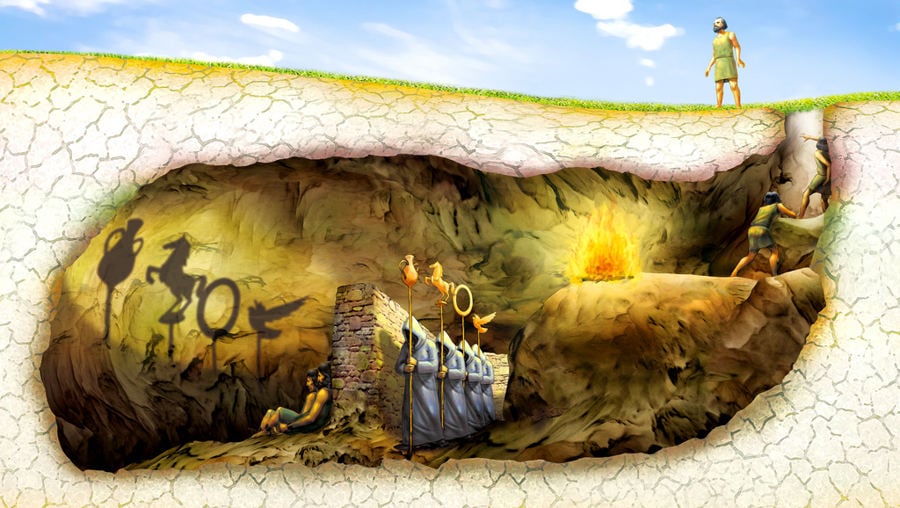
At https://www.learning-mind.com/plato-allegory-of-the-cave/
accessed 14/04/2020
In a dialogue between Socrates and Glaucon, Plato describes a cave with men shackled facing the cave wall so that they cannot move their bodies or their heads. Behind them and higher up, a fire burns whilst other men carry in front of it objects that cast a shadow on the cave wall that the shackled men can see. The men name these shadows through agreement and consensus and believe them to be real as they know no different. When one man is freed from his shackles, he turns and is dazzled by the fire light only to be confused by the objects he is seeing. When leaving the cave he struggles to see the things clearly. The sunlight is too bright to see so he starts to look at shadows and reflections and then the stars at night before finally seeing the sun and its true nature. If that man were to feel compelled to return to the cave and try to tell the prisoners about the real world outside, he would be ridiculed and possibly killed for his delusional behaviour.
Education and enlightenment
Plato intended the allegory to refer to and criticise the education of the individual and the masses. ‘Compare our nature in respect of education and its lack to such an experience as this.'(Plato 514) The allegory places the individual in a passive state, accepting and unquestioning what they see. In today’s world this could be our socially constructed reality and the acceptance of institutional facts and belief systems (Searle). The descent out of the cave was a descent out of ignorance and into enlightenment. Plato saw this as leaving the world of the material forms (copies) and into the realm of the mind and the ideal, the world of the philosopher. Today we could see this as an ascent into a bigger perspective or an awakening of a deeper understanding of reality beyond what we are presented with from birth.
The freed prisoner ‘compelled to stand up suddenly and turn his head around’ (Plato 515) would be turning away from an illusion and confronting the real world. The light from the fire signifying the artificially created light and knowledge and the light from the sun signifying pure truth and light. The individual ‘..in doing all this felt pain.. and was unable to discern the objects whose shadows he formerly saw..'(Plato 515) The experience of awakening to a more truthful reality would be confusing and painful.
In the film The Matrix,(1990) Neo awakes in the real world of the machines struggling to see with painful eyes. He ascended out of the ‘cave’ after swallowing the red pill enabling him to leave the illusionary world of the matrix and enter the grim real world of the machines.

There are many individuals who have freed themselves from the chains of the cave. They have been able to reject this socially constructed reality and seek alternatives. John Lennon and Martin Luther King could be seen to have rejected the reality that was presented to them and enlightened themselves outside the cave – whether this was in regard to racial inequality or peaceful living. When they returned to the cave to enlighten and liberate others they faced tough opposition – ‘Would he not provoke laughter, and would it not be said of him that he had returned…. with his eyes ruined.. And if it were not possible to lay hands on and to kill the man who tried to release them..would they not kill him? (Plato, 517). Both John Lennon and Martin Luther King were assassinated.

Unless there is a strong enough incentive for others to turn their heads and discover a new reality, those returning to the cave are seen as a threat. For Plato, the majority of ordinary people only see the material surface of reality and do not see through it to the divine forms themselves. Outside the cave could be described as an encounter with the ‘immaterial sublime’. Emmerson called this seeing with the ‘transparent eyeball’ a moment of insight and transcendence. ‘..the soul is able to endure the contemplation of essence and the brightest region of being.’ (Plato 518) Religious figures, such as Jesus (who was crucified) and the Buddha, could be seen to have had this moment of insight.
Mass Media and Technology
The images and shadows cast on the cave wall could be regarded as a metaphor for the mass media via technology in today’s world. We are inundated by images displayed through screens that we view via phones, laptops, tv’s and tablets. We name these images and apps – facebook, tv documentaries, newspaper articles and they reinforce our reality. Even the fictional content reinforces our reality or world view. ‘Then in every way such prisoners would deem reality to be nothing else than the shadows of the artificial objects.’ (Plato 515). Baudrillard describes this as the age of the ‘hyperrreal’ The artificial has become more real than the real itself.
‘Having never left the cave, and having no experience of that larger extra-cavern universe,the cave dwellers naively experience shadows on the wall as actuality, appearances as the real thing, these mere semblances as the ‘really real‘. (Plantiga, Handley 368)
The flickers of the shadows have been replaced by the flickering of the screen.

The world viewed and experienced through the screen is not a true reality. Reality shows are scripted or contrived with unstable personalities to create tension. Fame, celebrity, the illusion of the ideal relationship are not what they are perceived to be. Facebook pages are filled with only the beautiful, exciting aspects of our lives -never the nitty-gritty. Plato’s corrupt copy (media) has lost connection with the original. In the instance of journalism,the audience gains second hand information through various sources – tv news, papers, social medias that are likely to be skewed, have information omitted or have vested interests.
Consumer society
Who might the men or puppeteers be who carry the objects past the fire to cast the shadows. ‘See also, then, men carrying past the wall implements of all kinds..‘ (Plato 514) They can perhaps be best understood by looking at the wider structure of today’s society. We are living in a global capitalist society. We are all consumers, producers and some of us are profiteers. The mass media reinforces this status quo. The projectionists could be seen as those in power – governing bodies but also on a larger scale, capitalists and corporations who profit from our seduction of the images on the cave wall. Berry (2010 ) states that:
‘.. the information age floods our senses with endless imagery that we cannot avoid. The narrative has metamorphosed, however, the deceiving actors relating confusing information, for instance, no longer represent just our perceptual apparatus and reliance on convention but a corporate-sponsored, globalising, capitalist regime.’
Baudrillard argues that the object has now entered the realm of the fetish. The commodity no longer has exchange value but now has pure symbolic value. Consumer objects now have symbolic meaning. Adverts played on mass media symbolise happiness, success, popularity etc. The relationship to the real has now become a simulation. Examples of the shadows displayed on the cave wall could be the perfume advert in Fig 6. which symbolises confidence, attractiveness and beauty.

Despite ‘having their legs and necks fettered from childhood, so that they remain in the same spot, able to look forward only,’ (Plato 514) individuals in the global consumer village believe that they are free. The illusion allows for freedom of choice – what products to buy, what films to watch etc. to create a better life. The ‘projectionists continue to reinforce a consumer reality’ that reinforces the capitalist ideology. (O’Neill in Berry 1991:4)
How does one remove the shackles and exit the cave? Perhaps some people become dissatisfied with the illusion or possibly another person who has returned to the cave influences them somehow. Or perhaps there was a glitch in the accepted reality. A prop falling out of the hands of the projectionist and into a prisoners view, similar to when Truman in the film the Truman Show (1998) starts to notice things such as the falling studio light from the sky.
Critique of Plato’s cave
It is possible to examine Plato’s cave and argue that it is not quite valid today and would require some adaptation to make sense of modern society. McLuhan(1967) argues that prisoners are no longer shackled in contemporary society. The cave can be seen as the entirety of reality and contains different levels of truths. There is no outside and the cave remains sealed. Individuals can move about, look at different walls, interact with and even become the projectionists. Anyone can partake in creating the shadows through media such as youtube and facebook. If the prisoners are now free to become projectionist then maybe some people could use the media as a platform to enlighten others. For example, Michael Moore has directed many films that unveil realities such as the American health care system. Unfortunately this form of enlightening without leaving the cave relies on individuals choosing to look at the cave wall showing Micheal Moore’s projection.
Conclusion
Plato’s allegory of the cave is a timeless observation of human nature that illustrates the potential for human enlightenment and the attainment of a bigger and wiser perspective. It’s wisdom and insight allow for a deeper reflection of aspects of society (such as education) and the wider society as whole. However, slight modifications to the allegory could illustrate how modern society allows for the flexibility of human roles( within the cave) via mass media to reinforce the global capitalist system we live in today.
Reflections
It was very difficult to plan a coherent argument to this question. There were a lot of examples that illustrated how the allegory is relevant today and a whole section regarding the avant-garde artists was removed to respect the word count. The use of sub-headings was used in an attempt to place ideas in relevant sections. It was more effective to analyse the allegory starting off with the individual, and then move outwards to sections of society such as education and media before using the allegory to understand society as a whole.
List of Illustrations
Fig 1. Plato’s allegory of the cave.
At https://www.learning-mind.com/plato-allegory-of-the-cave/
accessed 14/04/2020
Fig 2. The Matrix (1990) Film still, Warner Bros. At https://retrophaseshift.com/wp-content/uploads/2019/08/Red-Pill-Blue-Pill.png (Accessed 14/04/2020)
Fig 3. John Lennon and Yoko Ono’ bed-in for peace Amsterdam (1969) At https://time.com/5557089/lennon-ono-bed-in/ (Accessed 14/04/2020)
Fig 4. Apps available on the modern mobile phone. At http://blogs.creighton.edu/cah17654/the-advancement-of-technology/ (accessed 15/04/2020)
Fig 5. Advert for Coco Chanel. An example of consumer fetishism. At https://www.marieclaire.co.uk/news/celebrity-news/keira-knightley-channels-her-inner-bond-girl-in-this-glam-new-chanel-video-1-91232 (Accessed 15/04/2020)
Bibliography
Allen, D. & Handley, A. (2018) ‘The most Photographed Barn in America:Simulacra of the Sublime in American Art and Photography,‘ Text Matters, Vol. 8 No. 8, 2018 At https://www.researchgate.net/publication/328672957_The_Most_Photographed_Barn_in_America_Simulacra_of_the_Sublime_in_American_Art_and_Photography (Accessed 16/04/2020)
Berry, G. (2010) ‘The Mythic Element of Mass Media and its Relation to Plato’s Cave’ Journal of Media And Communication ANZCA Special Ed. (April): 72-85 At https://www.researchgate.net/publication/44098969_The_Mythic_Element_of_Mass_Media_and_Its_Relation_to_Plato’s_Cave (Accessed 16/04/2020)
Deleuze, G. & Krauss, R. (1983) ‘Plato and the Simulacrum’ October, Vol.27 (Winter, 1983) pp.45-56. The MIT Press At https://www.s ’emanticscholar.org/paper/Plato-and-the-Simulacrum-Deleuze-Krauss/c429e1129e1c341d6b933e4da5f163b934765b48e9 (Accessed 16/04/2020)
Kleiner, H. ‘Allegory of the Cave’ (2014) Utah State University lecture, [online video] at https://www.youtube.com/watch?v=aBPd7getIcM (Accessed 16/04/2020)
Koch, A. & Elmore, R. (2006) ‘Simulation and Symbolic Exchange: Jean Baudrillard’s Augmentation of Marx’s Theory of Value’ Politics and Policy 34 (3) 556-575September, 2006. At https://libres.uncg.edu/ir/asu/f/Koch_Andrew_2006_Simulation_and_symbolic.pdf (Accessed 16/04/2020)
Radzikowski S. (2011) ‘Media Metaphor in Plato’s Republic’ At http://drshem.com/2011/08/20/media-metaphor-in-platos-republic/ (Accessed 16/04/2020)
Sadler, G.B. ‘Intro to Philosophy: Plato’s Republic Book 7’ (2011) Marist College Lectures.[online video] At https://www.youtube.com/watch?v=aBPd7getIcM (Accessed 16/04/2020)
Shorey, P. (1963) ‘Plato:The Allegory of the Cave translated’ from Plato: Collected Dialogues, ed. Hamilton & Cairns, Random House At https://yale.learningu.org/download/ca778ca3-7e93-4fa6-a03f-471e6f15028f/H2664_Allegory%20of%20the%20Cave%20.pdf (Accessed 16/04/2020)
 Lara's Understanding Visual culture (Visual Studies 1) blog