Find and collate 10 diverse examples of meta-painting from the 17th Century to the present.
Meta-painting
A meta-painting can be described as a painting that shows or suggests awareness of itself – it is a painting about ‘painting’. Lorenzo Pericolo(2013:12) states that ‘..meta-painting is the whole gamut of pictorial devices through which painting stages its fictiveness’. A meta-painting can partially uncover its materiality through suggesting or depicting its maker or the making of the painting. It can involve ‘the beholder as an active or even indispensable component of the image’ (Pericolo 2013:12); or incorporate a painting or paintings as an object of representation within the image. This inner picture or pictures can be described to be ‘nesting’ inside the outer picture (Mitchell 2006).
W.J.T Mitchell also explains ,when describing a ‘metapicture’, that the image can reflect or double itself – the same picture reappears inside the picture. This is known as the ‘mise en abine’. He also states that another form of metapicture or metapainting is:
‘The picture that is framed, not inside another picture, but within a discourse that reflects on it as an exemplar of ‘picturality’ as such.’ (Mitchell 2006)
This feels like quite a big statement from Mitchell and perhaps goes a little far because the implications of this would suggest that any picture can become a meta-picture. We could reference this idea of meta-painting in the realms of Clement Greenberg’s theory of abstract modernist painting. Modernist paintings were self-referential and drew attention to the nature of its medium -canvas, paint, texture and shape. Writer Ronald B Richard argues that all abstract paintings are meta-paintings as they emphasise the process of creation. This is supported by the earlier description of meta-paintings that partially uncover their materiality through suggesting or depicting its maker or the making of the painting.
Examples of meta-painting form the 17th Century to the present
- ‘Las Meninas‘ (1656) Diego Velázquez
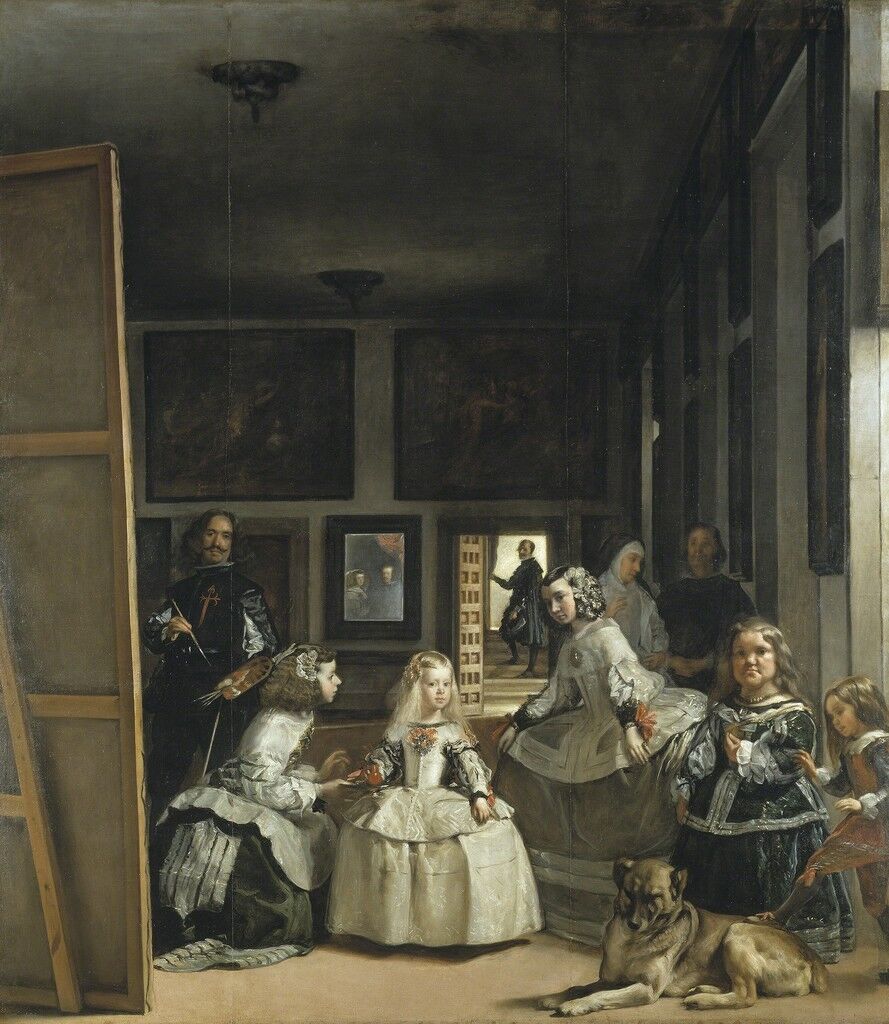
‘Las Meninas’ by Diego Velázquez is considered a masterpiece of Western painting. Painted for King Phillip IV of Spain in the 17th Century, Velázquez depicts a scene in his palace studio whereby the artist himself is seen in the process of painting alongside the King’s daughter Margaret and her court aides. The viewer is placed in an interesting position and is the source of the gaze for Velazquez, Margaret and several others in the room. Reflected in the mirror at the back of the room is the King and Queen which suggests that the viewpoint is from the King or Queen as they pose for their portrait perhaps awaiting Margaret to join them.
The presence of Velázquez himself indicates that the ‘Les Meninas’ is an early example of a meta-painting. The artist is shown in the creative process of creating his masterpiece . We are placed within the artists studio that has walls covered in paintings (the two at the back are copies of two Reubens paintings). This painting is definitely about the world of painting and gives us an insight into not what the artist sees when creating a portrait but what the sitter sees whilst the process occurs.
2. ‘The Art of Painting’ (ca. 1667) Johannes Vermeer
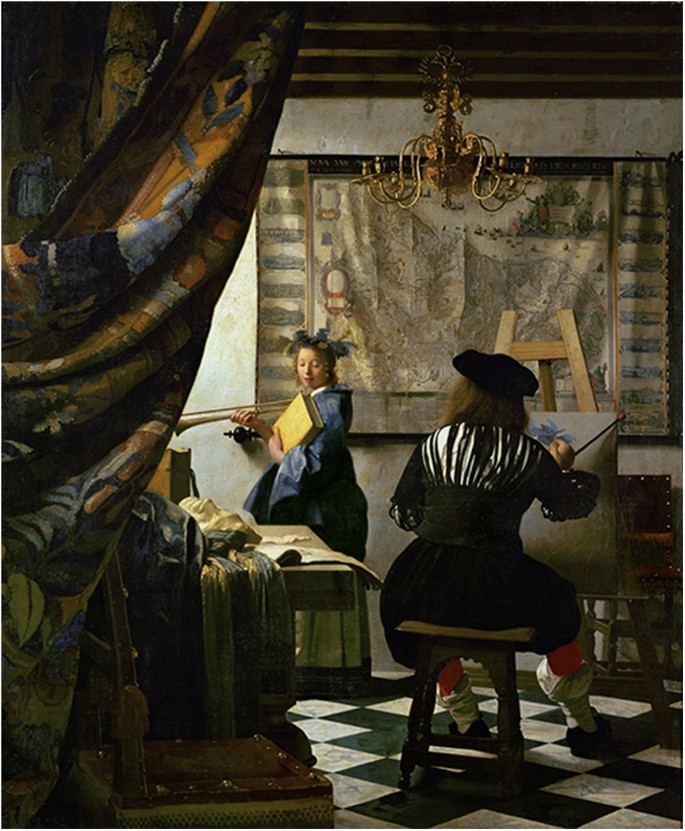
In this meta-painting by Vermeer, we are again viewing a painting about the creation and creator of a portrait painting. However, unlike ‘Las Meninas’‘ the viewer is positioned behind the painter (Vermeer) and allowed to see the staging of the scene and the object of representation – in this case a young girl holding a book and an instrument. We can peer over Vermeer’s shoulder and see the careful brushstrokes on his canvas as he takes in his subject matter.
3. ‘Reverse side of a painting’ (1670) Cornelius Gijsbrechts

On first viewing of Gijsbrechts Reverse Side of a Painting, I was convinced this was a 20th Century modern painting and not from the 17th Century! What we are viewing in this meta-painting is a realistic depiction of the back of a framed canvas, complete with a sales room ticket attached. The detail is extraordinary and includes the wooden inner and outer frames with splits in the wood and small nails surrounding the inner canvas. We, as the viewer are fooled into believing that this is a real painting but hung the wrong way round.
The artist has depicted the materiality of his craft. Viewers believe that they are looking at the physical materials that construct the framed canvas. Gijsbrechts was part of a group of 17th-century Dutch still-life painters known as ‘betriegertje (little trickster). Their aim was to decieve the viewer with their paintings of paintings.
4. ‘Gallery at the Louvre‘ (1831-33) Samuel F.B Morse
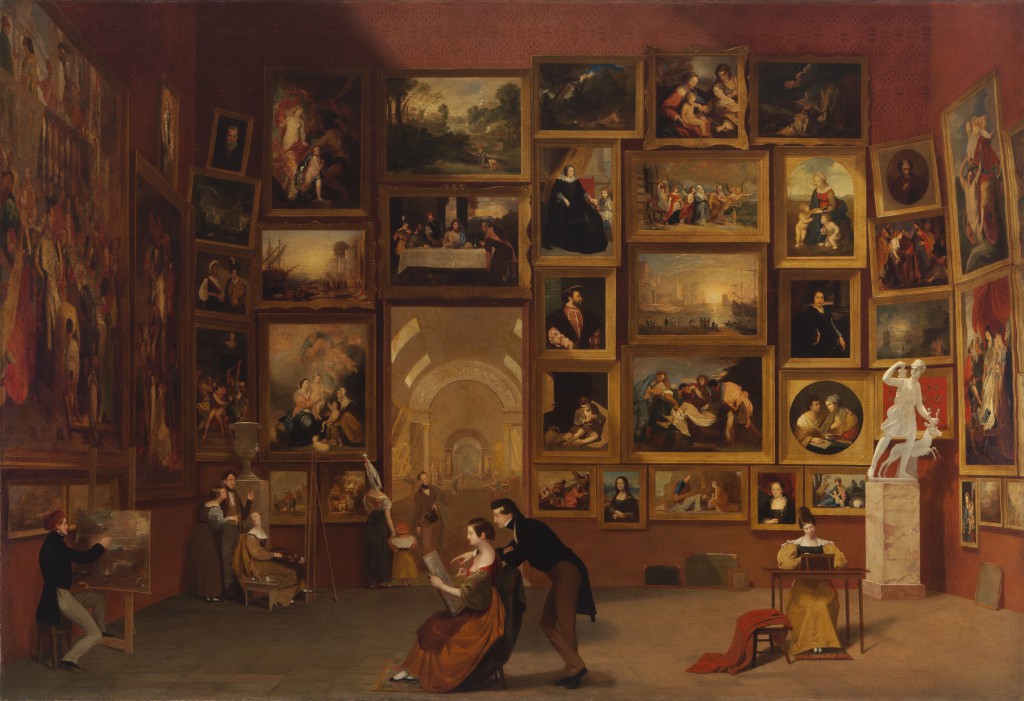
In Morse’s meta-painting of the Louvre, we are thrust into the institution of the art gallery and exposed to numerous classic paintings displayed on the walls including works by Titian and Da Vinci’s Mona Lisa. We are able to view paintings within the painting itself as well as experience the social institution of the gallery. Within the gallery are artists in the process of painting or drawing, presumably inspired by the surrounding masterpieces.
5.’The Treachery of Images‘, (1929) Rene Magritte

Magritte’s surrealist painting ‘The treachery of Images’ is quite an interesting meta-painting because it invites the viewer to contemplate what they are looking at – a pipe or a painting? The words beneath the painting of a pipe state in French – ‘This is not a pipe.’ Yet it is not clear whether this refers to the writing or the image of a pipe. The writing is not a pipe but also the image is not a pipe because it is purely the representation of a pipe using oil paints on canvas. However, it is a pipe because we perceive it as one even though we know that it is a painting!
6. ‘Droste’s Cacao‘ (1904) Jan Misset
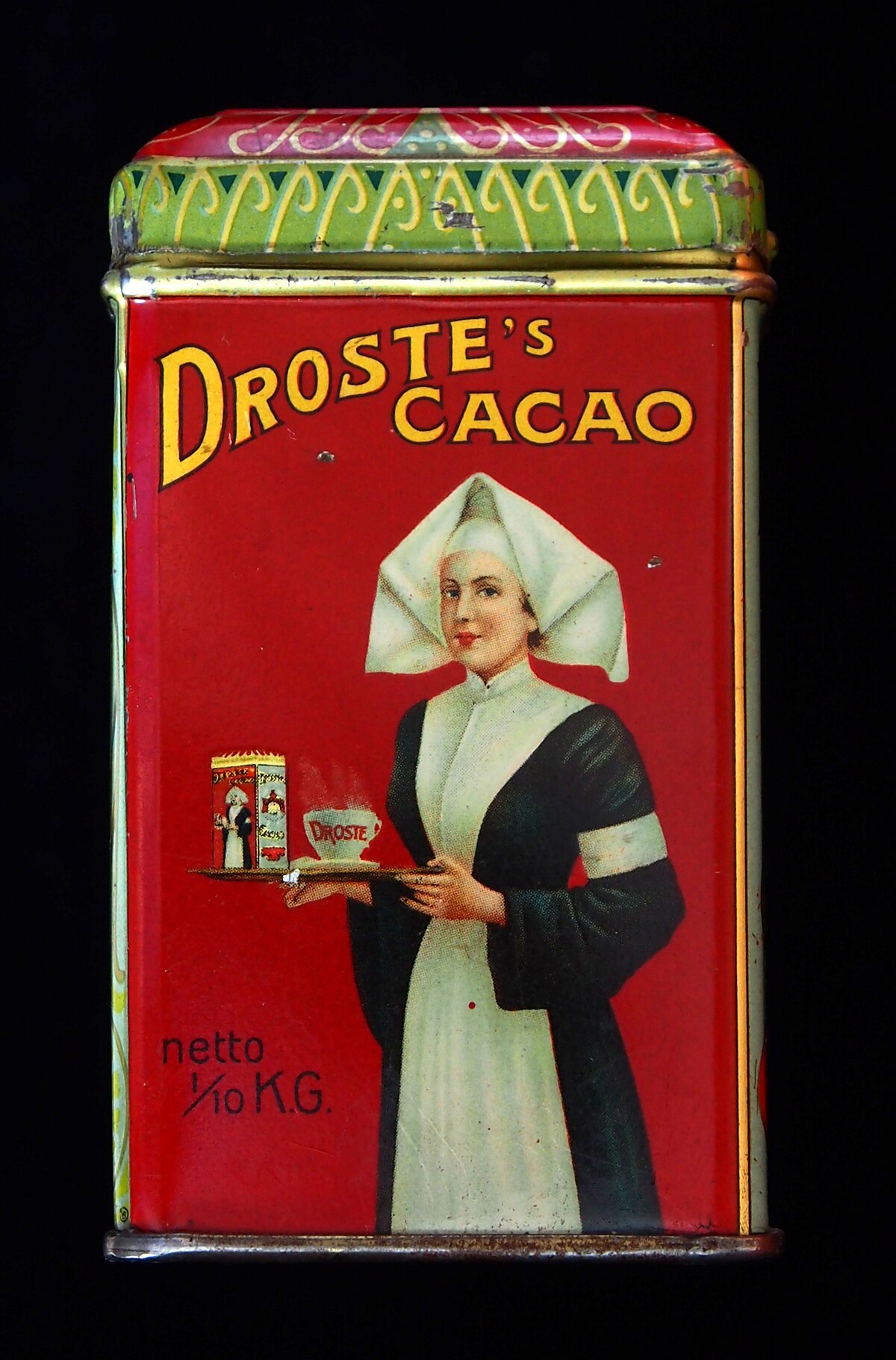
The effect of ‘mise en abine’ refers to an image that recursivley places a copy of itself within itself (often infinitely) and is most commonly found in photography. This type of picture often known as the ‘Droste’ effect originate from the tins of Dutch Droste cocoa from the early 20th Century. The nurse in the tins image is holding a tin that shows a repeated and recursive image.
7. ‘The face of war‘ (1940) Salvador Dali

I believe that ‘The Face of War’ by Surrealist artist Salvador Dali could be seen as a meta-painting displaying the effect of ‘mise en abine’. This unnerving face most likely refers to the horrors experienced in the Spanish Civil war. Our eyes are drawn to the face of death with its eye sockets and mouth wide open with its infinite recurring image. In the bottom right of the painting, we can also see the imprint of Dali’s hand revealing and suggesting the presence of creator.
8. ‘Las Meninas’ (1957) Pablo Picasso

During the year 1957, Picasso created 44 paintings inspired by Diego Velázquez’s Las Meninas (1656). This version is perhaps the one that recreates the scene most faithfully to the original. Picasso sticks to a black, white and grey palette and keeps the original figures in a similar position. We have already discussed the original Las Meninas as being a meta-painting and now we have a 20th Century painting based upon a painting that is about painting! A meta-meta painting!
9.‘Brushstrokes’ (1965) Roy Lichtenstein
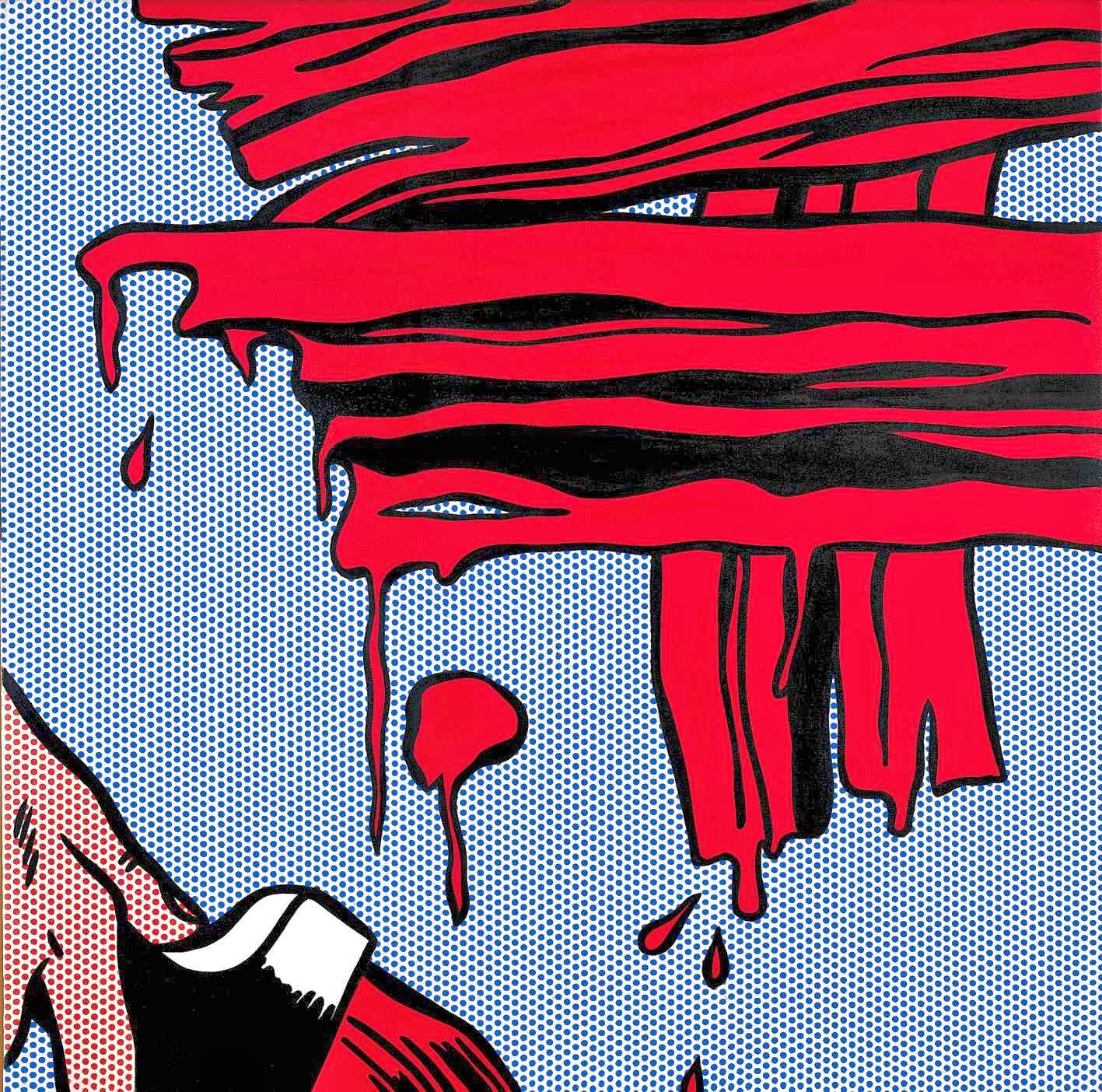
In this pop-art example of a meta-painting, Lichtenstein depicts the making of a painting. We can see the artist’s hand clutching the paint brush just after they have roughly placed red paint on a surface. We are viewing a close up and intimate moment between the painter and their painting.
10. ‘Letter on the Blind 11’ (2014) Frank Stella
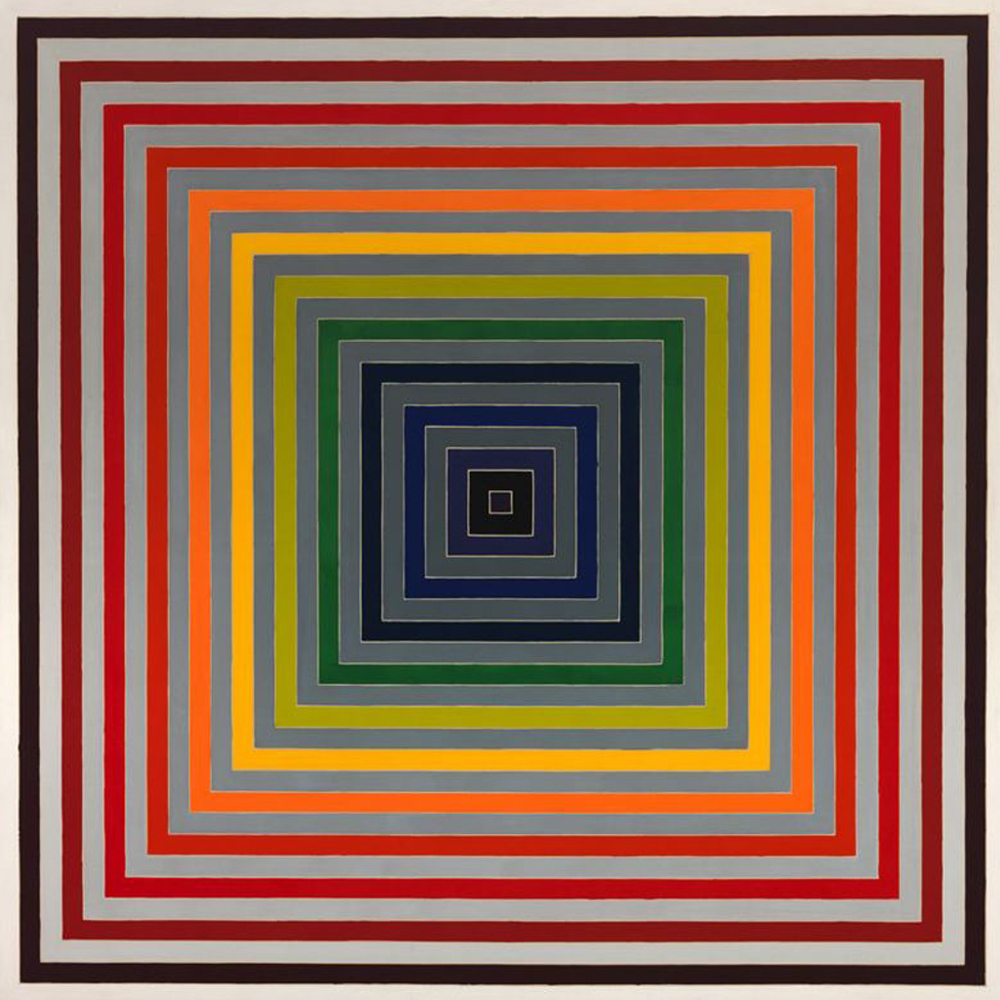
This last example of what might controversially be termed a ‘meta-painting’ was created by Frank Stella in 2014. As an abstract non-representational artwork, the viewer is conscious that they are looking at a painting. The use of materials becomes apparent as the artist has emphasised the canvas’s shape by using geometric lines to construct the pattern within. Recurring and diminishing squares create a ‘mise en abine’ effect as our eyes are drawn to the centre of the canvas.
Reflections
This was a really enjoyable exercise. It was interesting to learn about different paintings from different periods and explore how they can be defined as meta-paintings. I tried to include a diverse range of paintings and couldn’t resist adding an abstract one at the end as I thought the idea that abstract paintings could be meta-paintings was an intriguing concept.
List of illustrations
Fig 1. Velázquez, D. (1656) Las Meninas [oil on canvas] At https://www.artsy.net/article/artsy-editorial-centuries-people-las-meninas (Accessed 17/02/2020)
Fig 2. Vermeer, J. (ca 1667) The Art of Painting [oil on canvas] At https://www.nature.com/articles/palcomms201768 (Accessed 17/02/2020)
Fig 3. Gijsbrechts, C. (1670) Trompe l’oeil. Reverse Side of a Painting [oil on canvas] At https://commons.wikimedia.org/wiki/File:Cornelius_Norbertus_Gijsbrechts_-_Trompe_l%27oeil._The_Reverse_of_a_Framed_Painting_-_Google_Art_Project.jpg (Accessed 17/02/2020)
Fig 4. Morse, S.F.B. (1831-33) Gallery at the Louvre [oil on canvas] At https://www.terraamericanart.org/what-we-offer/our-art-collection/terra-collection-initiative-samuel-f-b-morses-gallery-of-the-louvre-and-the-art-of-invention/ (Accessed 18/02/2020)
Fig 5. Magritte, R. (1929) The Treachery of Images [oil on canvas] At https://www.renemagritte.org/the-treachery-of-images.jsp (Accessed 18/02/2020)
Fig 6. Misset, J. (1904) Droste’s Cacao At https://en.wikipedia.org/wiki/Droste_effect (Accessed 18/02/2020)
Fig 7. Dali, S. (1940) The face of war [oil on canvas] At https://www.dalipaintings.com/the-face-of-war.jsp (Accessed 18/02/2020)
Fig 8. Picasso, P. (1957) The Maids of Honor (Las Meninas, after Velázquez) [oil on canvas] At http://web.guggenheim.org/exhibitions/picasso/artworks/maids_of_honor (Accessed 18/02/2020)
Fig. 9 Lichtenstein (1965) Brushstrokes [screen-print on paper] At https://www.singulart.com/en/collection/inspired-by-roy-lichtenstein-1189 (Accessed 19/02/2020)
Fig 10. Stella, F. (2014) Letter on the Blind 11′ [offset lithograph] At https://www.sartle.com/artwork/letter-on-the-blind-ii-frank-stella (Accessed 19/02/2020)
Bibliography
Finch, C. (s.d) Gallery at the Louvre, Morse code Art net At http://www.artnet.com/magazineus/features/finch/mccoullough-morse-gallery-at-the-louvre-4-13-11.asp (Accessed 19/02/2020)
Gronstad, A. & Vagnes, O. (2006) What do pictures want? Interview with W.J.T. Mitchell Image & Narrative, (November 2006)At https://www.visual-studies.com/interviews/mitchell.html (Accessed 19/02/2020)
Guggenheim, Comparative works The Solomon R. Guggenheim Foundation 2012 At http://web.guggenheim.org/exhibitions/picasso/artworks/maids_of_honor (Accessed 19/02/2020)
https://en.wikipedia.org/wiki/Droste_effect
https://www.dalipaintings.com/the-face-of-war.jsp
https://www.renemagritte.org/the-treachery-of-images.jsp
https://www.tate.org.uk/art/artworks/lichtenstein-brushstroke-p07354
Lesser, C. (2018) Centuries Later, People Still Don’t Know What to Make of “Las Meninas” Artsy Mar 23, 2018 At https://www.artsy.net/article/artsy-editorial-centuries-people-las-meninas (Accessed 19/02/2020)
Pericolo, L. (2013) What is Metapainting? The self-aware image Twenty Years Later At https://www.academia.edu/16776812/What_is_Metapainting_The_Self-Aware_Image_Twenty_Years_Later
Richardson, R.B. (2011) Abstract paintings are metapaintings At http://ronaldbrichardson.com/metafiction/abstract-paintings-are-meta-paintings/ (Accessed 19/02/2020)
Web Gallery of art GIJSBRECHTS, Cornelis Norbertus Reverse side of a painting At https://www.wga.hu/html_m/g/gijsbrec/cornelis/reverse.html (Accessed 18/02/2020)
 Lara's Understanding Visual culture (Visual Studies 1) blog
