How could a Dyson Vacuum cleaner be seen as a work of art?

This is an interesting question and gave me quite a lot to think about. I considered the Dyson vacuum cleaner as a functional household object whose design is highly unique and interesting to look at. An individual has used their imagination and creativity to make a machine that, if you did not know its function, would not look out of place in a gallery for modern sculpture. The Bauhaus movement in the early 20th century had a philosophy of combining arts and crafts to create beautiful and useful items such as chairs, tables and cabinets. They combined art and functionality. The Dyson company could be seen to have a similar philosophy. Their cleaners have a simplistic look, with limited colours. Function is visible through the parts exposed by the perspex/plastic. They have a simple style that is compact and stylised like no other vacuum cleaner. A piece of art that has been designed to be a functional part of every home.
Marcel Du Champ’s conceptual art work entitled ‘fountain'(1917), places an ordinary functional object – a urinal, and turns it on it’s side to be viewed as a piece of art. The title ‘fountain’ gives the viewer a new perspective, an opportunity to think in a different way. If the idea or concept is important when creating a piece of art, then the Dyson could also be used in this way. If it was to be seen in a gallery and out of context (perhaps in a different position) with a new title, then maybe it would serve a different purpose and become a piece of art that challenges us to see something with a new perspective. So, for example, we could give it the title ‘indoor life’ or ‘sterile living’ or ‘creating space’ (due to the vaccum). The Dyson now becomes a metaphor for the unhealthy amount of time humans spend in the indoor environment. (This is quite a poor metaphor but I couldn’t think of one as good as Du Champ’s!)
How could Tenniel’s illustrations of Alice in Wonderland be seen as works of art?
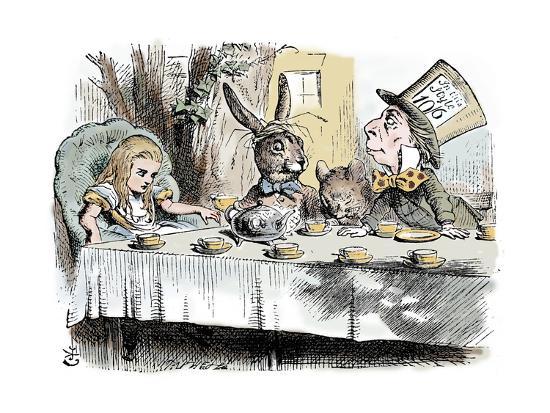
John Tenniel’s illustrations could be viewed as pieces of art. Tenniel creates characters and scenes from the story ‘Alice in Wonderland’. In this particular drawing he has created realistic characters using the skill of his creative imagination. He also uses drawing techniques such as linear perspective and tonal contrasts to create a visually interesting scene. We can compare Tenniel’s drawings to some earlier renaissance art that also illustrate a story – the bible. Although these were often fresco’s or paintings the objective was the same – to create a visual interpretation of a concept or story. Today however, we would generally use illustrations together with written text.
How could the Nazca lines be seen as a work of art?

The Nazca lines in Peru were created in the desert over 2000 years ago and still their purpose remains a mystery. Their patterns and forms are only visible from the air and range from 30- 1200 feet in length. The ‘geolyphs’ (drawings made on the ground) were man made images of animal such as snakes, lizards and birds and geometric patterns. The artists removed the top layer of earth and rocks to reveal a lighter colour. This contrast created a negative image. These images must have been planned and designed using a clever measuring technique. I would also suggest that this was made by many individuals as a ‘group project.’
I thought that the Nazca lines could be compared to other native art forms. The Aborigines used the desert sand to draw maps, retell their history and create ‘dreamtime’ stories. This would have been done with a stick or the hand to create an indent in the sand – similar to the indents of the Nazca lines. The meaning behind the Nazca lines though is unknown.
I also considered the Nazca lines as a form of earth or Land art. A deliberate alteration of the land / earth to create a desired image or picture. In the contemporary art world, Land artist Robert Smithson took his art outdoors to reconnect art with nature. ‘Spiral Jetty’ (1970) was created by the movement of earth to create a spiral pattern on the edge of a lake. This could be compared to the Nazca lines that were created in a similar way, albeit without machines.
Looking at the photograph above, the Nazca lines also look a lot like a print – a lino cut with a simple image or some kind of etching. The only difference here is the scale of the Nazca lines, which are extraordinarily large pieces of artwork, and the materials used.
List of Illustrations
Fig 1. DC49 Multi floor Dyson Vacuum Cleaner. Photograph at https://www.dezeen.com/2013/07/26/dyson-launch-smallest-vacuum-cleaner/ Accessed 13/11/2019
Fig 2. Tenniel J. (1865) Alice in Wonderland‘ [ink on paper] At https://time.com/4310913/rare-collection-of-alice-in-wonderland-books-to-go-on-sale/ Accessed 13/11/2019
Fig.3 Nazca Lines, The Condor (200 BC – 500 AD) At https://youngzine.org/news/history/nazca-lines-paintings-desert
Bibliography
Golomb, J. Nasca Lines in National Geographic online At https://www.nationalgeographic.com/archaeology-and-history/archaeology/nasca-lines (Accessed 13/11/2019)
https://uk.phaidon.com/agenda/art/articles/2013/november/18/explaining-smithsons-spiral-jetty/
Lunberry, C. (2002) ‘Quiet Catastrophe: Robert Smithson’s Spiral Jetty, Vanished’ in Discourse 24.2,Spring 2002 p86-120. At https://muse.jhu.edu/article/39973/summary (Accessed 09/11/2019)
Winton, A. G. (2007) The Bauhaus, 1919–1933 At https://www.metmuseum.org/toah/hd/bauh/hd_bauh.htm ( Accessed 13/11/2019)
 Lara's Understanding Visual culture (Visual Studies 1) blog